Hi, what do you want to do?






Newseum
Civil Rights: The Five Freedoms
After a close reading of the First Amendment and the five freedoms it guarantees, class members examine the civil rights timeline to see how civil rights groups applied these freedoms to create change. Using the issue the class chose in...

Media Smarts
You Be the Editor
Look at different case studies to discuss the ethics of journalism. Twelve real-life events are written up and your learners get to be the editors. Encourage your class to think about the implications of publishing decisions. After each...

Online Publications
Become a Journalist
Explore the newspaper as a unique entity with a detailed and extended unit. The unit requires learners to consider the newspaper's role in democracy, think about ethics, practice writing and interviewing, and examine advertising and news...

Newseum
Photo Ethics: News Independence
Young journalists read a case study about an annual school tradition of a streaker running across the football field after the homecoming game. Small groups then decide whether or not to cover the story and whether or not to include a...

iCivics
Drafting Board: Interest Groups
Does the influence of interest groups harm a political system? Your class members will analyze the role of interest groups in American politics, as well as consider the effect of perspective, bias, loyalty, and the...

Newseum
Is This Story Share-Worthy?
Young journalists use a "Is This Story Share-Worthy?" flowchart graphic to decide whether a story is worth sharing online. Instructors provide groups with fake news, poor quality stories, opinion pieces, biased news, and high-quality...

Newseum
The Tools to Persuade
After reviewing persuasion techniques, young historians examine how a specific technique was used in the pro- or anti-suffrage messages. They then examine how that same technique is used in modern-day media messages.

Newseum
Are You a Publisher?: Free Press and You
What kinds of media do your pupils use to read and publish information? After a discussion about what publishing means, and about the freedom of the press, class members interview one or two other people about their publishing habits....

Newspaper Association of America
Press Ahead!
Give class members some great news! A media unit teaches individuals about ethics, parts of a newspaper, business writing, photojournalism, and more topics that have to do with the press. Full of material for a variety of learners,...

Social Media Toolbox
Cyberbullying
What can we do to make our school community more aware of cyberbullying? From The Social Media Toolbox, lesson 10 of 16 takes on the tough topic of bullying. Learners research cyberbullying through online research, then create an...

Curated OER
Petition of Amelia Bloomer Regarding Suffrage in the West
Students investigate the role of Amelia Jenks Bloomer in the struggles for suffrage and political reform. They consider the factors involved in political socialization and compile webliographies of their research materials.
ReadWriteThink
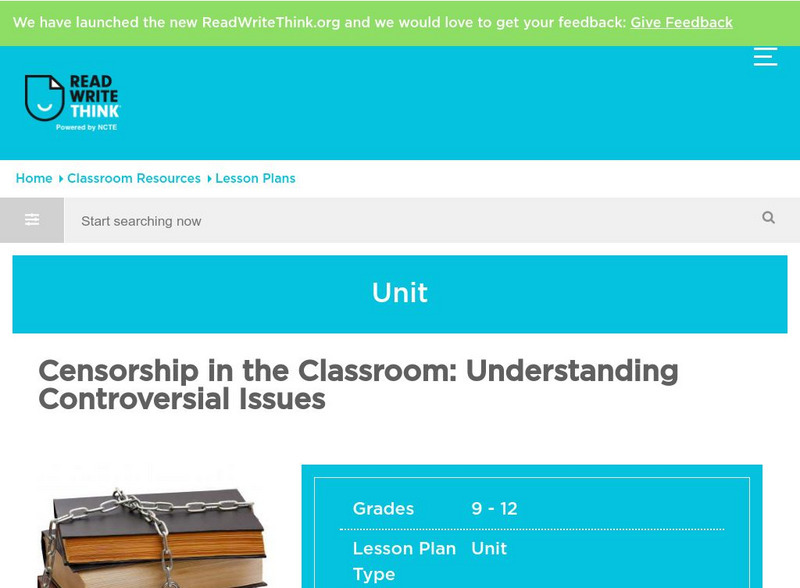
Read Write Think: Censorship in the Classroom
Online lesson that challenges students to examine the past and present practice of censorship in the classroom, in particular the "Banned books," from high school curriculums. Students research reasons for censorship and choose a side of...