Hi, what do you want to do?






Curated OER
A View of the Cell
In this viewing of a cell worksheet, students will read a paragraph about how microscopes work and will use a diagram of a light microscope to complete 2 short answer questions.

California Academy of Science
Kinesthetic Astronomy: Longer Days, Shorter Nights
A lamp, four globes, and some signs taped around the room are all you need to set up a solar system simulation for teaching how Earth's tilted axis creates the seasons. (Sticky dots are also needed, but not mentioned in the materials...

Curated OER
Reflection & Refraction
In this online interactive reflection and refraction worksheet, students respond to 7 multiple choice and fill in the blank questions regarding the information included in the provided paragraphs.

Curated OER
Cloud Shadows
Students classify the visual opacity of various materials, what is needed to create shadows, and classify clouds by the types of shadows that they produce.

Curated OER
Cloud Shadows
Students classify clouds as transparent, translucent or opaque. They conduct an experiment to determine the visual opacity of several classroom objects and then conduct further observations of clouds.
Curated OER
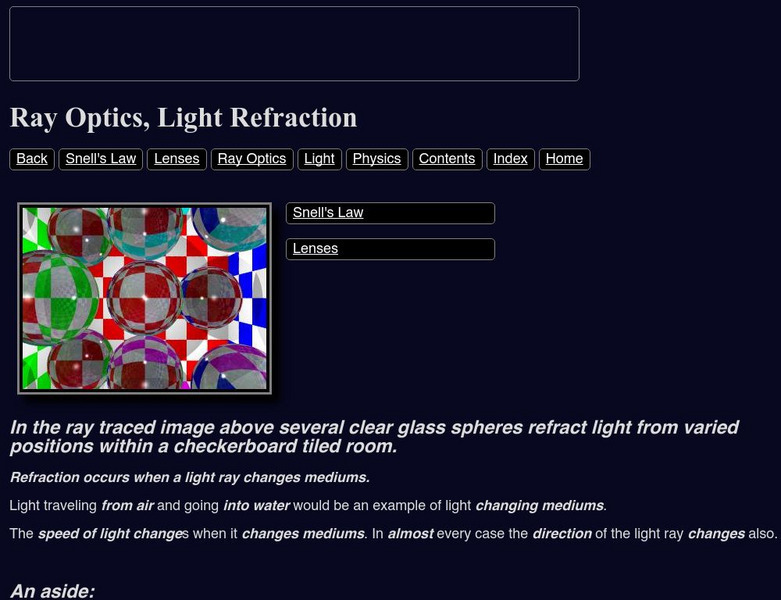
Ray Optics, Light Refraction
Site studies light refraction and provides illustrations several illustration. Contains links to Snell's Law, lenses, ray optics, light and much more.

Physics Classroom
The Physics Classroom: Reflection and the Ray Model of Light: Ray Diagrams
This illustrated physics tutorial serves as a step-by-step guide to drawing ray diagrams. It includes an opportunity for students to practice and check their answers.
Physics Classroom
The Physics Classroom: Reflection and Ray Model of Light: Ray Diagrams Concave
In this physics tutorial, students investigate the method for drawing ray diagrams for objects placed at various locations in front of a concave mirror.
Physics Classroom
The Physics Classroom: Ray Diagrams for Concave Mirrors Case B
Ray diagrams are useful tools for determining the location of an image as produced by a concave mirror. Of all the rays which emanate from the top of the object arrow and are incident to the mirror, there are two rays whose behavior at...
Physics Classroom
The Physics Classroom: Ray Diagrams for Concave Mirrors Case D
Ray diagrams are useful tools for determining the location of an image as produced by a concave mirror. Of all the rays which emanate from the top of the object arrow and are incident to the mirror, there are two rays whose behavior at...
Physics Classroom
The Physics Classroom: Refraction and the Ray Model of Light: Diverging Lenses
In this illustrated tutorial, students will see a specific method for constructing ray diagrams for double concave lenses.
Physics Classroom
The Physics Classroom: Refraction and the Ray Model of Light
Six complete lessons on refraction and the ray model of light. Tutorials include informational text, interactive activities, animations, and quick, interactive comprehension checks along the way.
Physics Classroom
The Physics Classroom: Refraction and the Ray Model of Light: Converging Lenses
An illustrated tutorial which takes students step-by-step through the process of drawing ray diagrams.

Khan Academy
Khan Academy: Light Through a Pinhole
Using the diagram provided, calculate where a ray of light coming through a pinhole hits an image plane.
Curated OER
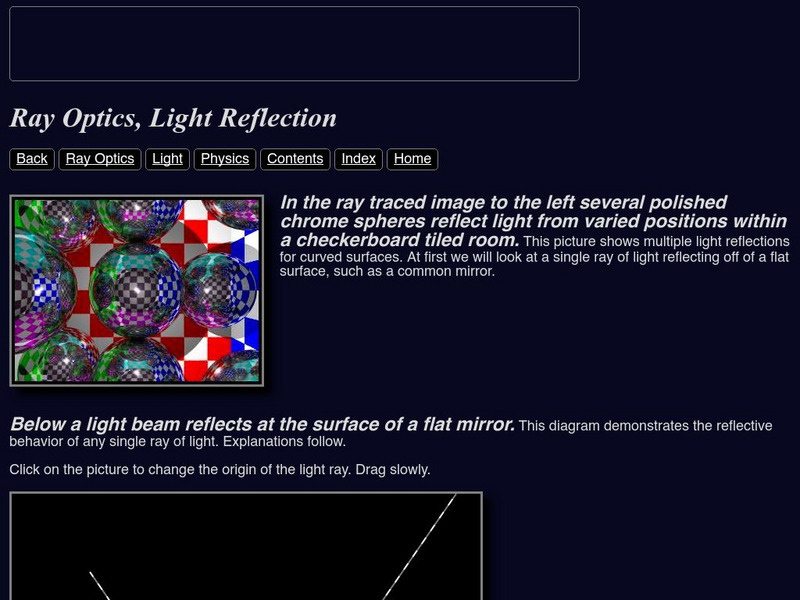
Ray Optics, Light Reflection
Site provides a diagram as well as a scientific explanation of light reflection. Includes links to ray optics, light and physics.
Physics Classroom
The Physics Classroom: Reflection/ray Model of Light: Ray Diagrams Convex
Students learn two rules of reflection as it has to do with convex mirrors. These two rules will greatly simplify the task of determining the image locations for objects placed in front of convex mirrors.
TeachEngineering
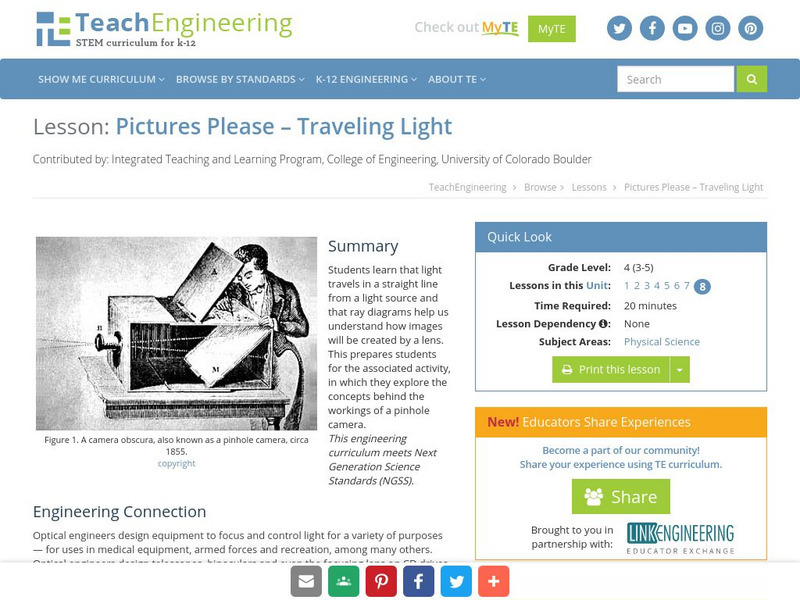
Teach Engineering: Pictures Please: Traveling Light
In this lesson, students learn that light travels in a straight line from a light source and that ray diagrams help us understand how an image will be created by a lens. In the accompanying activity, students explore the concepts behind...
Other
Propagation of Light Using Geometry
A discussion of Christian Huygens' contribution to wave optics, and particularly to our understanding of the reflection and refraction of light. Excellent diagrams and a geometric proof on why the law of reflection is mathematically...
Physics Classroom
The Physics Classroom: Lesson 3: Concave Mirrors
Lesson 3 of this tutorial on refraction is on concave mirrors. Content that is covered includes the anatomy of curved mirrors, reflection of light and image formation, ray diagrams, image characteristics for concave mirrors, plus more.
Physics Classroom
The Physics Classroom: Reflection/ray Model of Light: Mirror Portion Required
A tutorial which demonstrates how ray diagrams can be used to determine what portion of a plane mirror must be used in order to view an image.
Physics Classroom
The Physics Classroom: Reflection/ray Model of Light: Convex Mirror Images
Students explore three different ray diagrams for objects positioned at different locations along the principal axis in a convex mirror.
Physics Classroom
The Physics Classroom: Reflection/ray Model of Light: The Mirror Equation Convex
While a ray diagram may help one determine the approximate location and size of the image, it will not provide numerical information about image distance and image size. To obtain this, students are introduced to the Mirror Equation and...
University of Minnesota
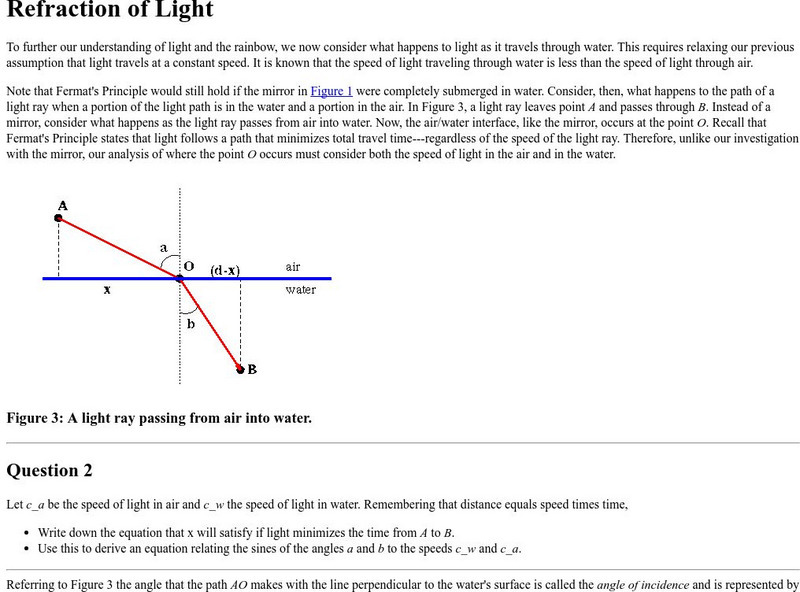
University of Minnesota: Refraction of Light
This page is a continuation of a tutorial about light reflection and refraction. It contains a diagram and suggestions on how to derive Snell's Law, which governs the refraction of light in a medium. For background to this derivation,...
Physics Classroom
The Physics Classroom:reflection/ray Model of Light: Reflection/image Formation
Through diagrams and illustrations, students explore how images are formed through the physics law of reflection.