Hi, what do you want to do?






Bowels Physics
Special Case — Ray Diagrams
Add a ray of light to the class as young scientists learn important foundational concepts. Assist pupils with focal lengths as they study ray diagrams. Pupils review images and compare them to mirrored images before solving problems on...

Exploratorium
Water Sphere Lens
With a Florence flask or fishbowl, make a double convex lens and use it to examine an image. Because of the refraction, the image will be inverted. A simple explanation is provided here for you to share with your class as they...

PHET
Geometric Optics
What would happen if your entire world was flipped upside down? In addition to changing the distance and size of an object, lenses flip the image upside down. The simulation allows scholars to vary the object, move the object, move the...

Curated OER
Typical Conceptual Questions for Physics I - Light and Quantum
This is a stellar overview of everything light and quantum! There are 30 multiple choice questions, none of them requiring any mathematical computation. There are a few diagrams to analyze: light rays striking reflective and refractive...

Curated OER
Microscopes and Telescopes
Students analyze a microscope and study what they do. In this investigative lesson students study how microscopes were first invented, and how ray diagrams are used in conjunction.

Glynn County School System
Multi-Wavelength Astronomy
Take a look at astronomy through the light lens. From radio to gamma, light waves exist in every corner of the universe. An enlightening PowerPoint presentation gives an overview of the different categories of light and then discusses...

Curated OER
Light
All aspects of the path of light are included in a great summary. Internal reflection and the angles of paths in different materials are explained and the behavior of visible light through lenses and the effect on focal points are...

Curated OER
Physics 152 Fall 2004 Final Exam, Parts A, B, C, D
At the end of a general physics course focused on light and electricity, you can administer this exam. Concepts covered include electromagnetism, circuits, induction, light rays, lenses and mirrors, characteristics of light, electron...

NASA
Collecting Electromagnetic Radiation
Astronomy is literally over your head, but this lesson will explain how we study it. Young scientists make telescopes, calculate and compare the light gathering power of lenses, and simulate detection of infared radiation....

Curated OER
A View of the Cell
In this viewing of a cell worksheet, students will read a paragraph about how microscopes work and will use a diagram of a light microscope to complete 2 short answer questions.

Curated OER
Focusing on Lenses
Students explore scientific observations by examining the parts of a microscope. In this optics lesson, students discuss the importance of a focal point and focal distance when utilizing an optical device such as a microscope. Students...

EngageNY
Secant and the Co-Functions
Turn your class upside down as they explore the reciprocal functions. Scholars use the unit circle to develop the definition of the secant and cosecant functions. They analyze the domain, range, and end behavior of each function.

Curated OER
Extreme Flashlight Tag
Fifth graders view a Powerpoint show about reflecting light. They experiment through a reflection simulation on the internet. Students complete the activity by using mirrors and light to complete send light to a specified spot.

Curated OER
Skeletal System
Seventh graders explore the functions of the skeletal system. They collaborate in small groups to determine the function of the skeletal system, the types of joints and movement, bone strength and growth, and bone injuries including...

Curated OER
Reflection & Refraction
In this online interactive reflection and refraction worksheet, students respond to 7 multiple choice and fill in the blank questions regarding the information included in the provided paragraphs.

Curated OER
Pinhole Viewer
Students make a pinhole viewer to demonstrate how it inverts light passing through it which produces inverted images.

Georgia State University
Georgia State University: Hyper Physics: Ray Diagrams for Mirrors
Provides a discussion of curved mirrors and ray diagrams. Shows and explains the process of drawing a ray diagram to determine the image location, size, and orientation.
Exploratorium
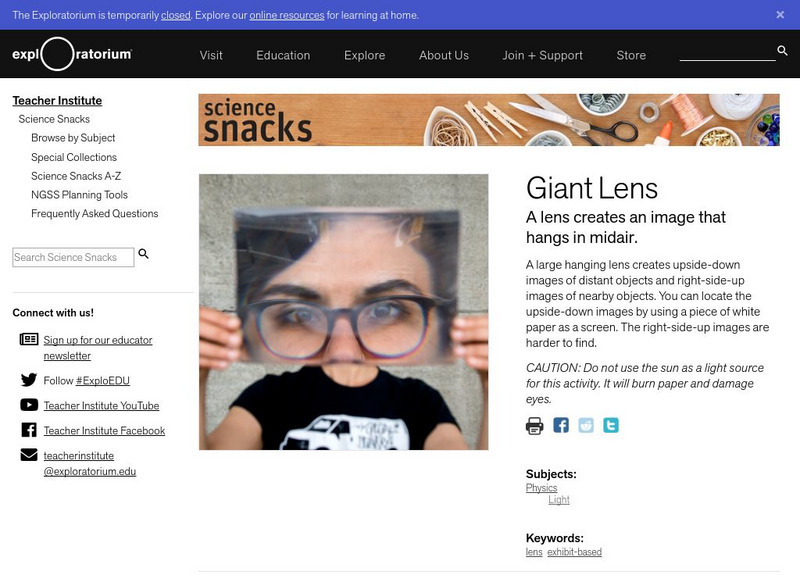
Exploratorium: Science Snacks: Giant Lens
A discussion of how to make a refraction exhibit using a Fresnel lens. Consists of assembly instructions and a "To do and notice" section.

Physics Classroom
The Physics Classroom: Refraction and the Ray Model of Light: Anatomy of a Lens
Illustrated diagrams in this tutorial help students understand the properties and functions of lenses.
Exploratorium
Exploratorium: Water Sphere Lens
A discussion of how to make a magnifying lens exhibit using a water-filled flask and a light bulb. Consists of assembly instructions and a "To do and notice" section. Great for a teacher demonstration or a student project.
TeachEngineering
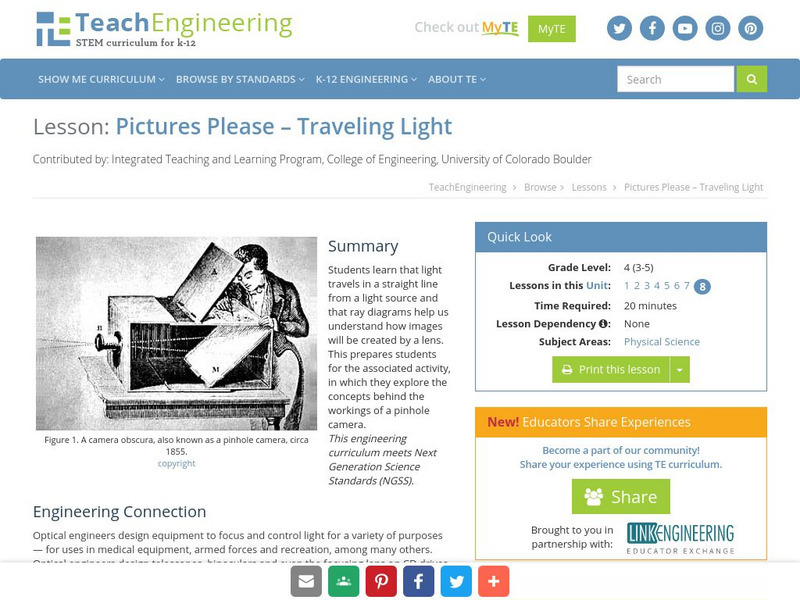
Teach Engineering: Pictures Please: Traveling Light
In this lesson, students learn that light travels in a straight line from a light source and that ray diagrams help us understand how an image will be created by a lens. In the accompanying activity, students explore the concepts behind...
Georgia Department of Education
Ga Virtual Learning: Optics
Students discover how mirrors affect optics in this module through reading informational text, watching animations, and answering self-checking practice questions.