Hi, what do you want to do?






American Psychological Association
A Tasty Sample(r): Teaching about Sampling Using M&M’s
Here's a sweet activity! As part of a study of psychological research methods and statistic gathering, individuals develop a hypothesis about the number of each color of M&Ms in a fun-size package. They then count the number of each...

Curated OER
Opinion Poll-arities
Students explore the mathematics behind opinion polls, as well as provides a framework for interpreting trends in opinion poll graphics.

Curated OER
Political Polls
Students explore politcical polling by conducting a poll of student body elections. They prepare a survey, distribute forms, and tabulate data.

Curated OER
Analyzing the Job Market for Babysitting in Your Neighborhood
Learners conduct research on a neighborhood in Canada. In this data analysis lesson, students use data from the 2006 Canadian census to draw conclusions about a population group.

Curated OER
Name Brands
Students explore the possibility that a products name might bias a consumers decision to buy a particular product. The question remains to be answered, "Why do consumers buy what they buy and why that particular product?"

Curated OER
Olympics
Young scholars participate in Olympic events. In this Olympic Games lesson, students research information about countries involved in the Olympic Games and prepare to participate in a closing ceremony for their school Olympics.

Curated OER
Loyalists
High schoolers explain why some colonists remained loyal to England during the American revolution. In this social studies instructional activity, students write a letter to an editor about their reasons for remaining loyal to England.

Curated OER
How Psychologists Do Research
Students discover how psychologists complete their research on different topics. In groups, they describe the elements of an experiment and the importance of sampling during research. They identify ethical issues in their research and...
Annenberg Foundation
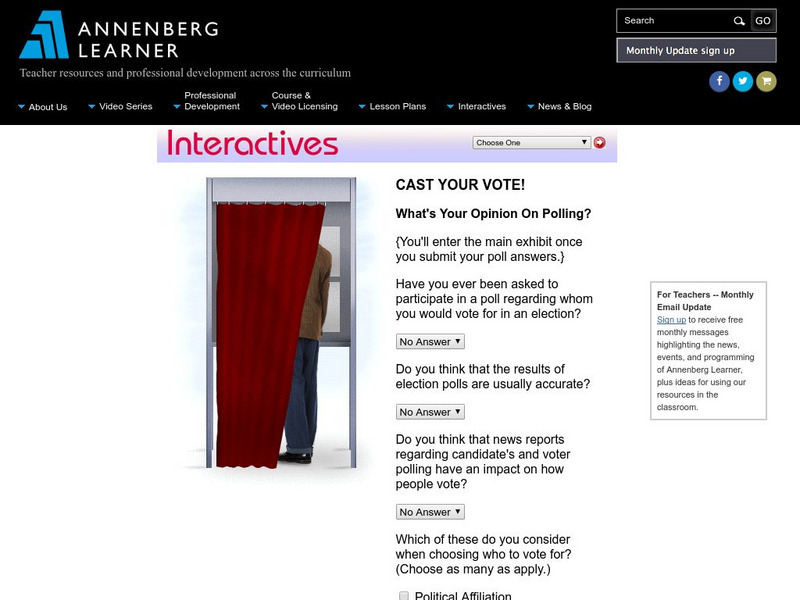
Annenberg Learner: Interactives: Cast Your Vote!
Upper elementary, middle, and high school students can use this exhibit to get an understanding of how polls and elections are conducted. The discussion includes random samples, margins of error, and other concepts related to statistics.