Hi, what do you want to do?






Curated OER
Who Gets Eaten? A Study of Natural Selection
Fourth graders represent a new predator on a population of colored worms. They mathematically determine the effect of the new predator on the survival and reproductive rates of the worms, simulating natural selection at work.

Curated OER
Cancer as a Multistep Process
Students analyze the causes of cancer from a genetic standpoint. They explain the increase in cancer with age and create a hypothesis for cancer development. They use the laws of probability as well.

Curated OER
Establishing Hardy-Weinberg Equilibrium
Students study how Hardy-Weinberg Equilibrium was established and what assumptions and conditions are necessary to reach Equilibrium. They record class data on their charts. Frequencies are calculated.

Curated OER
Punnett Squares/Genetics
Ninth graders complete a monohybrid cross and a dihybrid cross. In this biology lesson, 9th graders predict the traits of offspring using the Punnett square. They differentiate recessive and dominant genes.

Other
Monstrous Mutations: Effect of Random Mutations on Animals' Survival Skills
In this lab activity from Shelly's Science Spot, middle schoolers investigate how genetic mutations can affect the ability of animals to survive, by helping, harming, or having no impact.

National Health Museum
Access Excellence: Making a Phylogenetic Tree Lesson Plan
Constructing phylogenetic trees may be a daunting task for learners, but this lesson plan is a simulation of what molecular biologists must do to determine relationships. This plan is for students who have a good grasp of DNA structure...
TeachEngineering
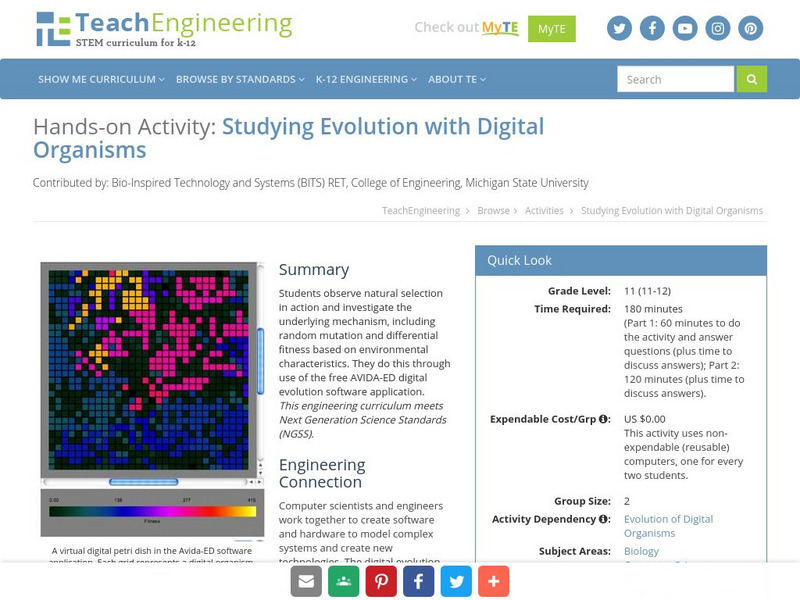
Teach Engineering: Studying Evolution With Digital Organisms
Students observe natural selection in action and investigate the underlying mechanism, including random mutation and differential fitness based on environmental characteristics. They do this through use of the free AVIDA-ED digital...
Other
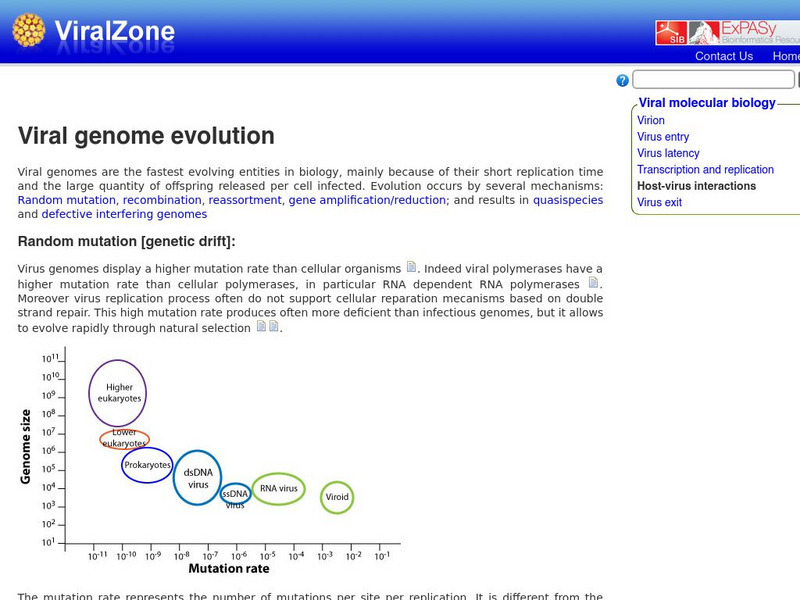
Viral Zone: Viral Genome Evolution
Viral genomes are the fastest evolving entities in biology, mainly because of their short replication time and the large quantity of offspring released per cell infected. Evolution occurs by several mechanisms: Random mutation,...
National Institutes of Health
National Center for Biotechnology Information: Phylogenetics Factsheet
A detailed website that explains the history and process of classifying animals using evolutionary, molecular, and physical characteristics relationships. Website also contains information on evolution and evolutionary processes....
Soft Schools
Soft Schools: Evolution Quiz
Take this interactive, multiple-choice quiz over evolution, then review your score and any missed questions at the end.
Science Daily
Science Daily: Antibiotic Resistance
Antibiotic resistance is the ability of a microorganism to withstand the effects of an antibiotic. It is a specific type of drug resistance. Antibiotic resistance evolves naturally via natural selection through random mutation, but it...
BioMan Biology
Bio Man Biology: Evolution and Classification Quizzes
A multiple-choice quiz on the mechanisms of evolution.
Other
Evolution: The Theory of Natural Selection (Part 1)
These pages are part of a site called Evolution that accompany a textbook by the same name. Mark Ridley is the author. This section has an advanced discussion of determining allele and genotype frequencies using the Hardy-Weinberg ratio.
New York University
Population Size and Genetic Drift: Lecture Notes
This is a college level lecture on genetic drift, complete with mathmatic formulae, includes special links.