
Curated OER
African American Emigration: Turner and McNeal
Students discuss reasons why African Americans may have wanted to emigrate from the United States followig the Civil War. They complete a Venn diagram noting the differences between proposals by Marcus Garvey and Henry McNeal Turner.

Curated OER
Mixing Races in New Orleans
Students discuss the changes in the legal, social, and political status of African Americans and those of mixed ethnicity after reading the narrative, Haitian Immigration: Eighteenth and Nineteenth Centuries.

Curated OER
Voluntary Movement or Not? Africian-American Movement to the West
Ninth graders, in groups, determine reasons for African-American migration to the west

Curated OER
Seeing through Immigrants' Eyes
High schoolers assume the perspective of an immigrant moving to Texas. They write a diary entry from an immigrant's perspective, describing how they arrived in their new town, what steps they take to get settled, and their feelings about...

Curated OER
Truth or Hogwash
Explore the history of domesticated pigs and their important byproducts. After discussing the use of pigs, class members create game boards describing the animals. While playing the game, they determine if the answers are true or...

Curated OER
Models of American Citizenship
Third graders investigate the concept of American citizenship by pretending to time travel. They travel back in time to visit the eras of Thomas Jefferson, Hellen Keller, Harriet Tubman, Dr. Martin Luther King, Jr., and community heroes....

Curated OER
The Impact of Mining on American History
Students listen to background information about coal and its mining in the United States history. They then construct a timeline using the above article. Illustrate with pictures from the www.coaleducation.org web site.

Curated OER
A New Way of Looking
Students compare and contrast works of art. In this art analysis lesson plan, students complete art analysis discussion activities and then journal activities.

Curated OER
Geography: How do Louisiana Rice Farmers Help the Environment after they Harvest Rice?
Third graders study maps of the United States locating Louisiana, the East Coastal Plain, the Mississippi Alluvial Plain, the West Gulf Coastal Plain, and five of the main rivers. In this geography lesson plan, 3rd graders create a...
Gilder Lehrman Institute of American History
Gilder Lehrman Institute: George Pullman: His Impact on Rr Industry, Labor, and American Life in 19th C.
[Free Registration/Login Required] This lesson plan seeks to discover the impact George Pullman had, not only on the railroad industry, but also on American life, by improving rail travel, and also establishing a company town for his...
OpenStax
Open Stax: Industrialization 1870 1900: From Invention to Industrial Growth
This section of the textbook describes how new inventions spurred industrial growth in the 19th century and discusses the business methods and models of Andrew Carnegie, John Rockefeller, and J. P. Morgan.
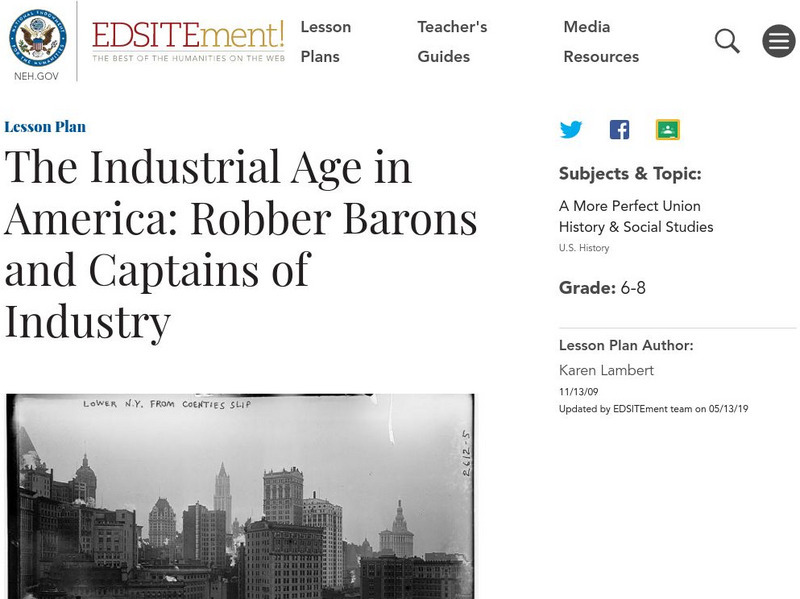
National Endowment for the Humanities
Neh: Edsit Ement: Robber Barons and Captains of Industry
A very thorough lesson plan from EDSITEment that explores the role of the robber barons in American industry in the 19th century. It explores the question of whether the robber barons were harmful or "Captains of Industry." You'll find...
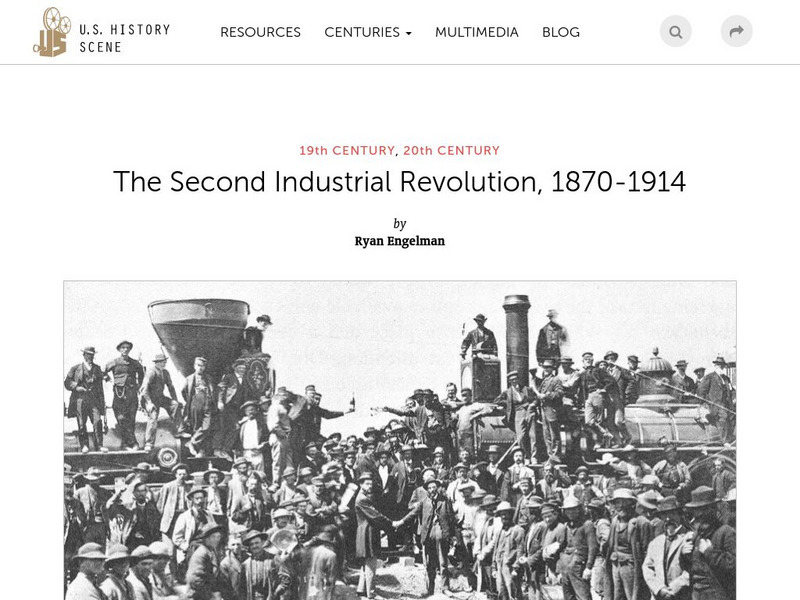
Other
U.s. History Scene: The Second Industrial Revolution, 1870 1914
Between 1820 and 1860, the visual map of the United States was transformed by unprecedented urbanization and rapid territorial expansion, facilitated by the railroad system. These changes mutually fueled the Second Industrial Revolution...
Kansas Historical Society
Kansas Conflict: Populist Versus Railroader in the 1890s
Good description of the conflict between the populists and the railroad owners during the 1890s. (Published 1997)

Library of Congress
Loc: Rise of Industrial America: Railroads in the Late 19th Century
A compilation of primary source documents addressing building and running the railroad system in the late 19th century.
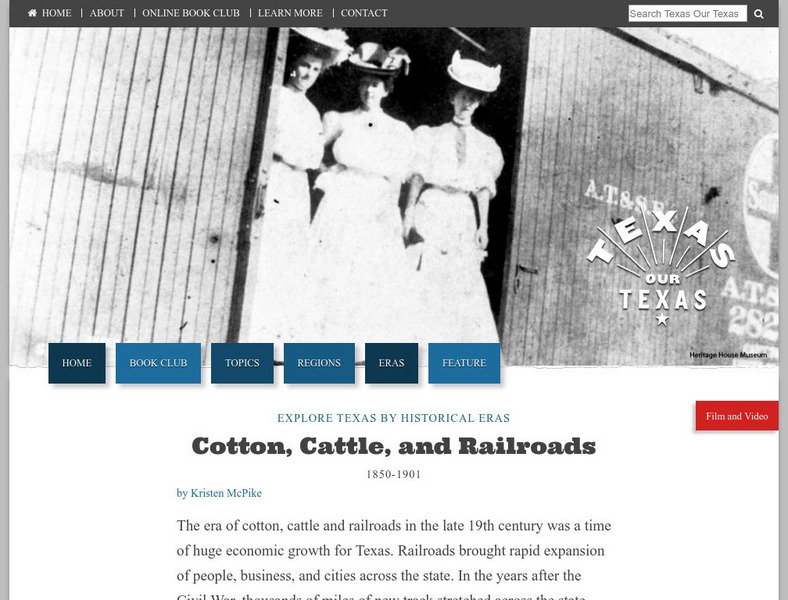
Texas Public Broadcasting
Texas Pbs: Texas Our Texas: Cotton, Cattle, and Railroads 1850 1901
A brief overview of the era of cotton, cattle, and railroads in the late nineteenth century which was a time of huge economic growth for Texas.
Other
Slide Player: Industry in Texas: Railroad, Lumber, Coal, and Oil
A narrated slideshow that is a summary of two chapters in a history text. It outlines the factors that led to the industrialization and urbanization of Texas, away from an agrarian economy. These included the growth of the railroad,...
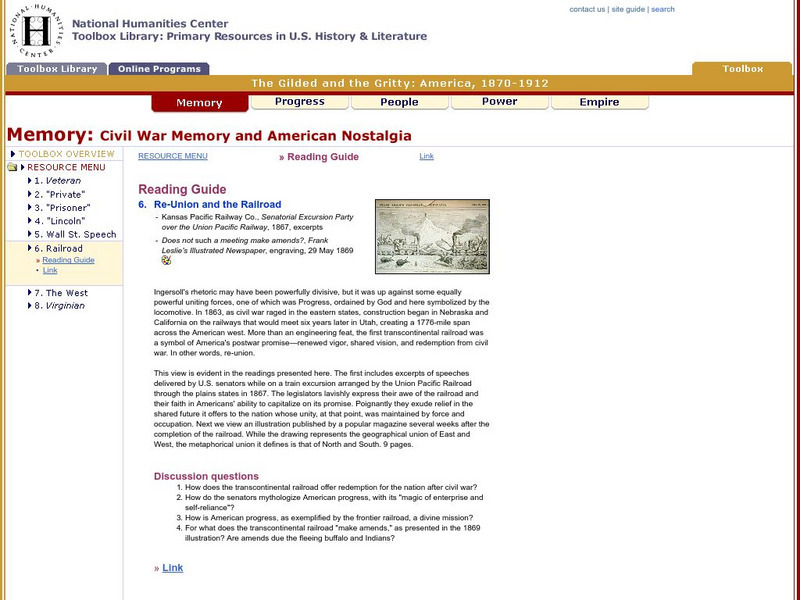
National Humanities Center
National Humanities Center: Toolbox Library: Railroad, the Gilded and the Gritty: America, 1870 1912
A speech and an engraving that illustrate how the railroad helped to unite the country after the Civil War.

Other
Modern World History: The Industrial Revolution Begins in England (1760 1850)
In this textbook unit, students learn the reasons why the Industrial Revolution took root in England first, and the innovations that made this possible. These included textile inventions such as the flying shuttle and the spinning jenny,...

Virginia Tech
Digital History Reader: Industrialization's Discontents: Great Strike of 1877
With its beginnings along the railroad tracks in Maryland and West Virginia, the Great Railroad Strike of 1877 was the first national strike in response to poor wages and poor conditions. Understand the impact of this strike on the...
Texas State Library and Archives Commission
Texas State Library and Archives Commission: Texas in Transition: Railroads, Oil, and the Rise of Urban Texas
A collection of lesson plans that explore the changes that have taken place in Texas as a result of the railroad and oil industries. There are case studies of the impact of urbanization on six Texas cities, as well as online exhibits on...
CPALMS
Florida State University Cpalms: Florida Students: Captains of Industry: Second Industrial Revolution
This tutorial looks at the Second Industrial Revolution in the United States and the most famous and successful industrial entrepreneurs of that time. A PDF file of the tutorial is available.

Digital Public Library of America
Dpla: Full Steam Ahead: The Steam Engine and Transportation in the Nineteenth Century
This primary source set uses illustrations, documents, and photographs to tell the story of how the steam engine transformed the railroad industry and played crucial roles in the Industrial Revolution and westward expansion.
University of Groningen
American History: Outlines: Industrial Growth
By 1860, when Abraham Lincoln was elected president, 16 percent of the population lived in urban areas and a third of the nation's income came from manufacturing. Funds were flowing into large-scale industrial development and into...