Hi, what do you want to do?





Get Safe Online
Get Safe Online: Safeguarding Children
The internet is a great resource, but it can also be dangerous. This resource contains many links to online safety resources for parents, teachers and students.
![Common Sense Media: Strong Passwords [Pdf] Lesson Plan](https://static.lp.lexp.cloud/images/attachment_defaults/resource/large/FPO-knovation.png "Common Sense Media: Strong Passwords [Pdf] Lesson Plan")
Other
Common Sense Media: Strong Passwords [Pdf]
In this lesson, students learn how to create secure passwords in order to protect their private information and accounts online.
Federal Trade Commission
Ftc: Protecting Kids Online: Kids and Socializing Online
Apply real-world judgment to help minimize risks while kids socialize online.
Get Safe Online
Get Safe Online: Videos
There are many security threats today associated with internet use. This site presents some online videos that discuss security issues such as online rip-off schemes, protecting privacy, and protecting your computer from online attacks.
Get Safe Online
Get Safe Online: Use Internet Telephony Safely
Internet telephony is using the internet for voice communication. It is also called voice over IP (VOIP). This site provides some tips on how to use VOIP safely and avoid loss of privacy.
Common Sense Media
Common Sense Media: Education: Secret Sharer Grades 6 8
Students look beyond protecting their own privacy to respecting the privacy of others online. Students read and analyze case studies about students who have compromised the privacy of someone else online by tagging, copying, and...
Childnet
Childnet: Online Safety: Online Grooming
Online grooming is when someone builds a relationship with a young person online because they want to trick or pressure them into doing something that may hurt or harm them. This site provides questions, answers, and tips about online...

Khan Academy
Khan Academy: Http Secure (Https)
The article examines Hypertext Transfer Protocol Secure (HTTPS) and how it protects the privacy of their user and prevents tampering of the website.
Other
Common Sense Media: Private and Personal Information [Pdf]
In this lesson students learn the difference between private information and personal information, distinguishing what is safe and unsafe to share online.
Other
Federal Deposit Insurance Corporation: Consumer Resources
A great resource from the FDIC for "becoming an informed banking consumer." Learn all about consumer protection and gain important and useful facts about such topics as phishing scams, identity theft, consumer rights, new cheque clearing...
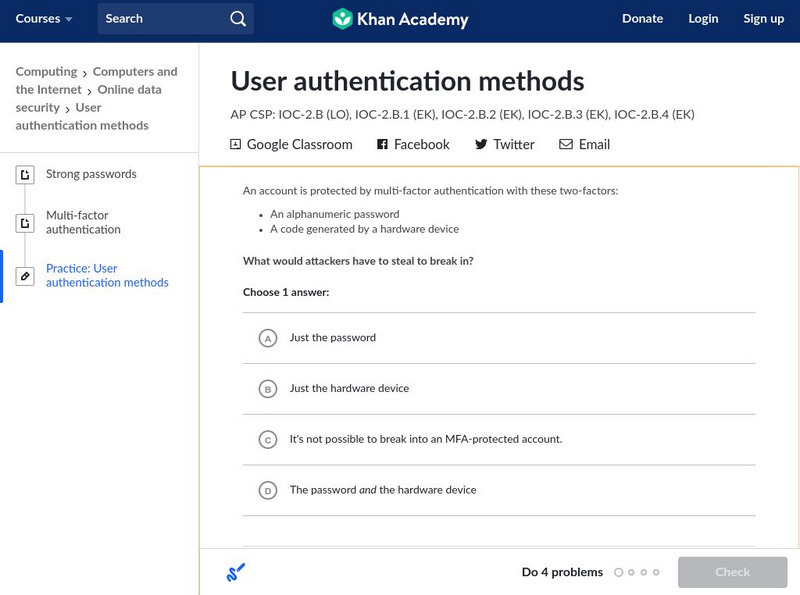
Khan Academy
Khan Academy: User Authentication Methods
Some practice problems on user authentication methods regarding computer security.
Other
Uk Information Commissioner's Office: What Is Personal Information? [Pdf]
In this lesson, students will develop their understanding of what is meant by 'personal information' and will create a chart with their own personal information. The exercise will help them to understand how to be careful with sharing...
Other
Uk Information Commissioner's Office: Who Needs to Know? Why? [Pdf]
In this instructional activity, children will consider what personal information is appropriate to share and how this depends on that person's relationship with them. The exercise will help them to understand how to be careful with...

Khan Academy
Khan Academy: Multi Factor Authentication
Find out about the security of the most common form of authentication, multi-factor authentication.
Other
Morino Institute: Promise of a New Communications Age
This speech outlines the nature of the communications revolution, establishes a framework for the most important challenges that must be addressed and proposes an Agenda for Action for individuals and groups to take advantage of the...