Hi, what do you want to do?






BBC
Bbc: Gcse Bitesize: Why Do Scientists Think That Light and Sound Are Waves?
Light travels as transverse waves and can travel through a vacuum. Sound travels as longitudinal waves and needs to travel through a solid, liquid or gas. Read about the properties of light and of sound, and learn the differences between...
University of Colorado
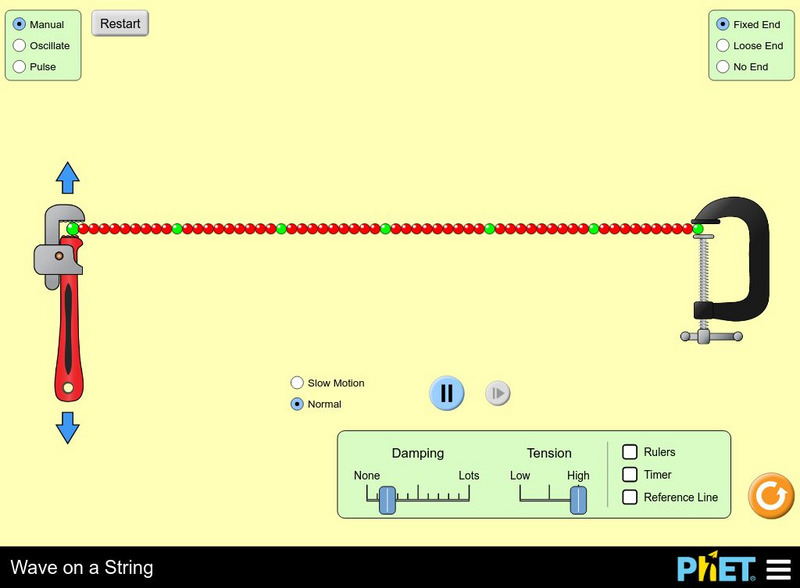
University of Colorado: Ph Et Interactive Simulations: Wave on a String
Students can observe the properties of a wave with different variables. Students can experiment with the type of end, damping factor, and tension in the string. Possible teacher lesson plans are included at the bottom of the page.

PBS
Pbs Learning Media: What Is a Wave?
This interactive activity adapted from the University of Utah's ASPIRE Lab provides an overview of the characteristics and properties of various types of waves, including light waves, sound waves, and water waves.
University of New South Wales (Australia)
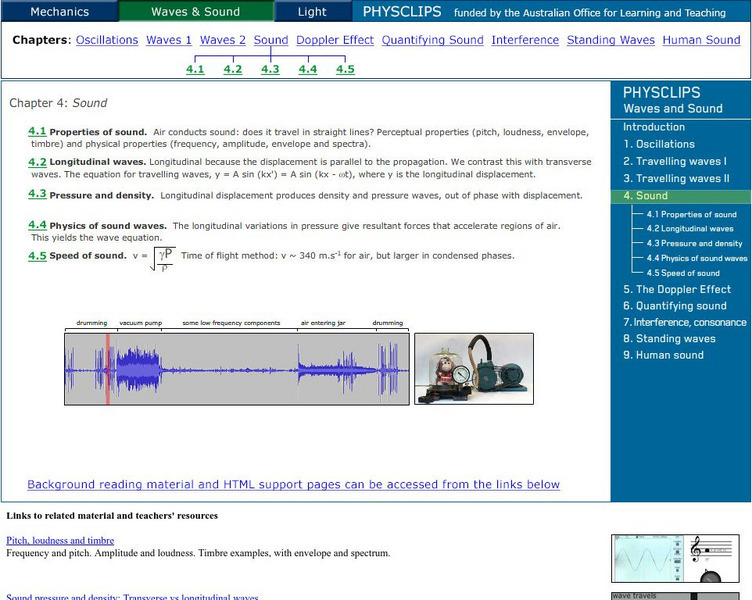
University of New South Wales: School of Physics: Physclips: Sound
Physiclips thoroughly presents the concept of sound with animations and film clips. Learn about the properties of sound and the physics behind sound waves with this site.

CK-12 Foundation
Ck 12: Wave Properties
[Free Registration/Login may be required to access all resource tools.] Students investigate behaviors of waves, including interference, reflection, refraction, and diffraction.
TeachEngineering
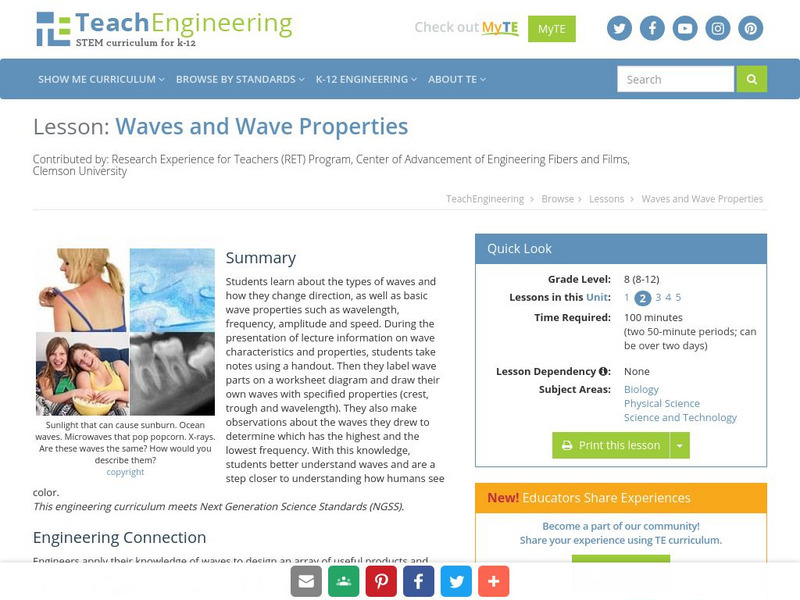
Teach Engineering: Waves and Wave Properties
Students learn about the types of waves and how they change direction, as well as basic wave properties such as wavelength, frequency, amplitude and speed. During the presentation of lecture information on wave characteristics and...
Georgia Department of Education
Ga Virtual Learning: Electromagnetic Waves
Through informational text, interactive activities, practice problems, and virtual simulations, students explore the properties of electromagnetic waves.
Georgia Department of Education
Ga Virtual Learning: Physical Science: Waves and Sound
In this module, students investigate the properties and behavior of different types of waves.
University of Colorado
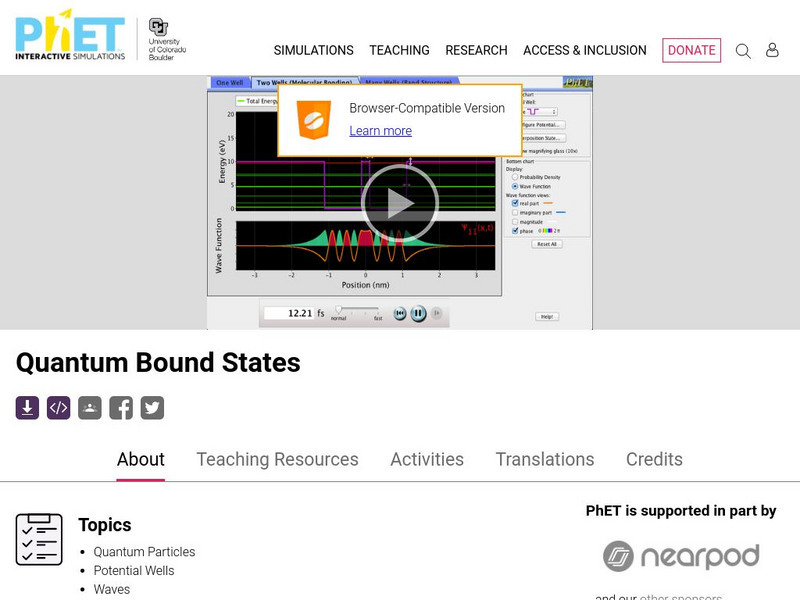
University of Colorado: Ph Et Interactive Simulations: Quantum Bound States
Explore the properties of quantum particles bound in potential wells, and see how the wave functions and probability densities that describe them evolve (or don't evolve) over time.
Georgia State University
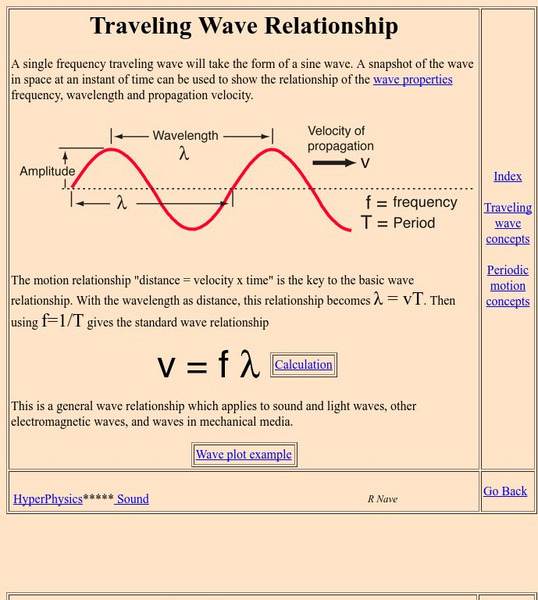
Georgia State University: Hyper Physics: Traveling Wave Relationship
Online physics text that illustrates and explains the various characteristics of waves such as amplitude, period, frequency, wavelength, and speed. Includes interactive exercises.
Oklahoma Mesonet
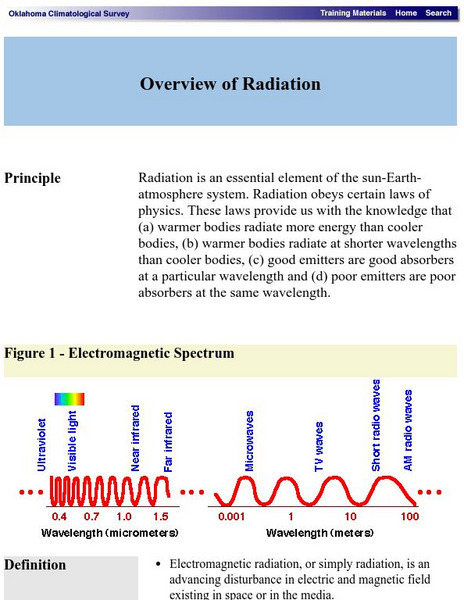
Oklahoma Climatological Survey: Overview of Radiation
This site details what radiation is, the physics of radiation, and radiative transfer as it occurs in nature. Content explores the electromagnetic spectrum, electromagnetic waves, properties of radiation, and solar radiation.
CK-12 Foundation
Ck 12: Fourth Grade Science: Physical Science: Characteristics of Sound
[Free Registration/Login may be required to access all resource tools.] Discusses sound waves and properties of sound.
Utah State Office of Education
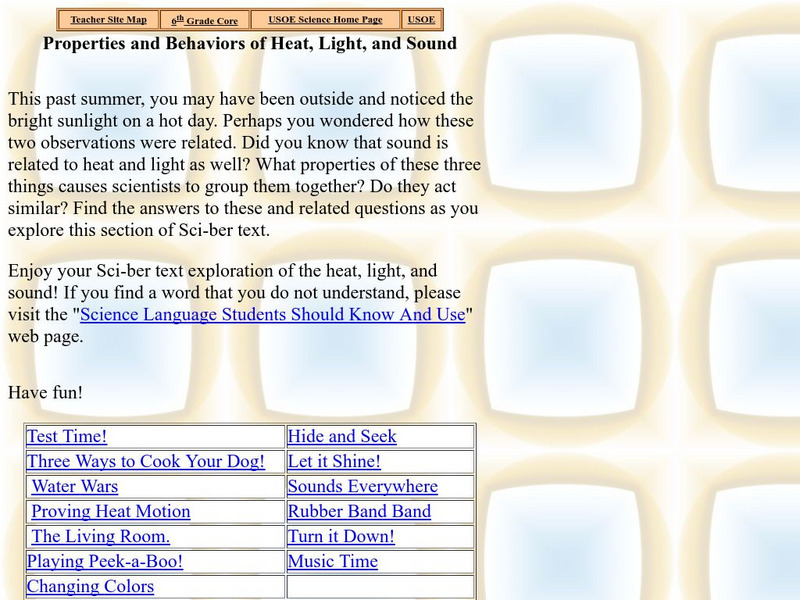
Utah Science: Properties and Behaviors of Heat, Light and Sound
How can scientists lump heat, light and sound together when investigating properties and behaviors? This learning module will address that question through a series of activities.
Texas A&M University
Texas A&m University: Properties of the Ocean Activities
This site is from the Texas A&M University provides a lesson plan on measurement and properties of the ocean. As part of the lesson learners are challenged to create a model of an underwater amusement park. Web resources are provided...
Physics Classroom
The Physics Classroom: The Wave Equation
A thorough explanation of the wave equation (Speed = Wavelength * Frequency). A data table and questions to check one's understanding are also part of this lesson.
University of Colorado
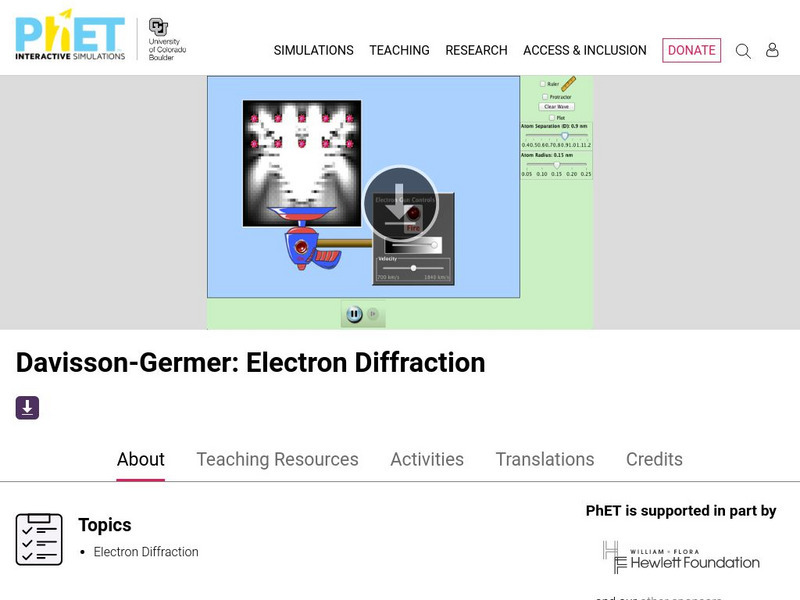
University of Colorado: Ph Et Interactive Simulations: Davisson Germer
Simulate the original experiment that proved that electrons can behave as waves. Watch electrons diffract off a crystal of atoms, interfering with themselves to create peaks and troughs of probability. Java required.

University of Colorado
University of Colorado: Ph Et Interactive Simulations: Quantum Tunneling and Wave Packets
Watch quantum "particles" tunnel through barriers. Explore the properties of the wave functions that describe these particles.
TeachEngineering
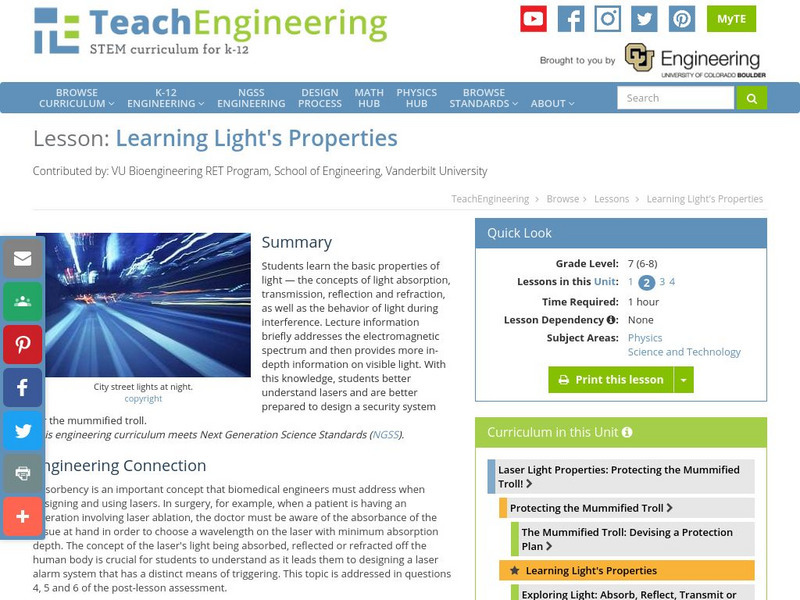
Teach Engineering: Learning Light's Properties
Students learn the basic properties of light--the concepts of light absorption, transmission, reflection and refraction, as well as the behavior of light during interference. Lecture information briefly addresses the electromagnetic...
University of New South Wales (Australia)
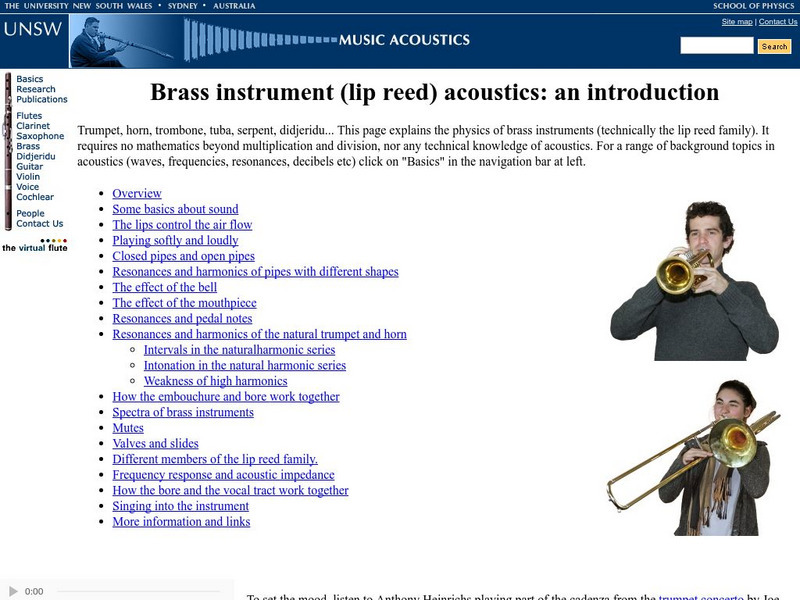
University of New South Wales: Introduction to Acoustics of Brass Instruments
Discover the acoustical properties of brass instruments from this well researched site provided by the University of New South Wales. Everything from lip control to bell shape is discussed as it applies to frequencies and harmonics.
University of Colorado
University of Colorado: Ph Et Interactive Simulations: Wave Interference
Conduct virtual experiments with water, sound, and light waves to determine the sine wave and patterns created in each.
Physics Classroom
The Physics Classroom: Properties of Periodic Motion
In Physics, a motion that is regular and repeating is referred to as a periodic motion. Most objects that vibrate do so in a regular and repeated fashion; their vibrations are periodic. Learn more here about periodic motion and take the...

Khan Academy
Khan Academy: The Effects of Ear Canal Acoustics on Hearing Ability
This is a five-question quiz related to the passage "The Effects of Ear Canal Acoustics on Hearing Ability."
TeachEngineering
Teach Engineering: Stations of Light
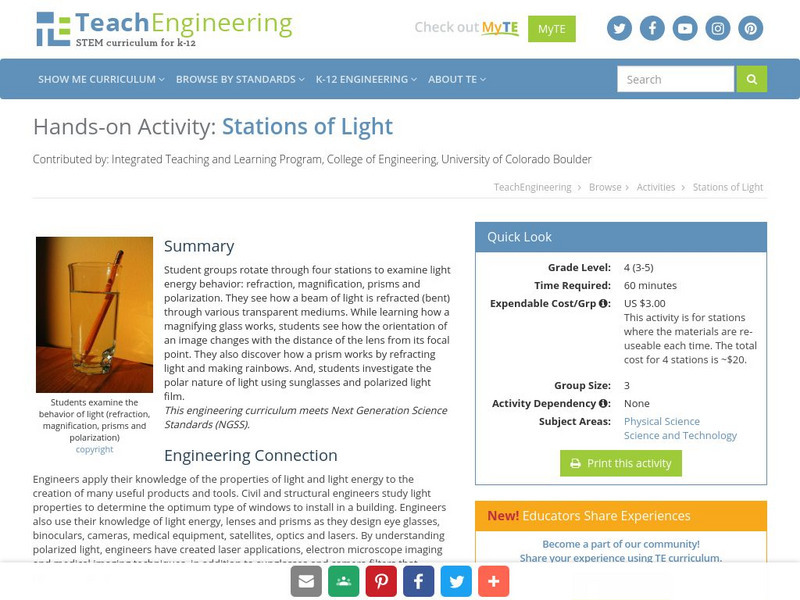
Student groups rotate through four stations to examine light energy behavior: refraction, magnification, prisms and polarization. They see how a beam of light is refracted (bent) through various transparent mediums. While learning how a...

Khan Academy
Khan Academy: Light: Electromagnetic Waves, Electromagnetic Spectrum and Photons
This article discusses the properties of electromagnetic radiation and photons.