Hi, what do you want to do?





CK-12 Foundation
Ck 12: Physical Science: Properties of Electromagnetic Waves
[Free Registration/Login may be required to access all resource tools.] The speed of electromagnetic waves, their wavelengths and frequencies and how to calculate wavelength or wave frequency.
BBC
Bbc: Gcse Bitesize: General Properties of Waves
Light travels as waves. Waves can be described by their amplitude, wavelength and frequency. The speed of a wave can be calculated from its frequency and wavelength.
Georgia Department of Education
Ga Virtual Learning: Physical Science: Light and Optics
Students will investigate the properties of light waves. They will learn about the different types of electromagnetic waves and mechanical waves, and investigate the phenomena of reflection, refraction, interference, and diffraction.

BBC
Bbc: Gcse Bitesize: Why Do Scientists Think That Light and Sound Are Waves?
Light travels as transverse waves and can travel through a vacuum. Sound travels as longitudinal waves and needs to travel through a solid, liquid or gas. Read about the properties of light and of sound, and learn the differences between...
Georgia Department of Education
Ga Virtual Learning: Electromagnetic Waves
Through informational text, interactive activities, practice problems, and virtual simulations, students explore the properties of electromagnetic waves.
TeachEngineering
Teach Engineering: Learning Light's Properties
Middle schoolers learn the basic properties of light--the concepts of light absorption, transmission, reflection and refraction, as well as the behavior of light during interference. Lecture information briefly addresses the...
University of Colorado
University of Colorado: Ph Et Interactive Simulations: Wave Interference
Conduct virtual experiments with water, sound, and light waves to determine the sine wave and patterns created in each.
Space Telescope Science Institute
Amazing Space: Star Light Star Bright
A few short, interactive activities on light waves can be found on this site. Numerous others links and teacher resources are posted here as well. A good background on light is offered for teachers.
Utah State Office of Education
Utah Science: Properties and Behaviors of Heat, Light and Sound
How can scientists lump heat, light and sound together when investigating properties and behaviors? This learning module will address that question through a series of activities.

PBS
Pbs Learning Media: What Is a Wave?
This interactive activity adapted from the University of Utah's ASPIRE Lab provides an overview of the characteristics and properties of various types of waves, including light waves, sound waves, and water waves.
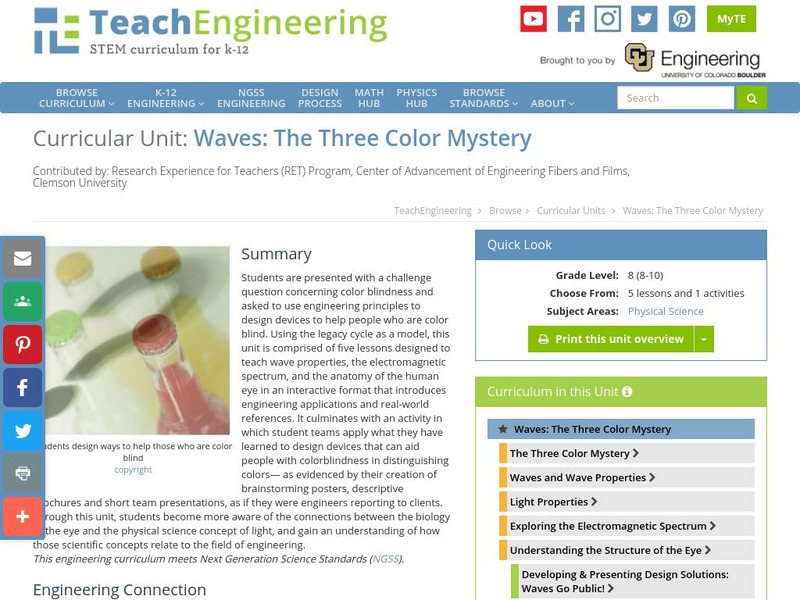
TeachEngineering
Teach Engineering: Waves: The Three Color Mystery
Students are presented with a challenge question concerning color blindness and asked to use engineering principles to design devices to help people who are color blind. Using the legacy cycle as a model, this unit is comprised of five...
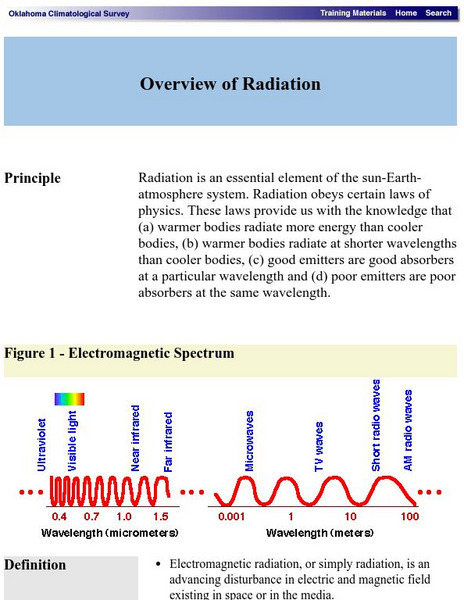
Oklahoma Mesonet
Oklahoma Climatological Survey: Overview of Radiation
This site details what radiation is, the physics of radiation, and radiative transfer as it occurs in nature. Content explores the electromagnetic spectrum, electromagnetic waves, properties of radiation, and solar radiation.
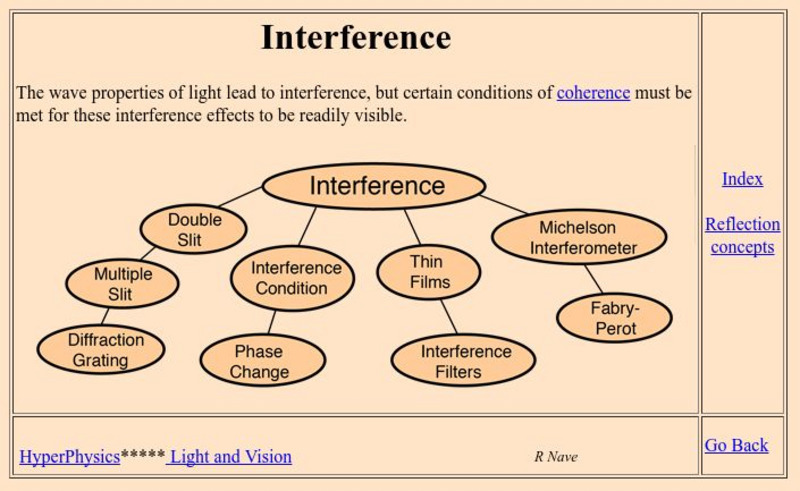
Georgia State University
Georgia State University: Hyper Physics: Interference
An indexing page for a physics department site about the wave properties of light that lead to interference.
Space Telescope Science Institute
Amazing Space: Star Light, Star Bright
An online exploration where students learn the basics about light and the properties of waves and the electromagnetic spectrum. Students will also learn how to measure wavelength and frequency so they can understand the electromagnetic...
Scholastic
Scholastic: Study Jams! Science: Energy, Light and Sound: Sound
A video and a short quiz on how sound travels in waves, its properties, and how to measure it.

Khan Academy
Khan Academy: Light: Electromagnetic Waves, Electromagnetic Spectrum and Photons
This article discusses the properties of electromagnetic radiation and photons.
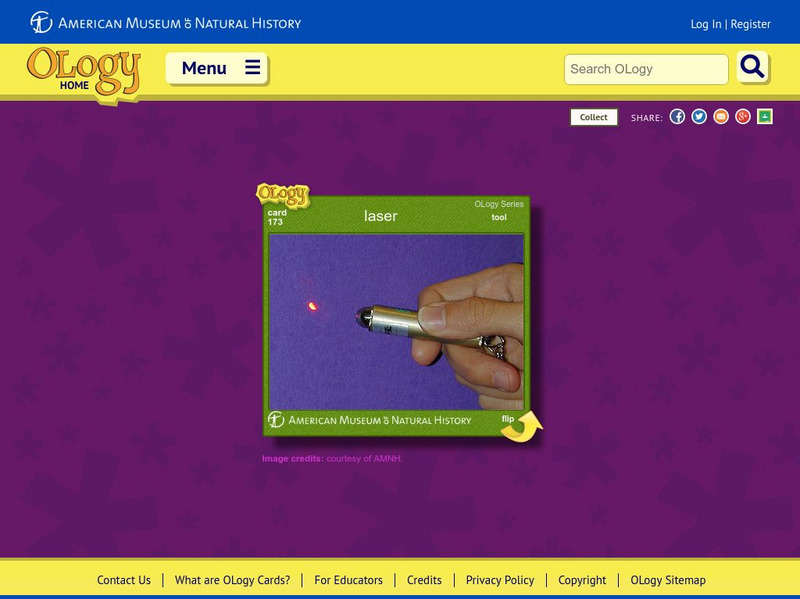
American Museum of Natural History
American Museum of Natural History: Laser O Logy Card
Flip over this interactive OLogy card to find fast facts, questions and answers, and similar bite-size pieces of information about the properties and uses of lasers.
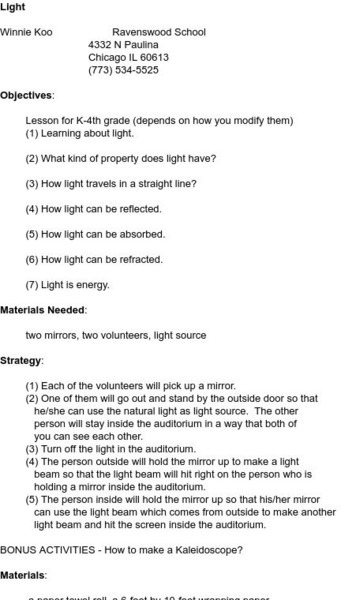
Science and Mathematics Initiative for Learning Enhancement (SMILE)
Smile: Light (K 4)
This site provides two activities that students can do in class. One uses mirrors to reflect light beams whole another is making a kaleidescope.
TeachEngineering
Teach Engineering: Waves Go Public!
Students apply everything they have learned over the course of the associated lessons about waves, light properties, the electromagnetic spectrum, and the structure of the eye, by designing devices that can aid color blind people in...
Sophia Learning
Sophia: Electromagnetic Spectrum: Lesson 2
This lesson will introduce the electromagnetic spectrum and the properties and uses of the waves it contains. It is 2 of 4 in the series titled "Electromagnetic Spectrum."
Sophia Learning
Sophia: Electromagnetic Spectrum: Lesson 3
This lesson will introduce the electromagnetic spectrum and the properties and uses of the waves it contains. It is 3 of 4 in the series titled "Electromagnetic Spectrum."
Sophia Learning
Sophia: Electromagnetic Spectrum: Lesson 4
This lesson will introduce the electromagnetic spectrum and the properties and uses of the waves it contains. It is 4 of 4 in the series titled "Electromagnetic Spectrum."
Sophia Learning
Sophia: Electromagnetic Spectrum: Lesson 1
This lesson will introduce the electromagnetic spectrum and the properties and uses of the waves it contains. It is 1 of 4 in the series titled "Electromagnetic Spectrum."
E-learning for Kids
E Learning for Kids: Science: Winery: Why Can We See Through Some Objects but Not Others?
Learn about the properties of materials in their interactions with light, including whether they are opaque, transparent, or translucent, and which of these produce shadows.