Hi, what do you want to do?






Curated OER
Ceramics Pottery and 3D AP
Students explore how to form clay by pinching to create a bottle with an elongated neck

Curated OER
Alice World:Tornado
Seventh graders use the Alice program and complete a world that is damaged after a tornado. In this atmospheric conditions lesson students complete an activity using the Alice program.

Curated OER
Combustion Reactions
High schoolers write a balanced chemical reaction. They articulate how burning fossil fuels increase the carbon dioxide levels in the atmosphere. Students incorporate all the environmental risks involved as well.

Curated OER
MANAGING THE SCHOOL FOREST
Pupils study how to plant a seedling, how to mulch the trees into the nursery bed, transplant seedlings to another site or school, and determine why we need to water and mulch trees.

Curated OER
Good Vibrations
Middle schoolers demonstrate sound waves and make changes in the waves
resulting in changes in pitch. Students associate changes in pitch in various "musical instruments"with size and shape and the sound waves they produce.

Curated OER
Homonyms - Quiz 15
Learners complete a quiz about homonyms. In this homonyms lesson plan, students read the sentences and select the correct homonym spelling to complete the online quiz.

Curated OER
Weather Myths
Fourth graders relate myths to weather phenomenon. They write and illustrated a weather myth and present it to the class.

Curated OER
Weather Records
Young scholars write newspaper articles using a "weather record" worksheet and information they find in newspapers.

Curated OER
Weather Predictions
Fourth graders explore meteorologists. They explore symbols on a weather map and make five day forecasts.

Curated OER
Physics Post-Lab
Students explore physics. In this science instructional activity, students discuss physics in their everyday lives. Students complete a physics worksheet.

Curated OER
The Rock Cycle
Third graders, in groups, examine soil samples with magnifying glasses. They discuss the living and non-living things they find in their soild samples.

TeachEngineering
Teach Engineering: Air Is It Really There?
By watching and performing several simple experiments, students develop an understanding of the properties of air: it has mass, it takes up space, it can move, it exerts pressure, it can do work.

BioEd Online
Bio Ed Online: About Air
In this lesson students will use popcorn of different colors to model the composition of air. They learn that gases occupy space, air is a mixture of different gases, and the oxygen needed by the human body is not the principal component...
![American Chemical Society: Best of Wonder Science: Air: It's Really There [Pdf] Activity](https://statictemp.lp.lexp.cloud/images/attachment_defaults/resource/large/FPO-knovation.png "American Chemical Society: Best of Wonder Science: Air: It's Really There [Pdf] Activity")
American Chemical Society
American Chemical Society: Best of Wonder Science: Air: It's Really There [Pdf]
An experiment to explore the properties of air, using a cup placed upsidedown in water.
Science and Mathematics Initiative for Learning Enhancement (SMILE)
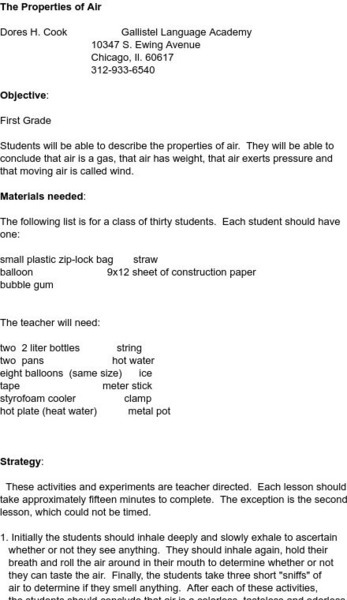
Smile: The Properties of Air
Lesson plan to teach properties of air. Students use balloons, plastic bottles, plastic bags and a meter stick to conclude that air is a gas that has weight, exerts pressure, and moves.
NASA
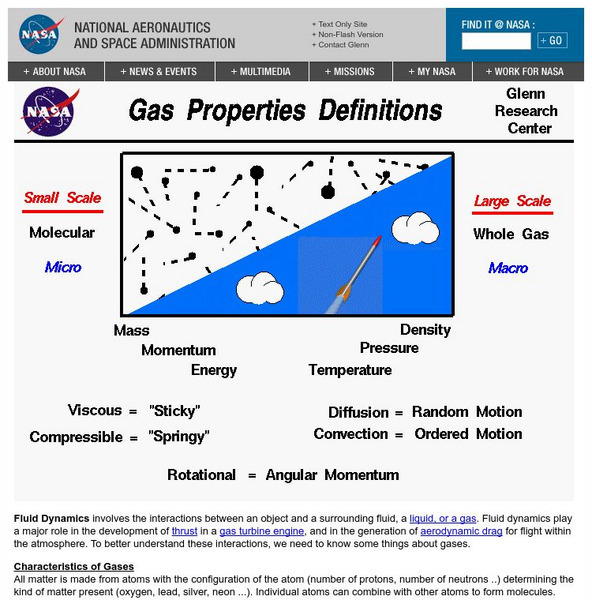
Nasa: Gas Properties Definitions
Use this site to learn about basic gas properties including motion, viscosity, and compressibility. Includes links to activities for all ages.
Other
Air Blaster: Smoke Ring Launcher
Steve Spangler shows how you can blow a cup off of your friends head and his or her papers off the desk with this "air blaster" or "AirZooka." Demonstrate that air does take up space and how air moves. What fun!

PBS
Pbs Kids: Science Rocks: Air Lift
Through this experiment, students are challenged to lift a book (and other items) with just air. Requires simple household items, gallon-size, zipper-lock plastic bag, book, pencil, drinking straw, and tape.
Other
Federal Aviation Administration: Air Takes Up Room [Pdf]
See how air takes up space by conducting this classroom experiment. With the aid of several common objects, observe the effects of air pressure.
Other
Educational Objects: Does Air Have Weight?
Explore the properties of air with this virtual experiment. Add air to a balloon to discover the property of weight.

Annenberg Foundation
Annenberg Learner: Virtual Particle Lab: Compressibility of Air
Explore the particle model of matter. Run the simulations and see if you can predict the results.
University of Notre Dame
Und: Properties of a Pure Substance [Pdf]
Often we find that different phases of pure substances can exist in equilibrium with one another. Let us consider an important gedankenexperiment (Latin-German for "thought experiment") in which we boil water. Ordinary water boiling is...

Science Education Resource Center at Carleton College
Serc: Density With Carbon Dioxide
A guided demonstration where learners investigate the properties of carbon dioxide gas and air based on density. Students learn about properties of air through observation and inquiry.
Encyclopedia of Earth
Encyclopedia of Earth: Petroleum: Gasoline
Explains what gasoline is and the different terms used for it, describes how it is produced, and what effects different properties of a gasoline can have on its performance. Also discusses how the composition of gasoline varies depending...