Hi, what do you want to do?





TeachEngineering
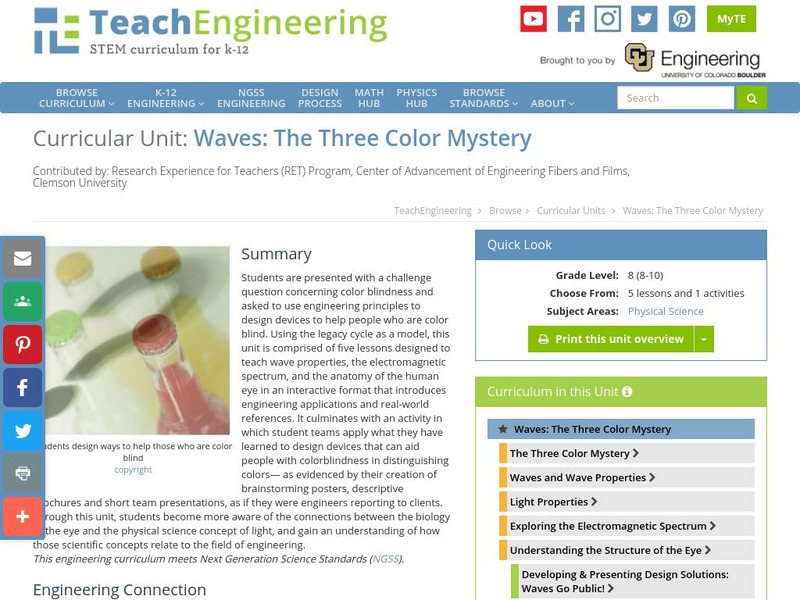
Teach Engineering: Waves: The Three Color Mystery
Students are presented with a challenge question concerning color blindness and asked to use engineering principles to design devices to help people who are color blind. Using the legacy cycle as a model, this unit is comprised of five...
Exploratorium
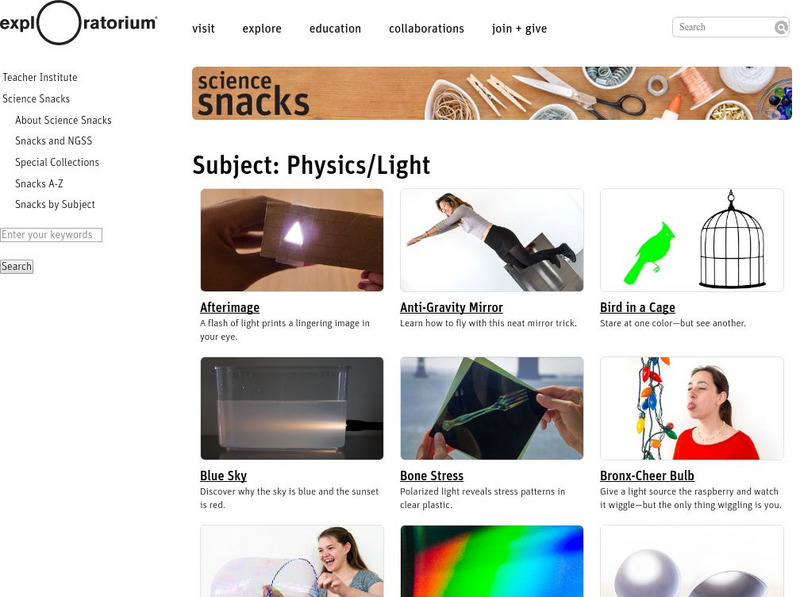
Exploratorium: Science Snacks: Physics/light
Here is a large collection of simple science class activities for understanding the physics of light.

Intel Corporation
Intel Engage: Designing Effective Projects: Dangerous Decibels
Students investigate sound in their environment, particularly how sounds impact their lives. At the beginning of the unit, students use online simulations to investigate the properties of sound and learn about the components of a sound...
American Association of Physics Teachers
Com Padre Digital Library: Open Source Physics: Doppler Effect Model
A simulation of the Doppler Effect, where a change in wave frequency can be observed from the reference frame of the wave source, an observer, or the medium.
American Association of Physics Teachers
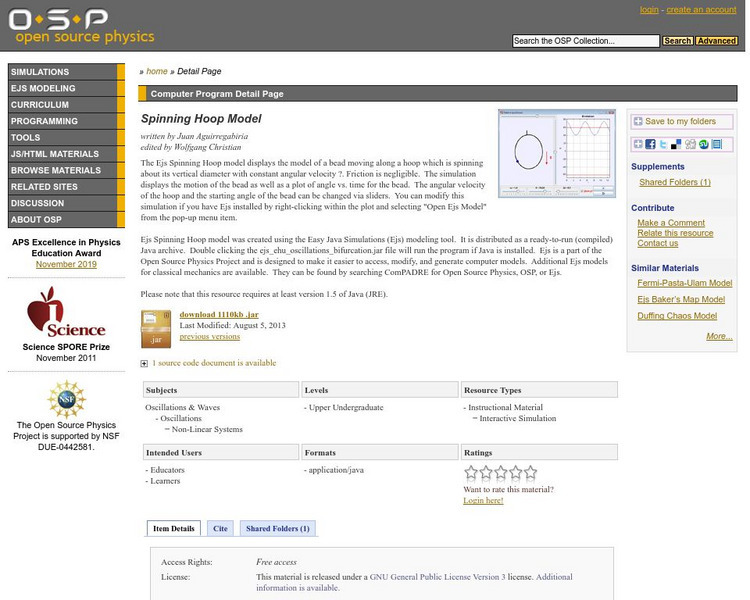
Com Padre Digital Library: Open Source Physics: Spinning Hoop Model
A model of a bead traveling along a spinning hoop. The hoop's velocity and the bead's initial angle can be modified, and the results are displayed on an accompanying chart.
TeachEngineering
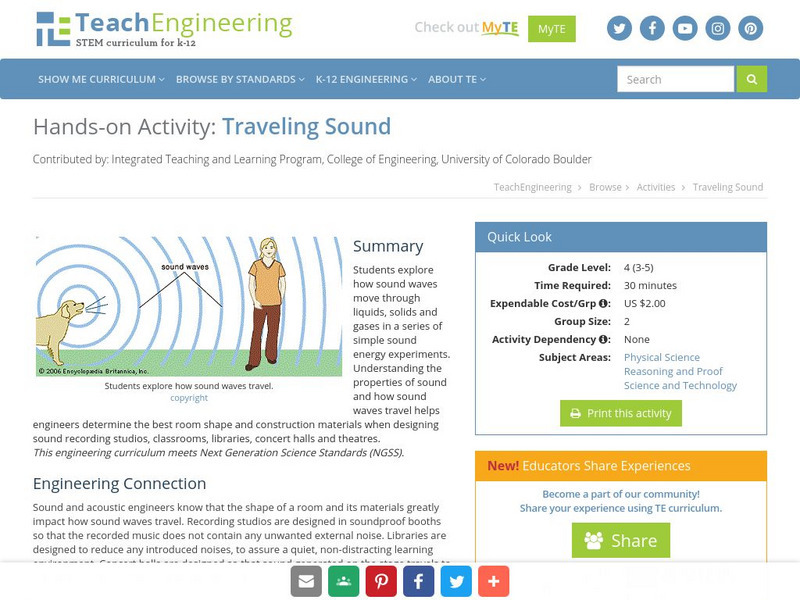
Teach Engineering: Traveling Sound
Students explore how sound waves move through liquids, solids and gases in a series of simple sound energy experiments. Understanding the properties of sound and how sound waves travel helps engineers determine the best room shape and...

American Association of Physics Teachers
Com Padre Digital Library: Open Source Physics: Quartic Oscillator Model
A model showing the movement of a bead on a horizontal rod, with symmetric springs on each side. A phase-space chart is shown alongside the model.
TeachEngineering
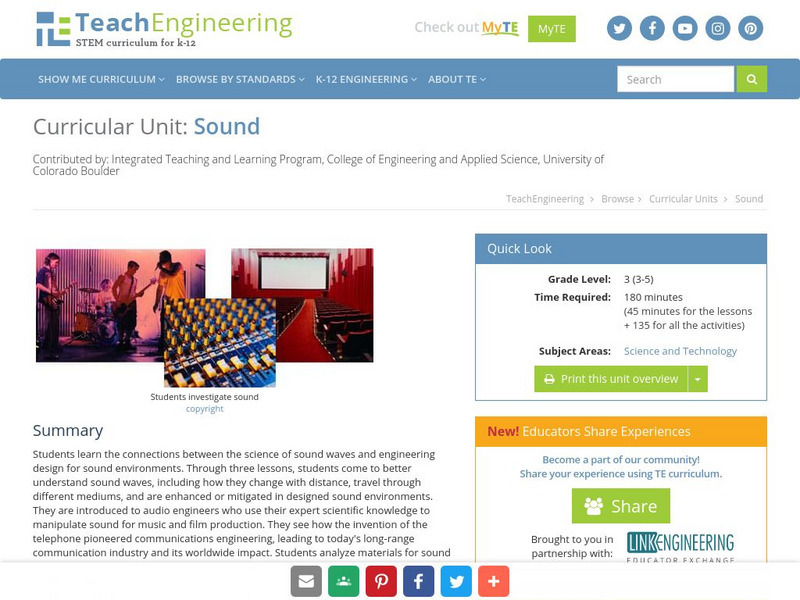
Teach Engineering: Sound
Students learn the connections between the science of sound waves and engineering design for sound environments. Through three lessons, students come to better understand sound waves, including how they change with distance, travel...
Georgia State University
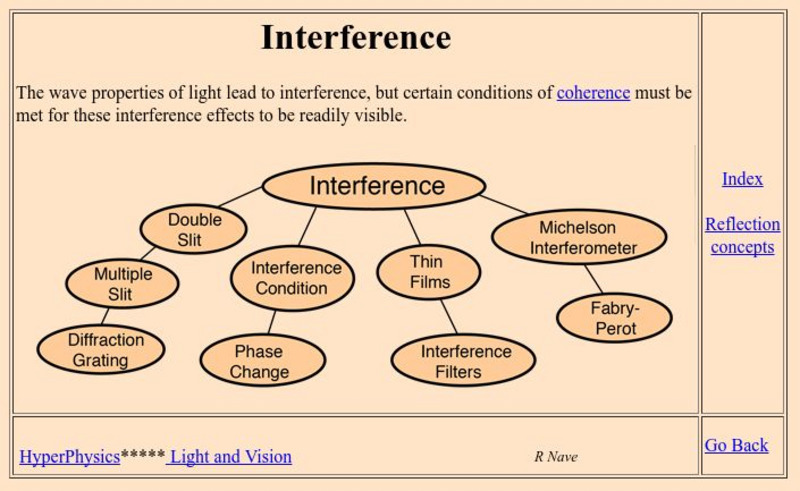
Georgia State University: Hyper Physics: Interference
An indexing page for a physics department site about the wave properties of light that lead to interference.

Scholastic
Scholastic: Study Jams! Science: Energy, Light and Sound: Sound
A video and a short quiz on how sound travels in waves, its properties, and how to measure it.
TeachEngineering
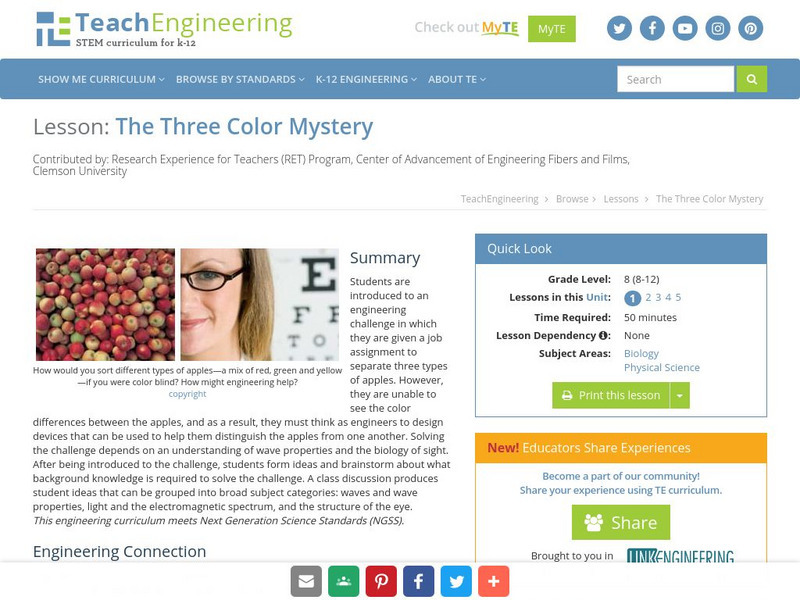
Teach Engineering: The Three Color Mystery
Students are introduced to an engineering challenge in which they are given a job assignment to separate three types of apples. However, they are unable to see the color differences between the apples, and as a result, they must think as...
Learning Wave Communications
Learning Wave: Distributive Property
The distributive property is demonstrated in a detailed example. A sample problem is provided for students to check for understanding.
CK-12 Foundation
Ck 12: Photoelectric Effect
[Free Registration/Login may be required to access all resource tools.] Students will understand the photoelectric effect and that light has both particle and wave properties. Includes a simulation for exploring the photoelectric effect.
Nobel Media AB
The Nobel Prize: Otto Stern Biographical
This is a brief biography on the life and scientific work of Otto Stern, a physicist honored with the Nobel Prize in physics for his "development of the molecular ray method and his discovery of the magnetic moment of the proton."
Physics Central
Physics Central: Physics at Your Desk: Drumming Fingers
An easy experiment through which students explore sound waves while tapping their fingers on a desk or table in a quiet room.
Museum of Science
The Atom's Family: Radiometer
Help Dracula find out about light waves by using a virtual radiometer.
American Association of Physics Teachers
Com Padre Digital Library: Open Source Physics: Oscillator Chain Model
In this simulation a series of coupled oscillators in a chain with anchored ends can be investigated for their wave properties.

NASA
Nasa: Beginner's Guide to Aerodynamics
Includes exhaustive information and a wealth of activities pertaining to aerodynamics and the physics of flight.
TeachEngineering
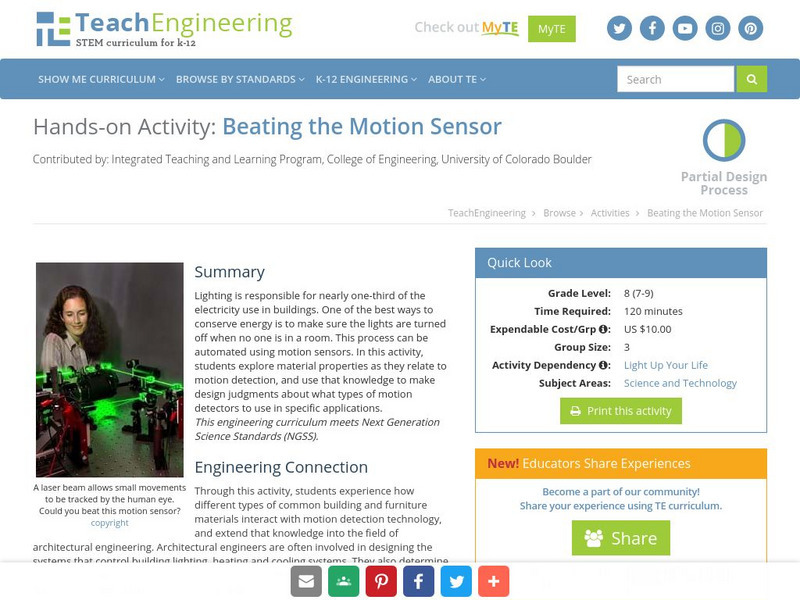
Teach Engineering: Beating the Motion Sensor
Lighting is responsible for nearly one-third of the electricity use in buildings. One of the best ways to conserve energy is to make sure the lights are turned off when no one is in a room. This process can be automated using motion...
Science Museum, London
Science Museum: Online Stuff: Atomic Firsts
Read about three famous British atomic physicists, each of whom won a Nobel Prize. J.J. Thompson discovered the electron, Ernest Rutherford successfully split an atom, and George Paget Thomson proved that electrons had wave-like properties.
Science and Mathematics Initiative for Learning Enhancement (SMILE)
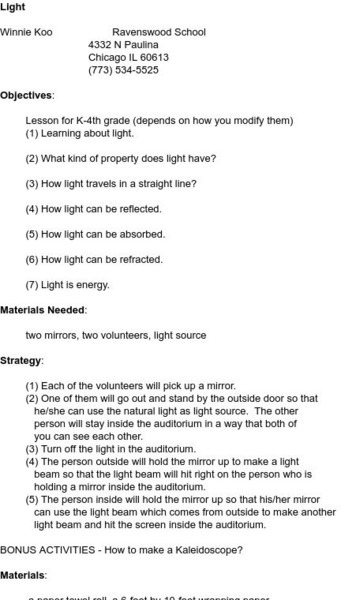
Smile: Light (K 4)
This site provides two activities that young scholars can do in class. One uses mirrors to reflect light beams whole another is making a kaleidescope.
Other
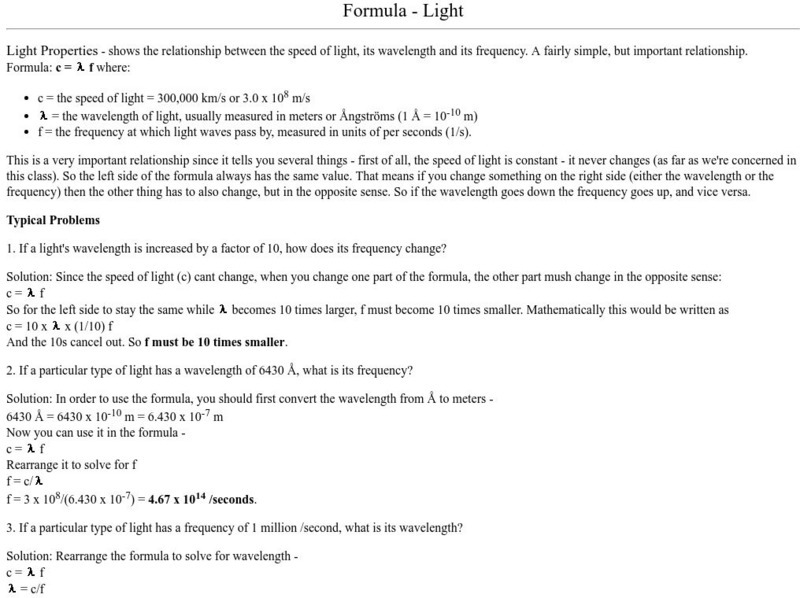
Uni: Astronomy: Formula Light
Learn about light properties through practice with formulas. This resource shows the relationship between the speed of light, its wavelength, and its frequency. A fairly simple, but important relationship.
Concord Consortium
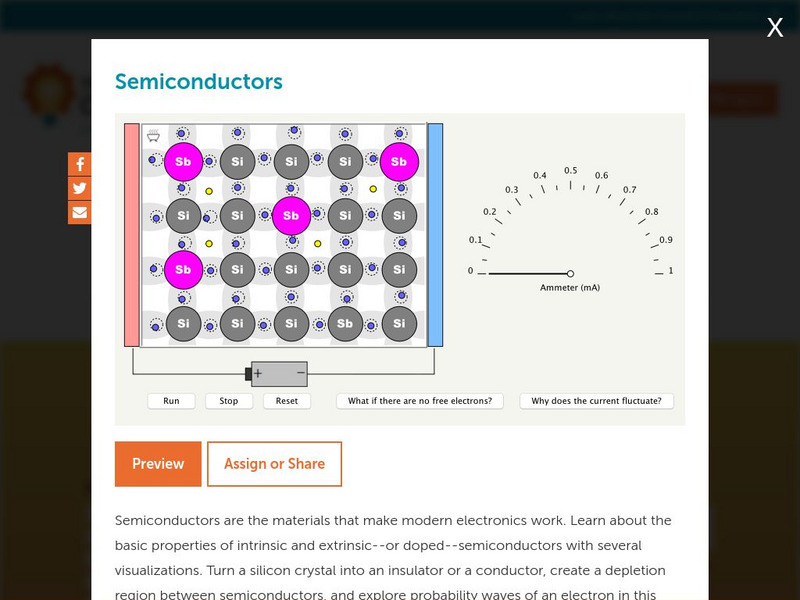
Concord Consortium: Semiconductors
Semiconductors are the materials that make modern electronics work. Learn about the basic properties of intrinsic and extrinsic- or doped- semiconductors with several visualizations. Turn a silicon crystal into an insulator or a...

Concord Consortium
Concord Consortium: Stem Resources: Semiconductors
Several visualizations that help students understand the basic properties of semiconductors. Students can turn a silicon crystal into an insulator or a conductor, investigate the probability waves of an electron, and make a depletion...