Hi, what do you want to do?






Museum of Science
Museum of Science and Industry, Chicago: Activities: Build a Roller Coaster
Build the roller coaster, then keep making adjustments to see how it affects the potential and kinetic energy of the marble along its tracks.
Discovery Education
Discovery Education: The Ultimate Roller Coaster Contest
Students design and build a three hill "tennis ball" roller coaster made of cardboard. During the design and building process, students explore the concepts of potential and kinetic energy and how they change as the roller coaster...

Science Buddies
Science Buddies: Put Your Water to Work: Using Hydropower to Lift a Load
Water creates a lot of energy, just look at the Grand Canyon. In this science fair project, you will demonstrate the power of water by converting the kinetic energy in moving water to mechanical energy, which will lift a small weight.

University of Colorado
University of Colorado: Ph Et Interactive Simulations: Masses & Springs
Hang various mass weights on spring scales while you adjust the spring stiffness and damping in this online activity. Slow down the action, take it to another planet, or watch the amount of potential, thermal, and kinetic energy.

Center of Science and Industry
Cosi Columbus: Rubberband Rollback
A simple experiment that explores potential and kinetic energy involving the use of a can, a rubber band, some washers, and other everyday materials. Discover why the can rolls forward, then back.

TED Talks
Ted: Ted Ed: All of the Energy in the Universe Is
The energy in the universe never increases or decreases- but it does move around a lot. Energy can be potential or kinetic. George Zaidan and Charles Morton get excited about energy. [3:52]
TeachEngineering
Teach Engineering: It's Tiggerific!
In Lesson 3, as part of the Research and Revise step, students investigate potential energy held within springs (elastic potential energy). Class begins with a video of either spring shoes or bungee jumping. Students then move on into...
TeachEngineering
Teach Engineering: Move It!
Mechanical energy is the most easily understood form of energy for students. When there is mechanical energy involved, something moves. Mechanical energy is a very important concept to understand. Engineers need to know what happens when...

TeachEngineering
Teach Engineering: Falling Water
Students drop water from different heights to demonstrate the conversion of water's potential energy to kinetic energy. They see how varying the height from which water is dropped affects the splash size. They follow good experiment...
Science Buddies
Science Buddies: Balloon Car
Students will design, build, and race balloon-powered cars in this fun instructional activity that teaches about engineering design and kinetic and potential energy.
CK-12 Foundation
Ck 12: Potential Energy
[Free Registration/Login may be required to access all resource tools.] Students explore the differences between kinetic and potential energy, and understand how they are dependent on each other.
Vision Learning
Visionlearning: General Science: Energy: An Introduction
Instructional module focusing on energy. Discussion includes forms of energy, conservation of energy, and the laws of thermodynamics. Site also includes an interactive practice quiz and links relating to the topic.
Science Education Resource Center at Carleton College
Serc: Exploring Energy Conservation With Rulers and Cars
In this lab, students will investigate the law of conservation of energy. The lab is designed as something of an open, hands-on assessment where students demonstrate how to maximize the conversion of potential energy into kinetic energy.
BBC
Bbc: Gcse Bitesize: Changes in Energy Stores
Energy can be described as being in different "stores". It cannot be created or destroyed but it can be transferred, dissipated or stored in different ways. There are seven main stores of energy: magnetic, internal (thermal), chemical,...
Physics Aviary
Physics Aviary: Energy Transformations
This lab is designed to have students investigate the transformations that occur when elastic potential energy is converted to kinetic energy. Students will be able to modify the mass of the object, the spring constant of the spring and...

Open Curriculum
Open Curriculum: Simplifying the Energy Zoo
Physics students find out how to effectively define and clarify kinetic and potential energy.
Physics Classroom
The Physics Classroom: Work and Energy: Energy Transformation on Roller Coasters
Using a roller coaster as an example, the transformation of mechanical energy from the form of potential to the form of kinetic and vice versa is explained and illustrated in the animation.
CK-12 Foundation
Ck 12: Physics Simulation: Power and Efficiency Simulation
Explore kinetic and potential energy by towing objects up a frictionless slope.
Physics Classroom
The Physics Classroom: Work and Energy: How High Will It Go?
This animation depicts the motion of a young child sliding across the snow on a sled. Students can analyze the work and energy involved in this scenario.
FT Exploring
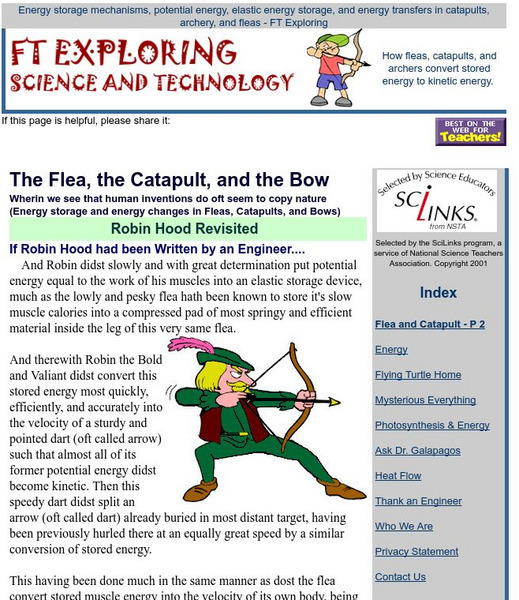
Ft Exploring: The Flea, the Catapult, and the Bow: Robin Hood Revisited
Find out how fleas, catapults, and archers convert stored energy into kinetic energy.
Texas Education Agency
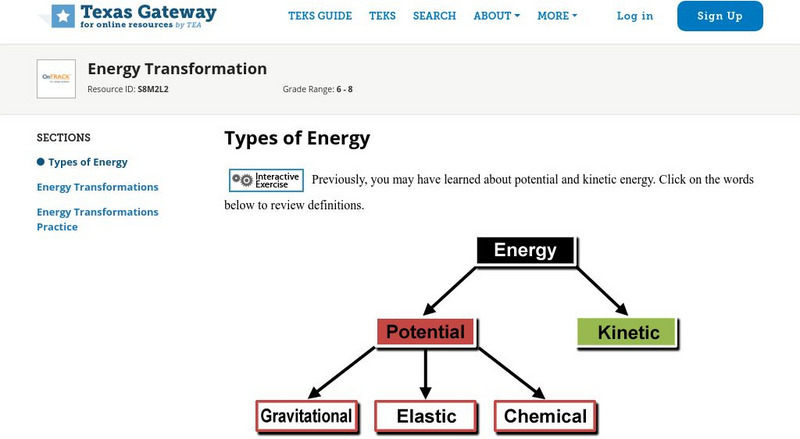
Texas Gateway: Types of Energy
This interactive tutorial provides a brief review of the 2 types of energy and an explanation of the law of of conservation of energy.
US Energy Information Administration
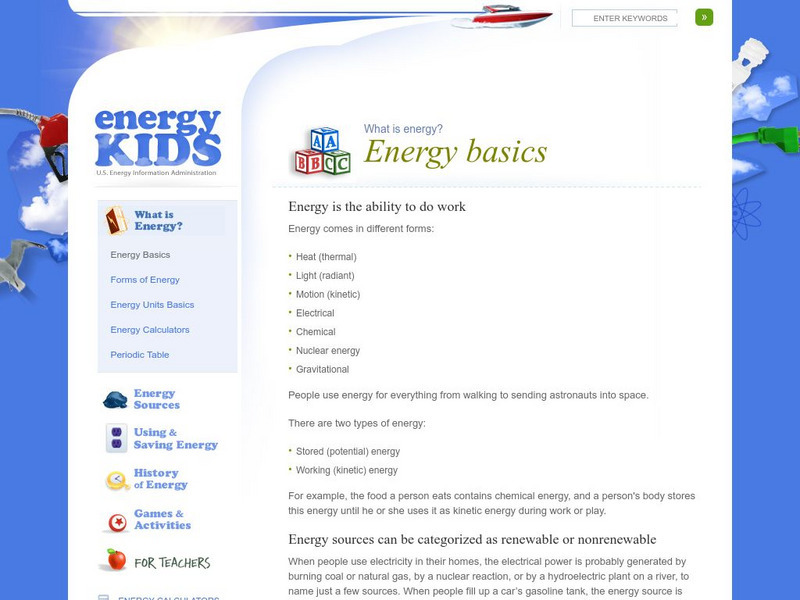
U.s. Eia Energy Kids: Energy Basics
Learn about the definition of energy, the forms that it comes in, and the difference between renewable and nonrenewable sources.
TeachEngineering
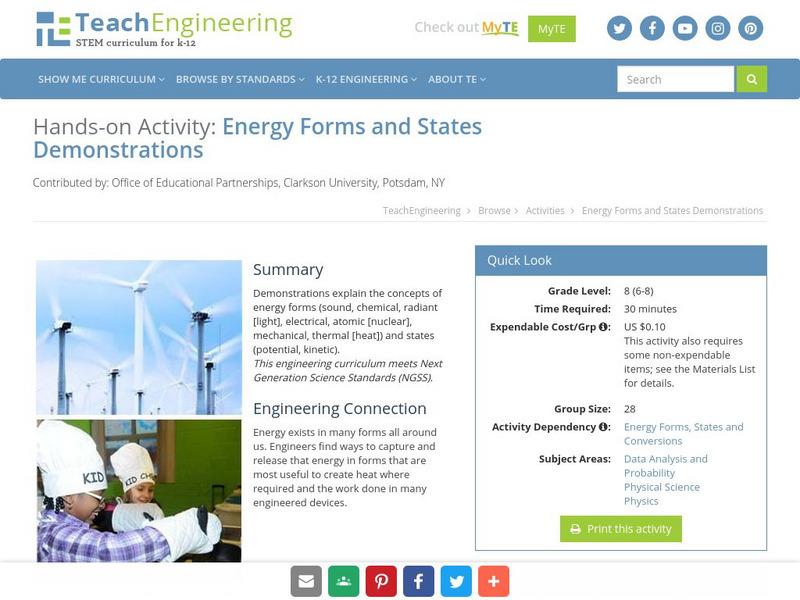
Teach Engineering: Energy Forms and States Demonstrations
Demonstrations explain the concepts of energy forms (sound, chemical, radiant [light], electrical, atomic [nuclear], mechanical, thermal [heat]) and states (potential, kinetic).

E-learning for Kids
E Learning for Kids: Science: Pirates: What Is Energy Conversion?
This lesson covers the different types of energy, the definitions of kinetic and potential energy, how energy can be converted into different forms, and the law of conservation of energy.