Hi, what do you want to do?






PBS
Pbs Learning Media: La'ona De Wilde: Environmental Biologist
In this video profile produced for Teachers' Domain, meet La'ona DeWilde, an environmental biologist who integrates her Athabascan heritage and her Western scientific training to help remote Alaskan villages address environmental issues.
Georgia Department of Education
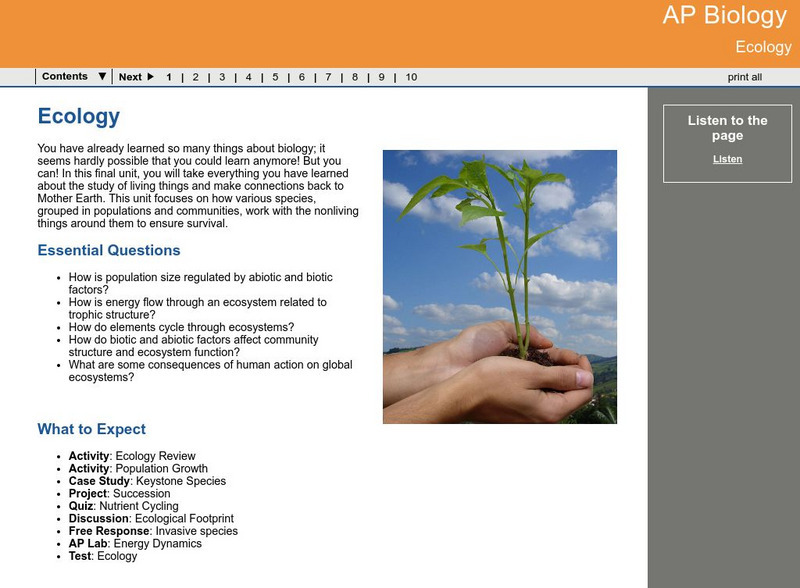
Ga Virtual Learning: Ap Biology: Ecology
Students review the study of living things and make connections back to Earth's systems. This unit focuses on how various species, grouped in populations and communities, work with the nonliving things around them to ensure survival.
Texas Education Agency
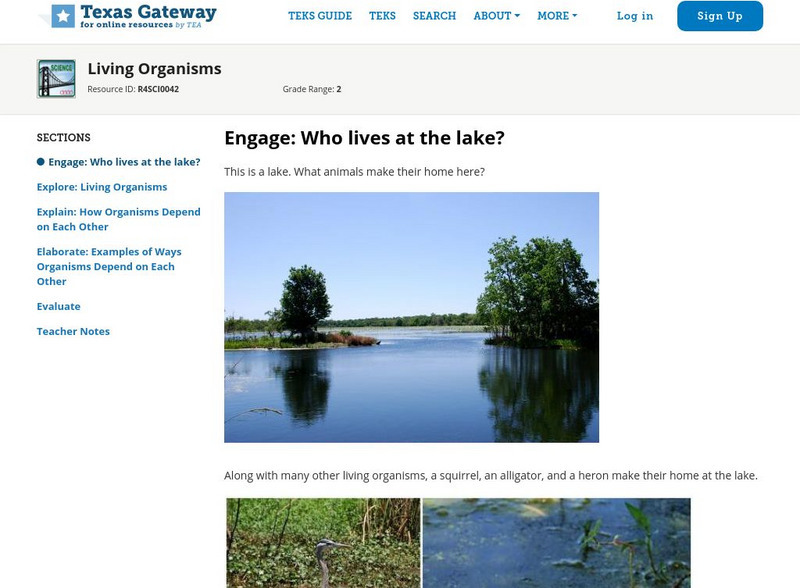
Texas Gateway: Living Organisms
Guide your students through a learning module about living organisms in a lake environment.
Utah Education Network
Uen: Human Settlement and Geography
Learn why people live in places with lots of people.
Sophia Learning
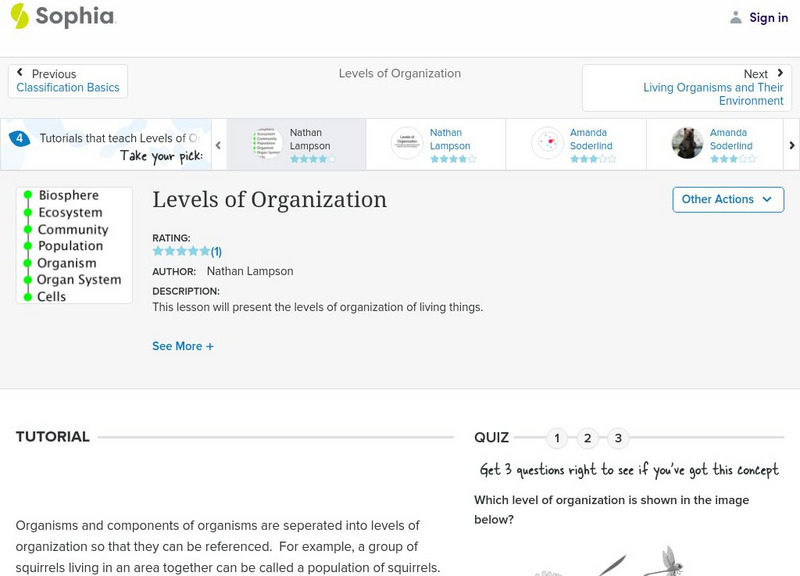
Sophia: Levels of Organization: Lesson 5
This lesson will present the levels of organization of living things. It is 5 of 6 in the series titled "Levels of Organization."
Sophia Learning
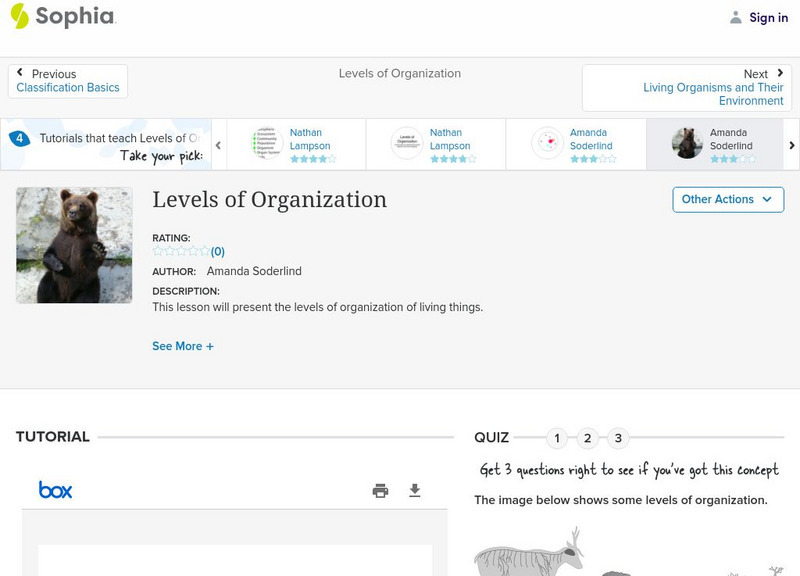
Sophia: Levels of Organization: Lesson 6
This lesson will present the levels of organization of living things. It is 6 of 6 in the series titled "Levels of Organization."
BBC
Bbc: Gcse Bitesize: Adaptations, Interdependence and Competition Aqa
The abundance and distribution of organisms in an ecosystem is determined by biotic and abiotic factors. Animals and plants have adaptations to allow them to compete for resources.
National Association of Geoscience Teachers
Nagt: From Creeks to the Classroom: Gone Fishin'
Gone Fishin allows participants to become the captain of a fishing boat, competing for fishery resources. Students discover that if they don't set fishing limits and monitor the fish population, soon there are no fish left in the ocean.

Read Works
Read Works: They're Back
[Free Registration/Login Required] An informational text about the increasing population of the endangered gray wolf. A question sheet is available to help students build skills in reading comprehension.
CommonLit
Common Lit: Book Pairings: "World Without Fish" by Mark Kurlansky
Selected (8) reading passages (grades 6-10) to pair with "World Without Fish" by Mark Kurlansky. Mark Kurlansky discusses how humans treat the oceans and the fish that live in them, and what the world will likely look like if fish...
Sophia Learning
Sophia: Human Activity: Lesson 2
This lesson will describe how human activity can impact a natural ecosystem. It is 2 of 4 in the series titled "Human Activity."
Concord Consortium
Concord Consortium: Stem Resources: Variations and Adaptations
Experiment with variations in grass to see which size grows best with different amounts of water. Understand that grass that can live in different levels and change to its environment has a better chance of surviving. Also, experiment...

Sophia Learning
Sophia: Human Activity: Lesson 3
This lesson will describe how human activity can impact a natural ecosystem. It is 3 of 4 in the series titled "Human Activity."

Sophia Learning
Sophia: Human Activity: Lesson 4
This lesson will describe how human activity can impact a natural ecosystem. It is 4 of 4 in the series titled "Human Activity."
Curated OER
Virginia Population Density
Although this site talks about regions in Virginia, it offers excellent information on regions in general, for example, ways regions might be classified; by population density, geology, watershed, ecosystem, economy, transportation,...
Other
Explore Learning: Food Chain Gizmo
In this ecosystem consisting of hawks, snakes, rabbits and grass, the population of each species can be studied as part of a food chain. Disease can be introduced for any species, and the number of animals can be increased or decreased...
BSCS Science Learning
Bscs: Restoring Oyster Reefs
After learning about the role of oysters in an estuary ecosystem and a population decline that oysters have faced over time from overharvesting and pollution, learners work with data to determine where are ideal sites for restoring...
BSCS Science Learning
Bscs: Restoring Oyster Reefs
After learning about the role of oysters in an estuary ecosystem and a population decline that oysters have faced over time from overharvesting and pollution, young scholars work with data to determine where are ideal sites for restoring...
TED Talks
Ted: Ted Ed: From the Top of the Food Chain Down: Rewilding Our World
Our planet was once populated by megafauna, big top-of-the-food-chain predators that played their part in balancing our ecosystems. When those megafauna disappear, the result is a "trophic cascade," where every part of the ecosystem...

Other
The Sustainable Scale Project: Ecological Footprint
The Ecological Footprint is rooted in the fact that all renewable resources come from the earth. It accounts for the flows of energy and matter to and from any defined economy and converts these into the corresponding land/water area...
Curated OER
Unesco: Cameroon: Sangha Trinational
Situated in the north-western Congo Basin, where Cameroon, Central African Republic and Congo meet, the site encompasses three contiguous national parks totalling around 750,000 ha. Much of the site is unaffected by human activity and...
Curated OER
Unesco: China: Huanglong Scenic and Historic Interest Area
Situated in the north-west of Sichaun Province, the Huanglong valley is made up of snow-capped peaks and the easternmost of all the Chinese glaciers. In addition to its mountain landscape, diverse forest ecosystems can be found, as well...
Curated OER
Unesco: United States of America: Olympic National Park
Located in the north-west of Washington State, Olympic National Park is renowned for the diversity of its ecosystems. Glacier-clad peaks interspersed with extensive alpine meadows are surrounded by an extensive old growth forest, among...