Hi, what do you want to do?





CK-12 Foundation
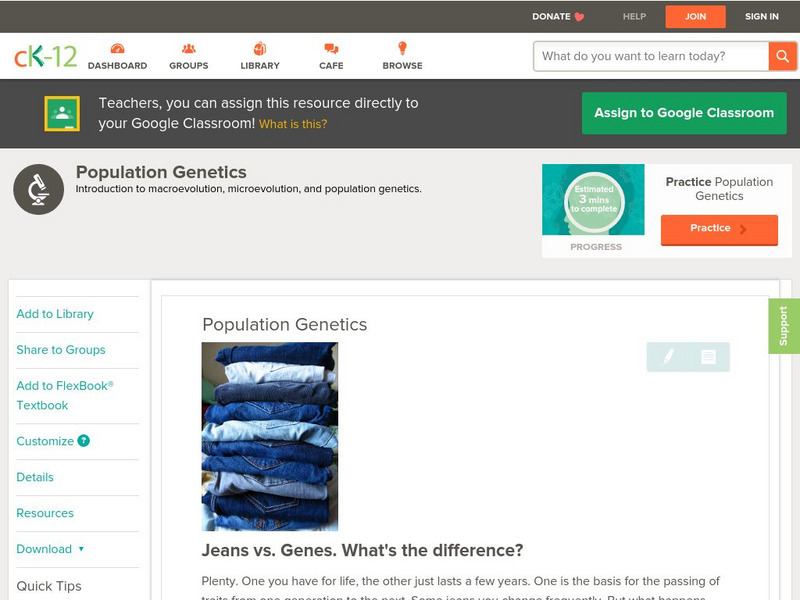
Ck 12: Biology: Population Genetics
[Free Registration/Login may be required to access all resource tools.] Introduction to macroevolution, microevolution, and population genetics.
CK-12 Foundation
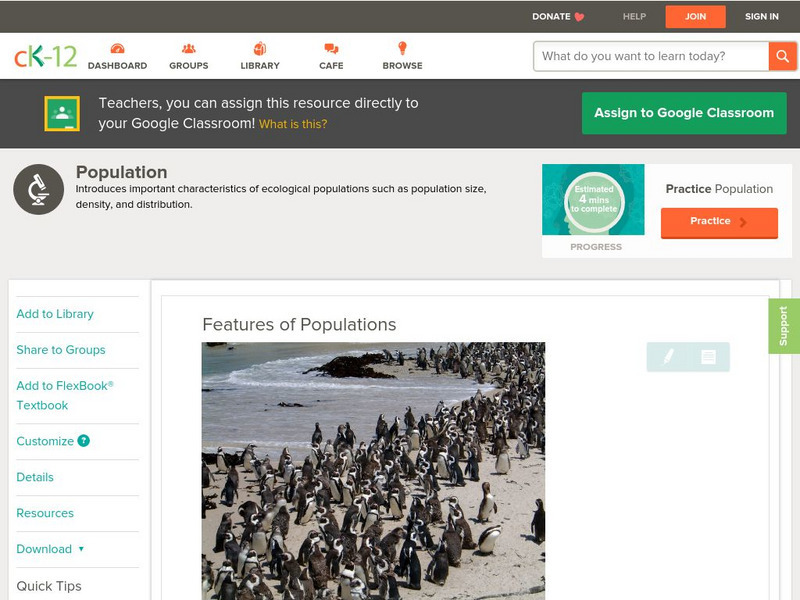
Ck 12: Life Science: Features of Populations
[Free Registration/Login may be required to access all resource tools.] A population is a group of organisms of the same species, all living in the same area and interacting with each other. Since they live together in one area, members...
CK-12 Foundation
Ck 12: Biology: Forces of Evolution
[Free Registration/Login may be required to access all resource tools.] Describes three of the four forces of evolution: mutation, gene flow, and genetic drift.
TED Talks
Ted: Ted Ed: Why Are Some People Left Handed?
Today, about one-tenth of the world's population are southpaws. Why are such a small proportion of people left-handed -- and why does the trait exist in the first place? The following video investigates how the uneven ratio of lefties...
CK-12 Foundation
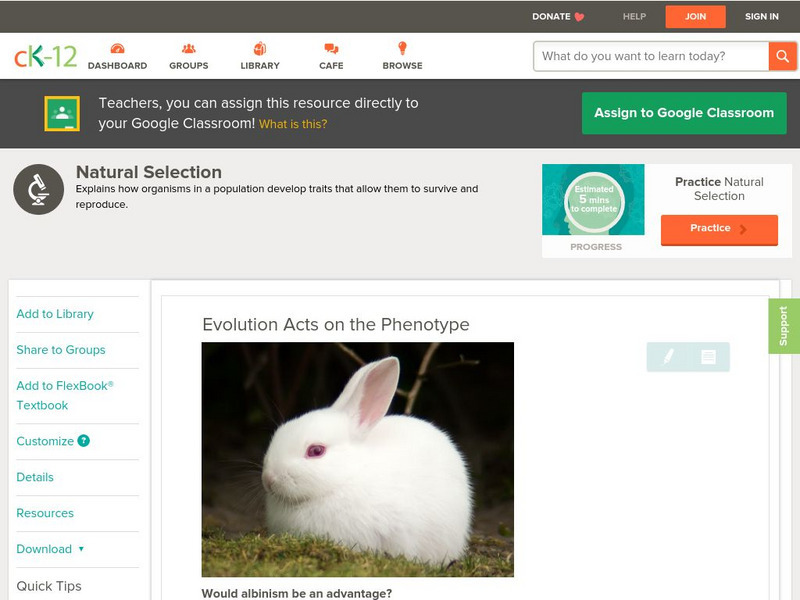
Ck 12: Life Science: Evolution Acts on the Phenotype
[Free Registration/Login may be required to access all resource tools.] Natural selection acts on the phenotype (traits or characteristics) of an individual. On the other hand, natural selection does not act on the underlying genotype...
CK-12 Foundation
Ck 12: Biology: Hardy Weinberg Theorem
[Free Registration/Login may be required to access all resource tools.] Introduces Hardy-Weinberg equilibrium.
CK-12 Foundation
Ck 12: Biology: Hardy Weinberg Theorem
[Free Registration/Login may be required to access all resource tools.] Introduces Hardy-Weinberg equilibrium.
Concord Consortium
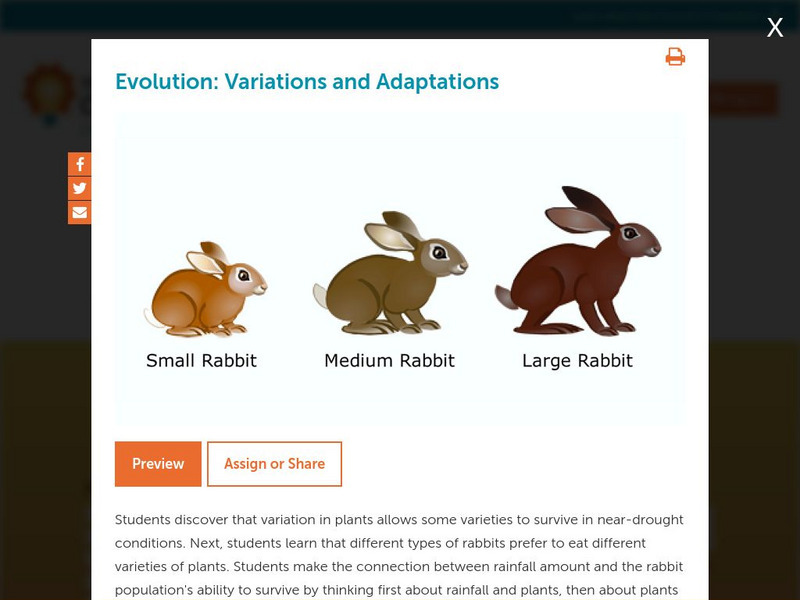
Concord Consortium: Evolution: Variations and Adaptations
Students discover that variation in plants allows some varieties to survive in near-drought conditions. Next, students learn that different types of rabbits prefer to eat different varieties of plants. Students make the connection...
Other popular searches
- Population Genetics 11 Grade
- Population Genetics Bunnies
- Population Genetics Lab
- Population Genetics Rabbit