Hi, what do you want to do?





CK-12 Foundation
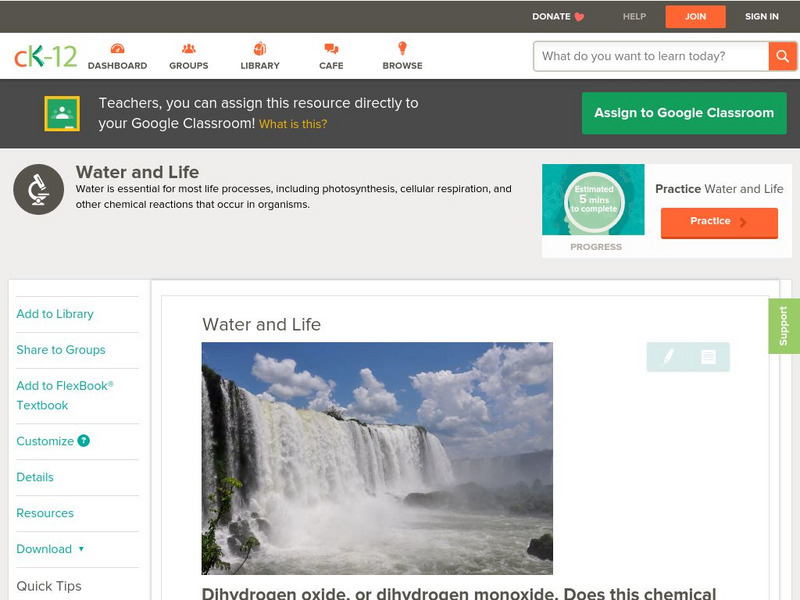
Ck 12: Biology: Water and Life
[Free Registration/Login may be required to access all resource tools.] Covers the structure and properties of water.
CK-12 Foundation
Ck 12: General Chemistry
[Free Registration/Login may be required to access all resource tools.] Students will be introduced to some of the basic concepts of chemistry.

Concord Consortium
Concord Consortium: What Happens to the Energy of Water Molecules During Hurricanes?
Activity 2 investigates How Hot Can Water Get? In Activity 2 students analyze the relationship between energy changes and phrase changes as they discuss what happens when water boils. Bonus reading includes Why is Temperature Constant...
Science Buddies
Science Buddies: Study Chirality With a Homemade Polarimeter
Some molecules can be either left- or right-"handed." The left- and right-handed molecules have the same number and type of atoms, and their chemical structures look identical, but they are actually mirror images of each other. Many...
TeachEngineering
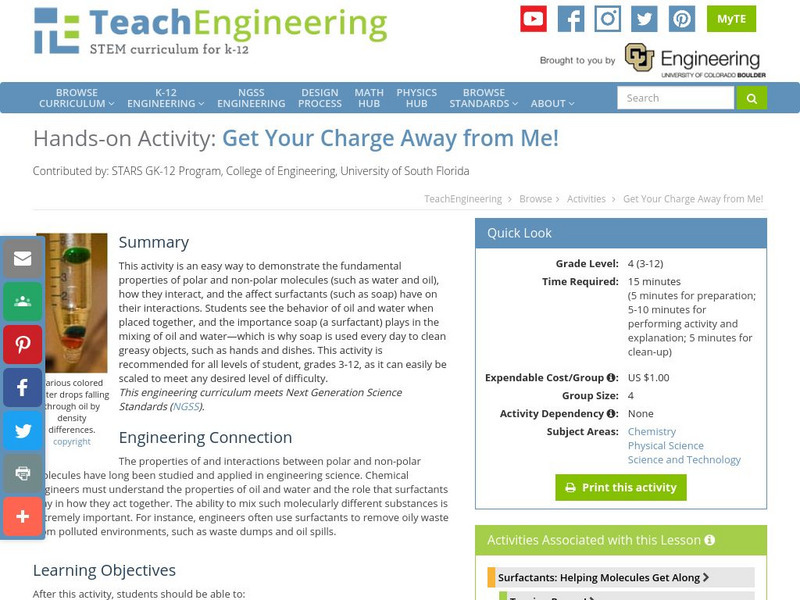
Teach Engineering: Get Your Charge Away From Me!
This activity is an easy way to demonstrate the fundamental properties of polar and non-polar molecules (such as water and oil), how they interact, and the affect surfactants (such as soap) have on their interactions. Students see the...
American Chemical Society
Middle School Chemistry: Lesson Plans: Why Does Water Dissolve Salt?
Young scholars use their own model of a salt crystal and water molecule to show how water dissolves salt. Then, they relate their observations to the structure of salt, water, and alcohol on the molecular level.
American Chemical Society
Middle School Chemistry: Lesson Plans: Why Does Water Dissolve Sugar?
Lesson plan in which students design an experiment to determine if different types of liquids affect the amount of dissolution of an M&M candy shell.

Concord Consortium
Concord Consortium: Stem Resources: Molecular Self Assembly
A series of science simulations exploring how molecules assemble themselves and how scientists are learning to engineer their structure. Students will discover what patterns molecules form with interactive lessons. At the end there is a...
Concord Consortium
Concord Consortium: Protein Folding
Generate all polar, all nonpolar, or random proteins and observe how the protein folds in response to these molecular properties. Explore how the potential energy of the system changes over time to draw conclusions about how proteins...
Concord Consortium
How Are Interactions With Water Important for Maintaining My Life?
An investigation of how polar and nonpolar interactions affect shapes of biological molecules and their function. Modules explore the following: 1. Why don't oil and water mix? 2. Can a substance dissolve in both a nonpolar and a polar...
CK-12 Foundation
Ck 12: Chemistry Simulation: Soap
[Free Registration/Login Required] Learn the chemistry behind the ability of soap molecules to remove stains from clothing. The amphipathic nature of soap molecules is highlighted.

University of Southern California
Atomic Bonds
This slide show on atomic bonds contains several slides on electron affinity. Other topics include covalent, Sigma and Pi bonds, and atomic bonding in solids.
American Chemical Society
Middle School Chemistry: Can Liquids Dissolve in Water?
Find out if liquids can dissolve in water.

Concord Consortium
Concord Consortium: Stem Resources: Protein Partnering and Function
A learning module with built-in interactive features where students can read about the differences between large and small molecules, build protein structures, and test their strength under different conditions. They will review polarity...

Concord Consortium
Concord Consortium: Stem Resources: Seeing Intermolecular Attractions
This simple interactive tool lets students explore the forces of attraction between polar and non-polar molecules.