Hi, what do you want to do?






Teach Engineering
Glowing Flowers
What a bright idea! Young scientists conduct an experiment on flowers to finish the last of a six-lesson unit on Cells. Putting the stems into dye-injected water and leaving it overnight results in flowers that glow. This is to simulate...

Curated OER
Pollination of Flowers by Moths
Turn your classroom into a pollination station as your kids transform into moths or predators trying to survive and aiding in plant reproduction along the way. Using silent party blowers as proboscises, the moths will have two minutes to...

Curated OER
Bee Pollen Popular
The world would be a much different place without the help of pollinators. Read about the important role bats, hummingbirds, and various insects play in plant reproduction, exploring the interdependence of living things in an ecosystem....

PBS
Season Seeking
It's a time of change. A hands-on activity engages young scientists in a lesson highlighting the change of seasons. They brainstorm indicators of season changes in nature and then look for them. Next, they record observations in a field...

Howard Hughes Medical Institute
Seed Dispersal in Tropical Forests
How do seeds get around? It's not like plants can control seed dispersal—or can they? Dig deeper into the amazing mechanisms of seed dispersal observed in tropical plants through interactives, a video, and plenty of hands-on data...

Teach Engineering
Design Inspired by Nature
Let nature guide your engineering designs. By taking apart a flower, pupils learn about reverse engineering. They use the results to brainstorm designs for new products or ideas. This is the seventh installment of a nine-part Life...

The New York Times
Trouble in the Hive: Researching the Decimation of Honeybee Colonies
Teach your class about colony collapse disorder and foster discussion about causes and solutions for the honeybee problem. Class members read and discuss an article and participate in one of two detailed activities about pollination and...

PBS
Reading Adventure Pack: Bees
A Reading Adventure pack explores the busy life of bees. After reading a fiction and nonfiction text, scholars complete three hands-on activities. Participants invent a robot that can do the work of bees, cheers to hardworking bees with...

New South Wales Department of Education
Plant Groups
Bryophytes can grow in temperatures just above zero degrees. This 17th installment in a series of 20 introduces learners to the five groups of plants: algae, bryophytes, pteridophytes, gymnosperms, and angiosperms. Classes then explore...

New South Wales Department of Education
Plant Features
Pine needles are actually modified leaves. In the 16th installment of 20, young scientists explore plants. Through an analysis of leaves — shape, veins, and edges — pupils see how to classify plants based on structural features.

New South Wales Department of Education
History of Plant Classification
Bamboo, the fastest growing plant in the world, can grow up to 35 inches in one day! Pupils learn how plants historically have been classified and determine if these traits are appropriate to use in this 17th lesson of 20. They will also...

Curated OER
Caribbean Garden
Students investigate plant life by creating an art project. In this arts and crafts lesson, students identify several different native Caribbean plants such as guava, ginger, mahogany and hibiscus. Students create plants...

Curated OER
Sock Walk (Seed Dispersal)
Students collect seeds from field plants as part of understanding seed dispersal.

University of Illinois
University of Illinois Extension: The Great Plant Escape Parts of a Seed
Help Detective Le Plant discover how a seed grows into a plant. Students will learn to describe a seed's structure and what's needed for seed growth.
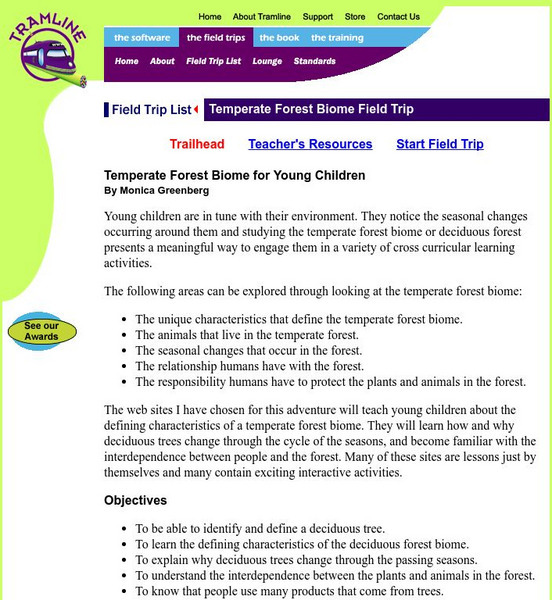
Tramline
Virtual Field Trip: Temperate Forest Biome
Travel with your students on a Virtual Field Trip to learn about Temperate Forest Biomes. You will also discover many informative and interactive websites.