Hi, what do you want to do?






American Chemical Society
Norbert Rillieux, Thermodynamics and Chemical Engineering
The man who invented the earliest examples of chemical engineering was an American-born, French-educated, free man of color before the Civil War, and went on to translate Egyptian hieroglyphics. There is something of...

Other
Stratford Hall Plantation: General Robert E. Lee
This biography of Robert E. Lee is part of a larger site about the Lee family plantation, Stratford Hall. Read about his personal life before and after the war. Included are links to his farewell address and information about the horses...
Curated OER
National Park Service: Plantation Agriculture: Coastal Rice
Brief description of coastal rice plantations in the late 18th and early 19th centuries from the National Park Service.
Other
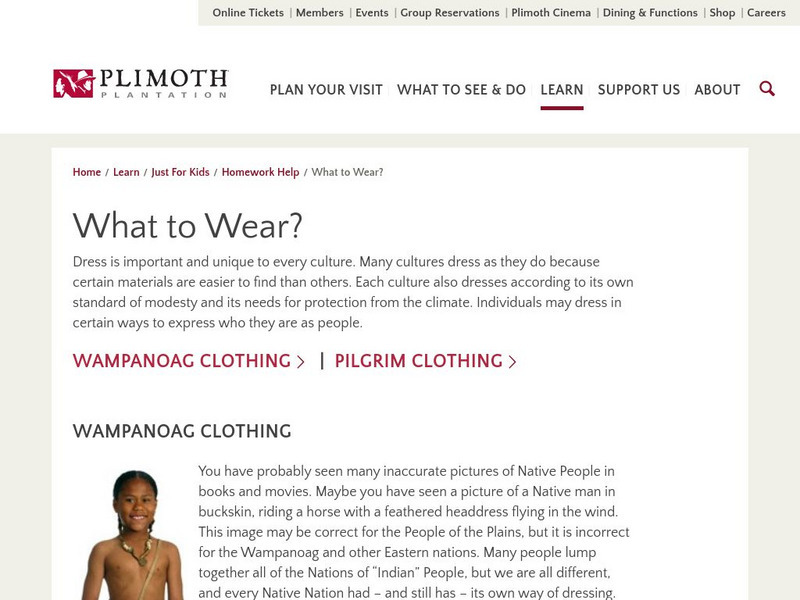
Plimoth Plantation: What to Wear?: Wampanoag and Pilgrim Clothing
Compare the clothing of the Wampanoag people with the English clothing of the Pilgrims in the 1600s. Photographs provide clear images of how they would have dressed.
Digital History
Digital History: Pre Civil War South
A comprehensive look at the economy of the South and the changes brought by the cotton gin. Read through five pages that discuss the economy, the tradition of the plantation, and the sectionalism that arises in this time period.
Other
Encyclopedia of Arkansas: Ethnic Groups Africian Americans
Perhaps one of the largest ethinc/cultural group to inhabit Arkansas are the African Americans. Follow their first arrival as slaves working the plantations through all the years toward emancipation, and into present times. Highly...
The History Cat
The History Cat: History of Colonial America: Jamestown Colony
Describes the struggles of the Jamestown Colony to survive in its first years. Many died from disease and starvation, and things only began to turn when the colonists started to grow tobacco. The use of indentured servants and later,...
The History Cat
The History Cat: Age of Exploration: The Columbian Exchange
A fascinating look at the exchanges that took place around the world after the Americas were discovered. This covered the gamut from diseases which wiped out 90% of the native peoples in North and South America, to farm animals, tools,...
The History Cat
The History Cat: Slavery in America
Discusses the growth of the slave trade to America, the experiences of slaves, the difference between indentured service and slavery, and how slaves were bought and sold at auction. Describes the lives of slaves, their homes, the...
British Library
British Library: Ireland: Propaganda and Plantations
A six-part site that relates the method England used to take over Ireland throughout the 16th century.
Other
Encyclopedia of Arkansas: Cotton Industry
Cotton has long been an important and successful part of the economy and history of Arkansas. This is an overview of the cotton industry from the early days of plantations, slaves, immigrant workers to today's productive source of...
National Women’s History Museum
National Women's History Museum: Angelina Grimke Weld
Although raised on a slave-owning plantation, Angelina Grimke Weld became an ardent abolitionist.
University of Virginia
American Historical Review: The Differences Slavery Made
An in-depth scholarly investigation on the differences slavery made in the shaping of societies in the North and South by using two similar communities, one north and one south of the Mason-Dixon Line.
Other
Encyclopedia of Arkansas: Ethnic Groups Italians
A variety of diverse cultures settled in Arkansas. The Italian migration and settlement in Arkansas over different time periods is the focus of this article.
PBS
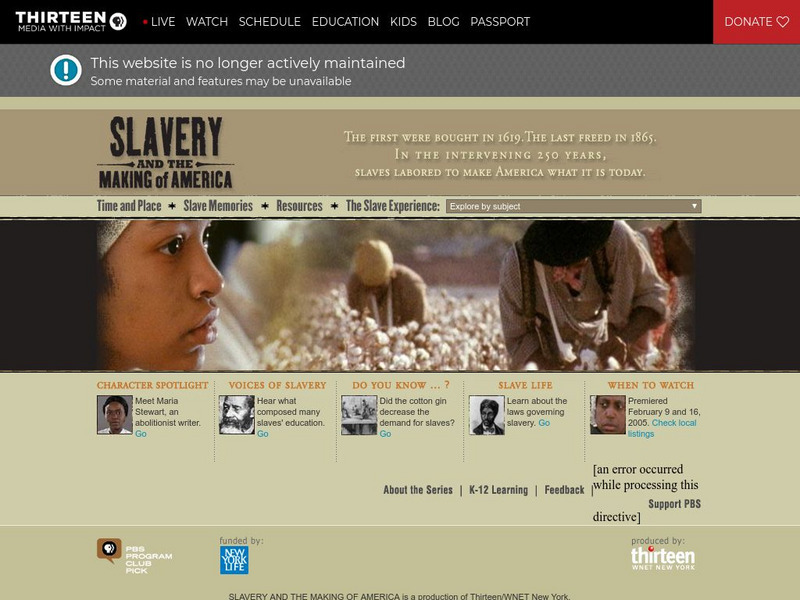
Wnet: Thirteen: Slavery & the Making of America
Using primary documents, oral histories, and other historical resources, discover how the arts of Africa, Europe, and pre-Civil War America influenced the culture of enslaved African Americans.
US Department of State
Bureau of International Information Programs: History Outline: Sectionalism
Article reviews several conditions of American society that sowed the seeds of civil war, particularly slavery and sectional conflict.
University of Groningen
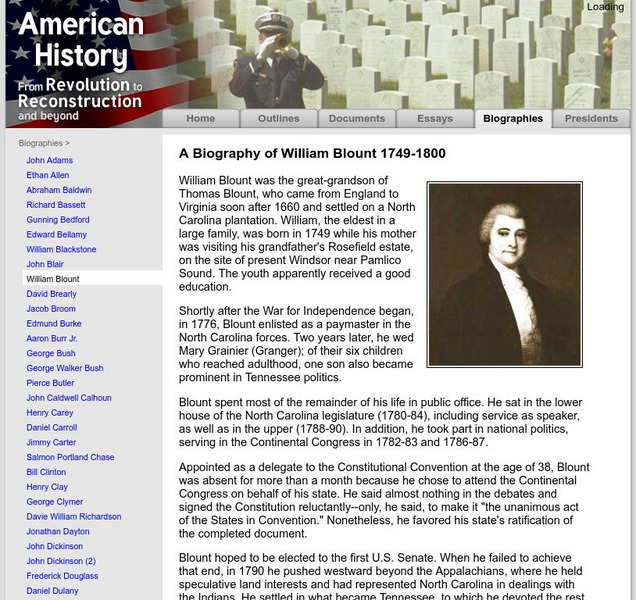
American History: Biographies: William Blount 1749 1800
William Blount was the great-grandson of Thomas Blount, who came from England to Virginia soon after 1660 and settled on a North Carolina plantation. William, the eldest in a large family, was born in 1749 while his mother was visiting...
University of Groningen
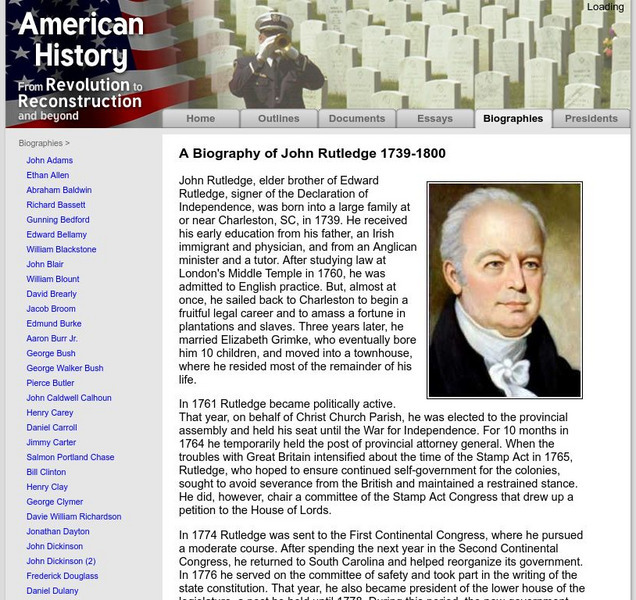
American History: Biographies: John Rutledge 1739 1800
John Rutledge, elder brother of Edward Rutledge, signer of the Declaration of Independence, was born into a large family at or near Charleston, SC, in 1739. He received his early education from his father, an Irish immigrant and...

Georgia Humanities Council and the University of Georgia Press.
New Georgia Encyclopedia: The Butler Family
An entry on the Butler family who owned large plantations on the Sea Islands. The "patriarch" was Pierce Butler who also served as a delegate to the Constitutional Convention.
Library of Congress
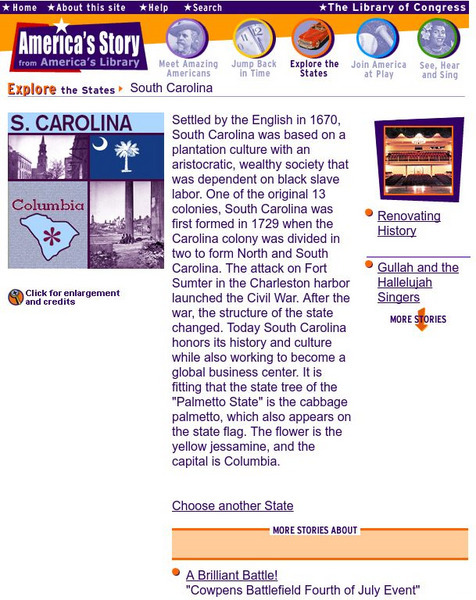
Loc: America's Story: South Carolina
Explore how South Carolina moved from a "plantation culture" in 1670 to a "growing research center and banking state" today. South Carolina played a major role in the Revolutionary War and the Civil War.

University of Groningen
American History: Outlines: Movement South and Westward
Following Eli Whitney's invention in 1793 of the cotton gin -- a machine that separated raw cotton from seeds and other waste -- the cotton market boomed. Planters in the South bought land from small farmers who frequently moved farther...
Curated OER
National Park Service: Resource Study: Charles Pinckney National Historic Site [Pdf]
A scholarly publication which examines the archaeological findings of Snee Farm, the plantation and house owned by Charles Pinckney, a delegate to the Constitutional Convention from South Carolina. Click on "Table of Contents" to get a...
University of Groningen
American History: Outlines: Colonial Economy
Whatever early colonial prosperity there was resulted from trapping and trading in furs. In addition, the fishing industry was a primary source of wealth in Massachusetts. But throughout the colonies, people relied primarily on small...

Georgia Humanities Council and the University of Georgia Press.
New Georgia Encyclopedia: Joel Chandler Harris (1845 1908)
The famous Uncle Remus folktales were retold by this writer. Site offers a biography of Harris, a brief discussion of the Uncle Remus tales, and a list of suggested readings.
Other popular searches
- Slavery and Plantations
- Southern Plantations
- Plantations Ireland
- Coffee Plantations
- Southern Colony Plantations
- Iron Plantations
- Cotton Plantations
- Colonial Plantations
- Louisiana Plantations
- Hawaii Sugar Plantations
- Rice Plantations
- Maryland Plantations