Hi, what do you want to do?






New South Wales Department of Education
History of Plant Classification
Bamboo, the fastest growing plant in the world, can grow up to 35 inches in one day! Pupils learn how plants historically have been classified and determine if these traits are appropriate to use in this 17th lesson of 20. They will also...

New South Wales Department of Education
Plant Features
Pine needles are actually modified leaves. In the 16th installment of 20, young scientists explore plants. Through an analysis of leaves — shape, veins, and edges — pupils see how to classify plants based on structural features.

New South Wales Department of Education
Plant Groups
Bryophytes can grow in temperatures just above zero degrees. This 17th installment in a series of 20 introduces learners to the five groups of plants: algae, bryophytes, pteridophytes, gymnosperms, and angiosperms. Classes then explore...

Foundation for Water & Energy Education
How Can Work Be Done with Water Power? Activity C
Third in a set of lessons regarding reservoirs, dams, and hydropower, this involves a two-day hydropower plant simulation. Collaborative groups build, maintain, and finance the plant. The transparency of the reservoir setup can be...

Teach Engineering
Glowing Flowers
What a bright idea! Young scientists conduct an experiment on flowers to finish the last of a six-lesson unit on Cells. Putting the stems into dye-injected water and leaving it overnight results in flowers that glow. This is to simulate...

Teach Engineering
Corn for Fuel?!
Can corn power the world? Young scientists learn about how corn and other plants can provide renewable biofuels in the second of nine lessons. They set up an experiment to investigate how different variables affect plant growth. All of...

Michigan Farm Bureau
The Little Red Hen
No one will be saying "Not I" with a lesson that combines The Little Red Hen with the life cycle of a wheat stem! After reading the story in your class, pass out wheat stems to your learners and have them examine the plants closely,...

Forest Foundation
The Nature of Trees
Young botanists examine the different parts of tress and then draw parallels between the functions of these parts and the function of parts of the human body.

Reading Resource
Flower Building Long Vowel Game
Reading can be as lovely as a walk through the garden! Sets of flowers host words that share long vowel sounds, which kids match to the correct flowerpots.

Horticultural Society of New York
Dress Up Your Salad
Salad dressings use a variety of different ingredients, but it's important to have a healthy balance of greens to create a delicious mix. Young chefs examine five types of herbs including chives, basil, dill, parsley, and thyme to...

Curated OER
Fruit Flowers
Make a fun and healthy snack to celebrate Earth Day! Included are the directions for making a flower out of strawberries, kiwi, mint leaves, and raspberry licorice. Just provide your class with the materials and watch them make edible...

Curated OER
Sock Walk (Seed Dispersal)
Students collect seeds from field plants as part of understanding seed dispersal.
Science Buddies
Science Buddies: Shoots: How Do Mint Plants Branch to Form New Stems?
Do you like to climb trees? The branches of trees are what make them so fun to climb. Each branch starts out as a tiny shoot that grows out from a stem. How is the growth of shoots along a stem regulated?
TeachEngineering
Teach Engineering: Plant Cycles: Photosynthesis & Transpiration
What do plants need? Students examine the effects of light and air on green plants, learning the processes of photosynthesis and transpiration. Student teams plant seeds, placing some in sunlight and others in darkness. They make...

Other
Atlas of Plant Anatomy
This impressive site provides a wealth of information on roots, stems, and leaves. To retrieve information, you simply pass the mouse over the photos and click the highlighted area to receive an explanation about the structure.
TeachEngineering
Teach Engineering: Water Desalination Plant
Students use a thermal process approach to design, build and test a small-scale desalination plant that is capable of significantly removing the salt content from a saltwater solution. Students use a saltwater circuit to test the...

Technovation
Curiosity Machine: Challenges: Build a Planting Machine
A challenge that asks students to build a machine that distributes seeds precisely. This site includes a lesson plan, tips, and a place to document their engineering design process.

Concord Consortium
Concord Consortium: Stem Resources: Photosynthesis
This activity introduces the concept of plant color being determined by pigments, which interactive with light. The idea that chlorophyll is used by plants for energy is then discussed, along with the first step of the photosynthetic...
Songs for Teaching
Roots, Stems, Leaves Song and Lyrics
Learn about the parts of a plant as you sing this catchy song. You can listen to others sing it, or sing along with the supplied lyrics. Songs help information "stick" with you!
TeachEngineering
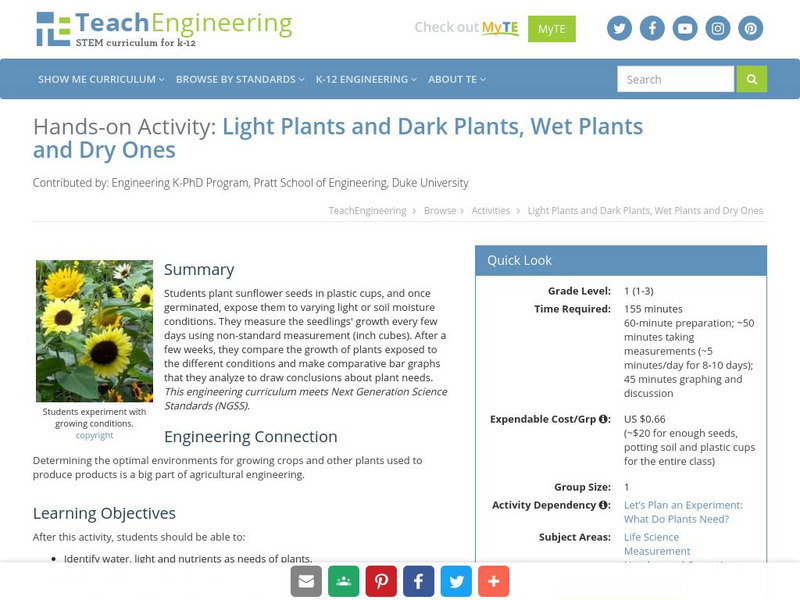
Teach Engineering: Light Plants and Dark Plants, Wet Plants and Dry Ones
Students plant sunflower seeds in plastic cups, and once germinated, these are exposed to different conditions of light levels and/or soil moisture contents. During exposure of the plants to these different conditions, students measure...
TeachEngineering
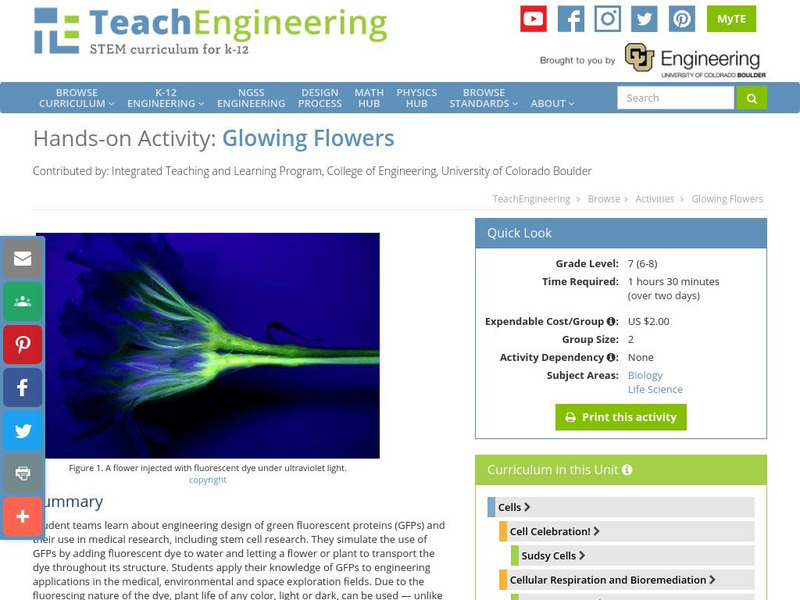
Teach Engineering: Glowing Flowers
Student teams learn about engineering design of green fluorescent proteins (GFPs) and their use in medical research, including stem cell research. They simulate the use of GFPs by adding fluorescent dye to water and letting a flower or...
Technovation
Curiosity Machine: Challenges: Make a Root System
Inspire students to make a root system to help a plant stay put with simple materials like pipe cleaners, string, and marbles. This STEM challenge allows students to not only solve a problem but get tips and document their process all on...
University of Illinois
University of Illinois Extension: The Great Plant Escape
Inspector LePlant and his friends look at the world of plants in this site for younger students. Features include the parts of plants and the seven basic requirements that plants need to survive as well as a short quiz.
Science Buddies
Science Buddies: Growing, Growing, Gone! An Experiment on Nitrogen Fertilizers
Plants need nitrogen to build proteins and nucleic acids to grow healthy stems and leaves. Though the Earth's atmosphere is made up of 79% nitrogen, the form of nitrogen found in the atmosphere cannot be used by plants. In this...