Hi, what do you want to do?





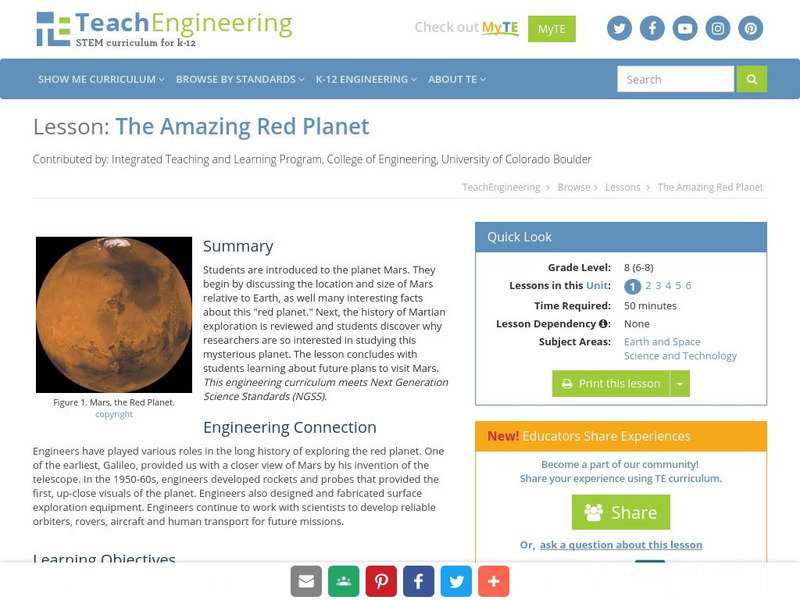
TeachEngineering
Teach Engineering: The Amazing Red Planet
The purpose of this lesson is to introduce students to the planet Mars. This lesson will begin by discussing the location and size of Mars relative to Earth, as well as introduce many interesting facts about this red planet. Next, the...
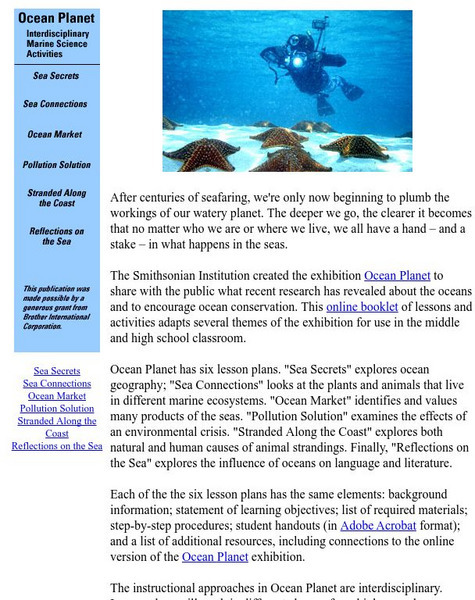
Smithsonian Institution
Smithsonian Education: Ocean Planet
A series of lesson plans designed to be used with the Smithsonian Ocean Planet exhibit (available online). Lesson topics include marine ecosystems, pollution of ocean water, animal strandings, and literature.

Alabama Learning Exchange
Alex: Inner and Outer Planets of the Solar System
In this science activity young scholars will work collaboratively to learn and introduce the eight planets, sizes, characteristics, and their order. They will use size comparisons, research a planet, design a poster and create a...

TeachEngineering
Teach Engineering: The Outer Planets
Students explore the outermost planets of our solar system: Saturn, Uranus and Neptune. They also learn about characteristics of Pluto and its interactions with Neptune. Students learn a little about the history of space travel as well...
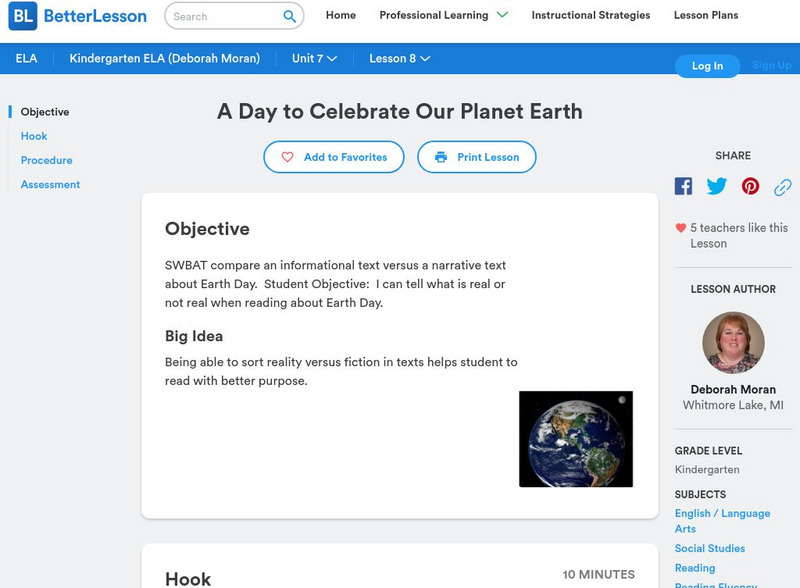
Better Lesson
Better Lesson: A Day to Celebrate Our Planet Earth
Students will compare an informational text versus a narrative text about Earth Day. Included in this lesson are videos and pictures of the lesson in action, a printable Earth Day Venn Diagram, and a recycling activity.

University Corporation for Atmospheric Research
Ucar: Planet Magnet
Students use iron filings to explore the magnetic field around a magnet and record their observations then apply their experience with the magnet to understand the magnetic field around Earth.
Smithsonian Institution
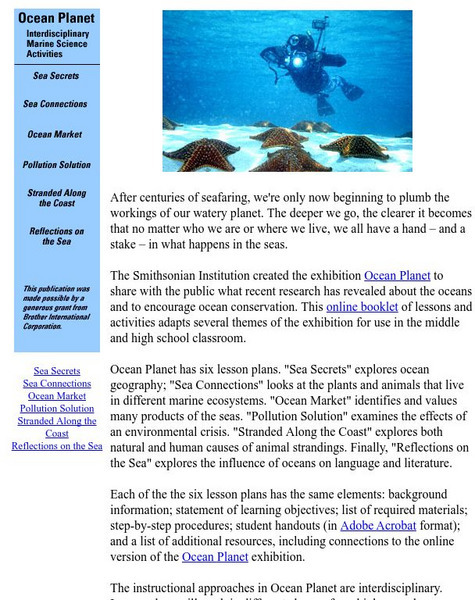
Smithsonian: Ocean Planet: Interdisciplinary Marine Science Activities
Smithsonian Institution presents ?Ocean Planet: Interdisciplinary Marine Science Activities?. Through this series of six interdisciplinary lessons, learners will look at such things as the organisms in different marine ecosystems, the...
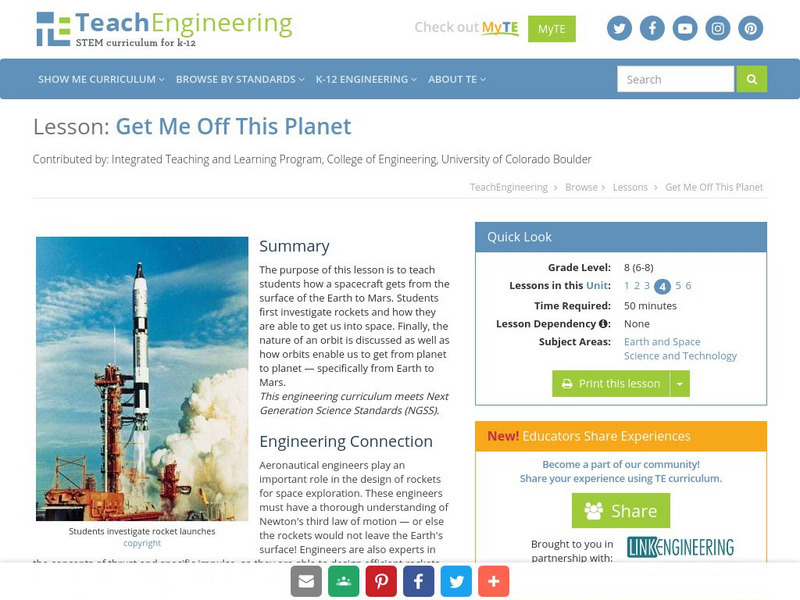
TeachEngineering
Teach Engineering: Get Me Off This Planet
The purpose of this instructional activity is to teach students about how a spacecraft gets from the surface of the Earth to Mars. The instructional activity first investigates rockets and how they are able to get us into space. Finally,...
PBS
Pbs Learning Media: Solar System Scale Model
Teach the concept of scale models and the size of the solar system through this extensive lesson plan. Students will learn about scale models, estimate which objects to use to create a scale model of Earth and Sun, and figure out how far...

Alabama Learning Exchange
Alex: If Earth No Longer Existed. . .
Students will work in cooperative groups to research characteristics of each of the planets in our solar system. Students will design a travel brochure outlining the characteristics of each planet. Each group will make an oral...
University of Texas at Austin
The University of Texas Mc Donald Observatory: Rock Cycle
This activity combines the concept of Earth's rock cycle with the characteristics of other planets in the solar system.
Discovery Education
Discovery Education: Classroom Planetarium
Create a classroom model of the solar system while teaching about relative size of all the planets, and each planet's distance from the sun.

Michigan State University
Michigan State University: Lets Net: Global Connection: Art Across the Planet
Art unit in which students draw their homes and share these drawings with students in a foreign country Includes unit description, list of materials, and links to lesson plans.
Science Buddies
Science Buddies: A Puzzling Parallax
Did you know that ancient astronomers could measure the distance to other stars? They could also distinguish between stars and planets. How could they do that without modern technology of telescopes? See if you can discover the link...
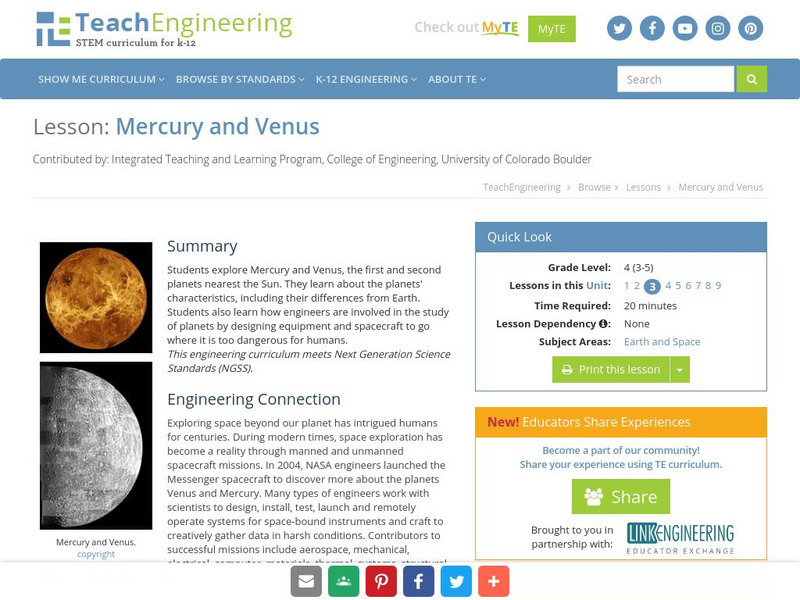
TeachEngineering
Teach Engineering: Mercury and Venus
Students explore Mercury and Venus, the first and second planets nearest the Sun. They learn about the planets' characteristics, including their differences from Earth. Students also learn how engineers are involved in the study of...
TeachEngineering
Teach Engineering: Mars and Jupiter
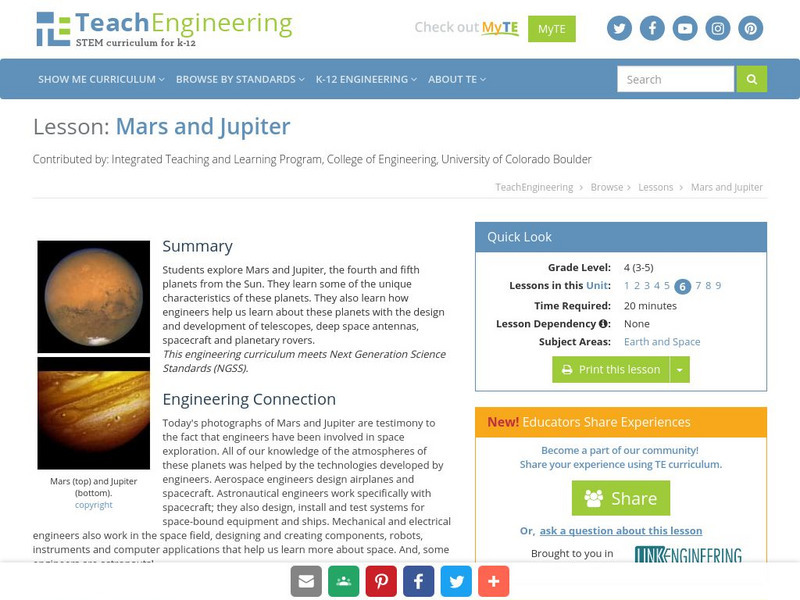
Students explore Mars and Jupiter, the fourth and fifth planets from the Sun. They learn some of the unique characteristics of these planets. They also learn how engineers help us learn about these planets with the design and development...
Other
Making a Scale Model of the Solar System
In this lesson plan site, students are asked to construct a scale model of the planets to help visualize the relative size of planets and their relative distance from the Sun. Links are provided to the Sun and the planets which contain...
TeachEngineering
Teach Engineering: Not So Lost in Space
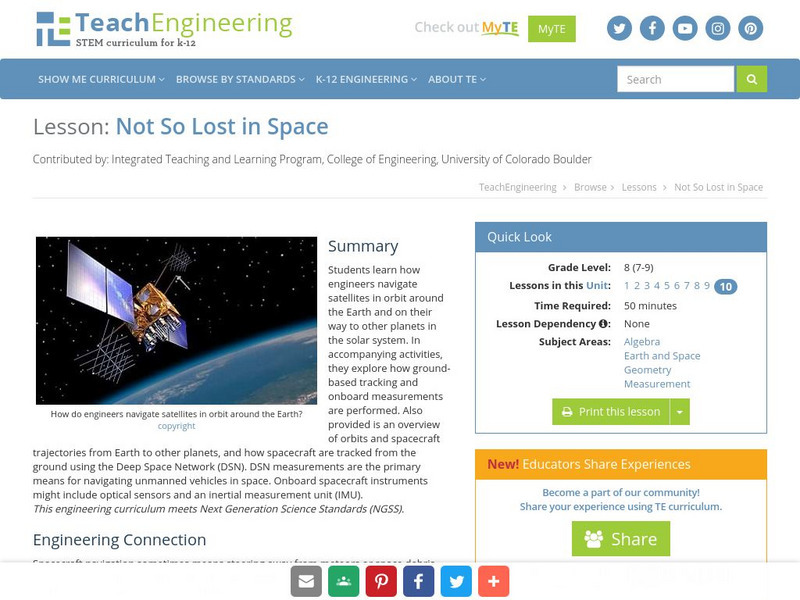
Students learn how engineers navigate satellites in orbit around the Earth and on their way to other planets in the solar system. In accompanying activities, they explore how ground-based tracking and onboard measurements are performed....
TeachEngineering
Teach Engineering: Our Big Blue Marble
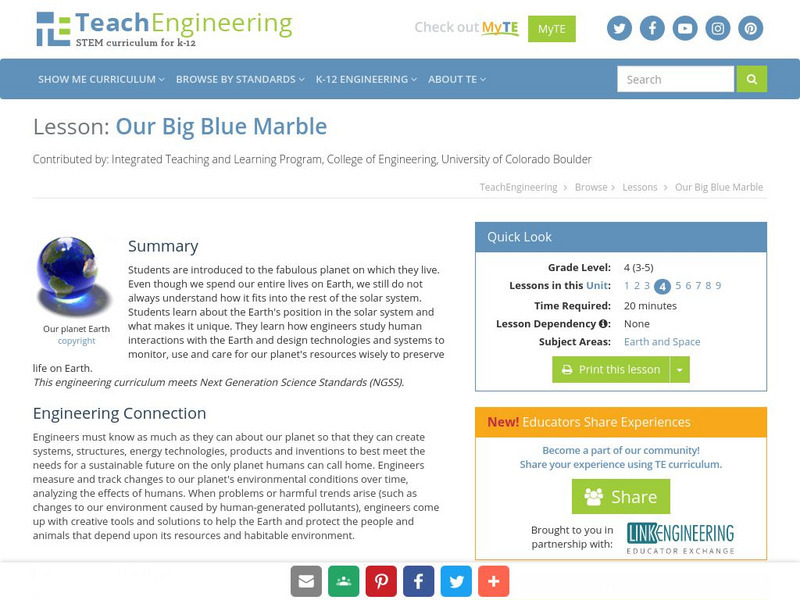
Students are introduced to the fabulous planet on which they live. Even though we spend our entire lives on Earth, we still do not always understand how it fits into the rest of the solar system. Students learn about the Earth's position...

PBS
Pbs Teachers: Math Space Odyssey: How Much Do You Weigh in Outer Space?
Demonstrate the ability to apply the use of decimals, fractions, ratios and proportions to situations based upon given information about planets in the solar system.
TeachEngineering
Teach Engineering: How Should Our Gardens Grow?
In this lesson, students will learn about types of land use by humans and evaluate the ways land is used in their local community. They will also consider the environmental effects of the different types of land use. Students will assume...
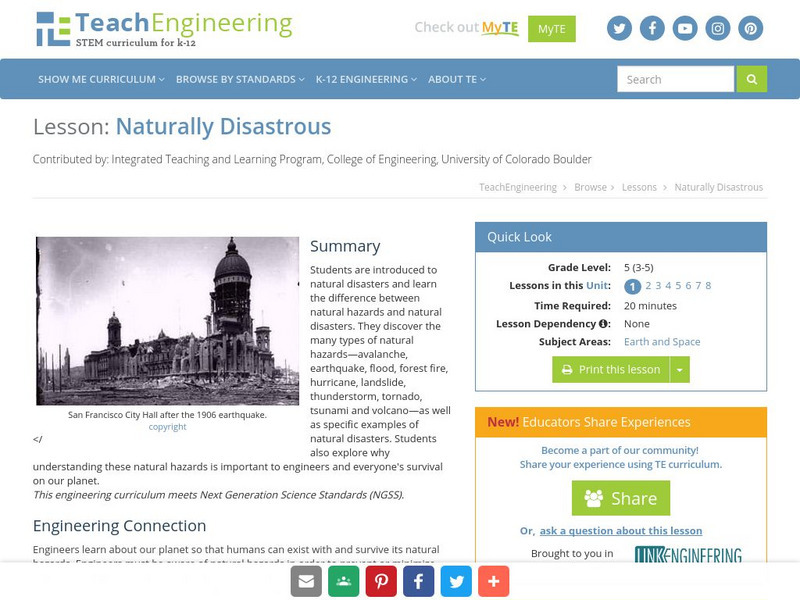
TeachEngineering
Teach Engineering: Naturally Disastrous
Learners are introduced to natural disasters, and learn the difference between natural hazards and natural disasters. They discover the many types of natural hazards - avalanche, earthquake, flood, forest fire, hurricane, landslide,...
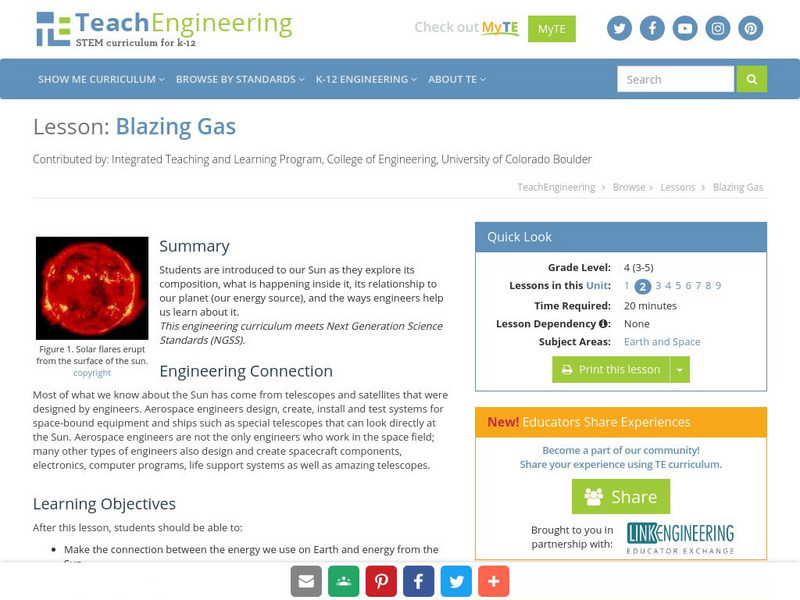
TeachEngineering
Teach Engineering: Blazing Gas
Students are introduced to our Sun as they explore its composition, what is happening inside it, its relationship to our planet (our energy source), and the ways engineers help us learn about it.
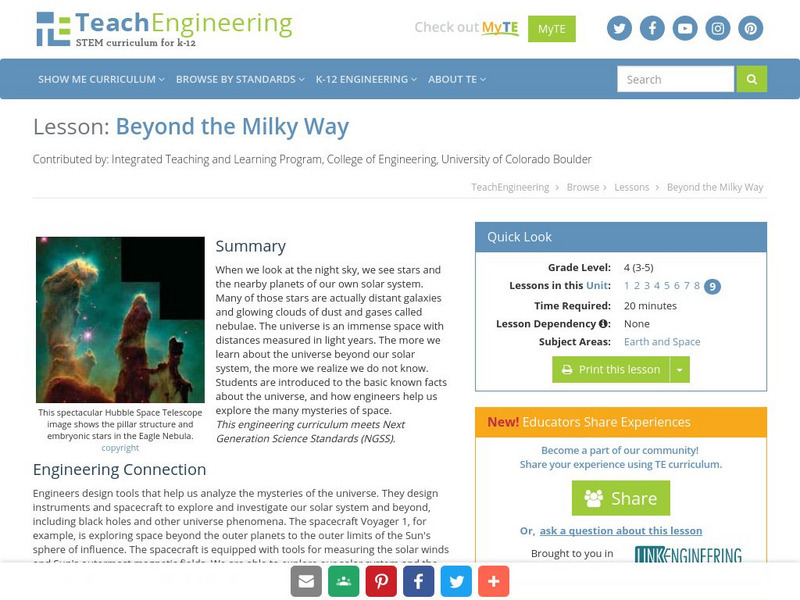
TeachEngineering
Teach Engineering: Beyond the Milky Way
When we look at the night sky, we see stars and the nearby planets of our own solar system. Many of those stars are actually distant galaxies and glowing clouds of dust and gases called nebulae. The universe is an immense space with...
Other popular searches
- Inner and Outer Planets
- Worksheets Planets
- Paper Mache Planets
- Inner Planets
- Nine Planets
- The Planets
- Imaginary Planets
- Sun and Planets
- Stars and Planets
- Planets Outer Space
- Planets and Astronomy
- Outer Planets