Hi, what do you want to do?






Smithsonian Institution
National Air and Space Museum: Exploring the Planets: Ancient Times & the Greeks
In ancient times only five planets were known: Mercury, Venus, Mars, Jupiter, and Saturn. Learn about Greek astronomer Ptolemy's theory for the solar system that was to survive for fourteen centuries.
Enchanted Learning
Enchanted Learning: Zoom Astronomy: The Earth's Atmosphere
Site provides information on the Earth's atmosphere as well as offers additional information about Earth.

Ducksters
Ducksters: Astronomy for Kids: The Planet Uranus
Kids learn about the ice giant planet Uranus of the Solar System including fun facts, mass, day, year, and distance from the Sun. Astronomy for kids and teachers.

Ducksters
Ducksters: Astronomy for Kids: The Planet Venus
Kids learn about the planet Venus of the Solar System including fun facts, mass, day, year, and distance from the Sun. Astronomy for kids and teachers.
University of California
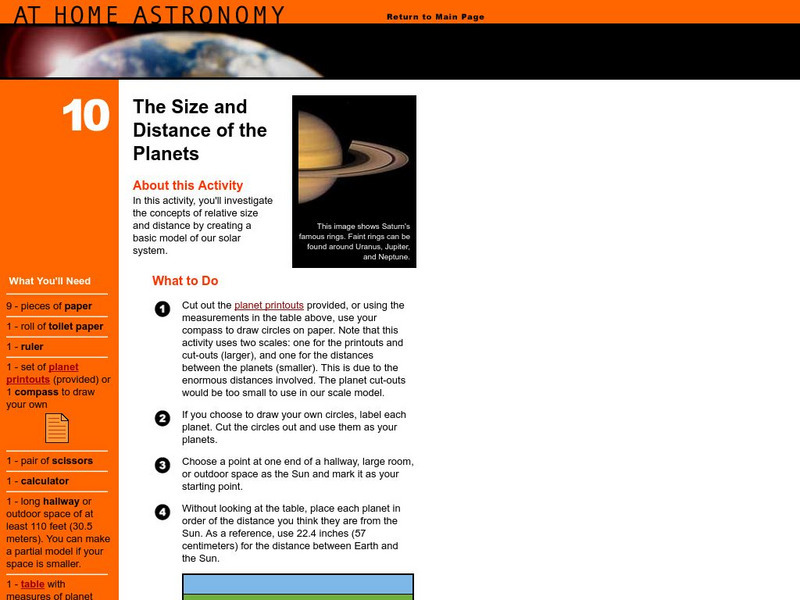
Uc Berkeley: At Home Astronomy: The Size and Distance of Planets
In this activity, "You will investigate the concepts of relative size and distance by creating a basic model of our solar system." Planet printouts are provided and this site contains related links.

Science Buddies
Science Buddies: The Moon and the Stars
When you are in the city, only a few of the brightest stars are visible. But when you are in the country, you can see many more stars than you can count. Sometimes you can even see the bright belt of our galaxy, the Milky Way. In this...
Discovery Education
Discovery Education: Classroom Planetarium
Create a classroom model of the solar system while teaching about relative size of all the planets, and each planet's distance from the sun.

Ducksters
Ducksters: Astronomy for Kids: The Planet Earth
This site is astronomy for kids and teachers! Here students can learn about the planet Earth of the Solar System including fun facts, mass, day, year, and distance from the Sun.

Other
Hong Kong Space Museum
Besides an introduction to exhibitions and events at the museum, the site provides a guide to stargazing, an astronomy FAQ, space news, virtual tours (see site map) and research resources (including Chinese-English star and constellation...

NASA
Nasa: Astronomy Picture of the Day: Jupiter From Voyager
Taken by Voyager 1 as it passed Jupiter in 1979, this image shows the Great Red Spot, which is a hurricane-like storm that has lasted over 300 years, and is more than three times the size of planet Earth.
Science Buddies
Science Buddies: A Puzzling Parallax
Did you know that ancient astronomers could measure the distance to other stars? They could also distinguish between stars and planets. How could they do that without modern technology of telescopes? See if you can discover the link...
Science Buddies
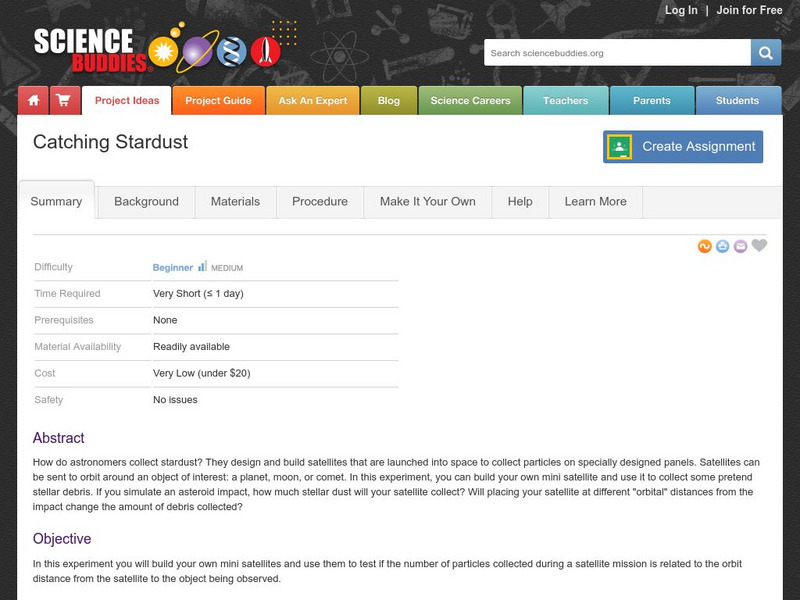
Science Buddies: Catching Stardust
How do astronomers collect stardust? They design and build satellites that are launched into space to collect particles on specially designed panels. Satellites can be sent to orbit around an object of interest: a planet, moon, or comet....
Cool Math
Coolmath: Science Monster: Mars
How much would you weigh on Mars? Learn this information and other cool facts about the red planet, Mars.
Other
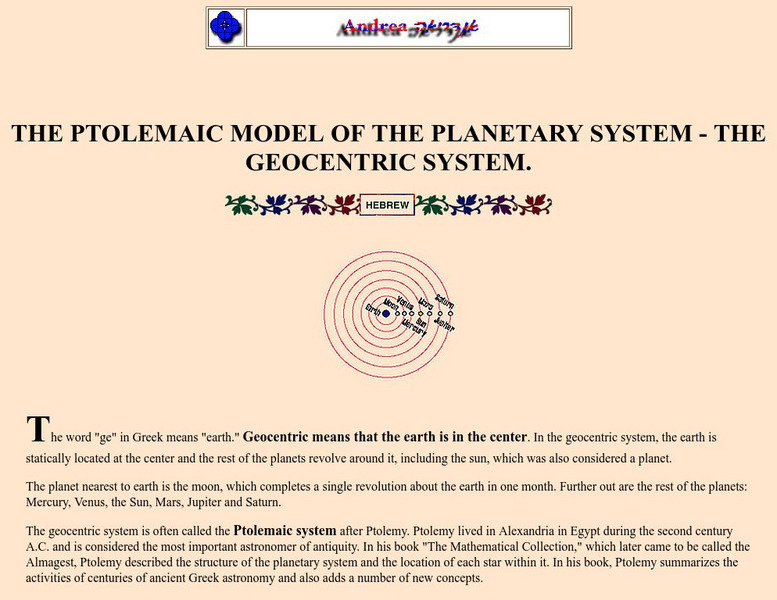
The Ptolemaic Model of the Planetary System
An easy-to-read description and history of Ptolemy's geocentric model of the universe. Geocentric means that Ptolemy believed the Earth was the center of the universe.
Enchanted Learning
Enchanted Learning: Neptune
A wealth of facts await you on this complete site. Topics include size, mass and gravity, length of day, orbit, distance from the sun, and more. A coloring page, quiz, fill-in-the-blanks activity, and interactive puzzle will challenge...
NASA
Astronomical Society of the Pacific: Telescope Treasure Hunt
This hands-on astronomy activity lets learners hunt for different objects in the night sky that contribute to stellar and planetary formation, using a Treasure List. They will learn how stars and their planets form and will find objects...
Cosmo Learning
Cosmo Learning: Introduction to Astrophysics
A collection of audio lectures from an introduction to astrophysics course taught at the University of California, Berkeley. The course discusses the solar system, stars, quantum mechanics, gravitation, and cosmology focusing on how...
NASA
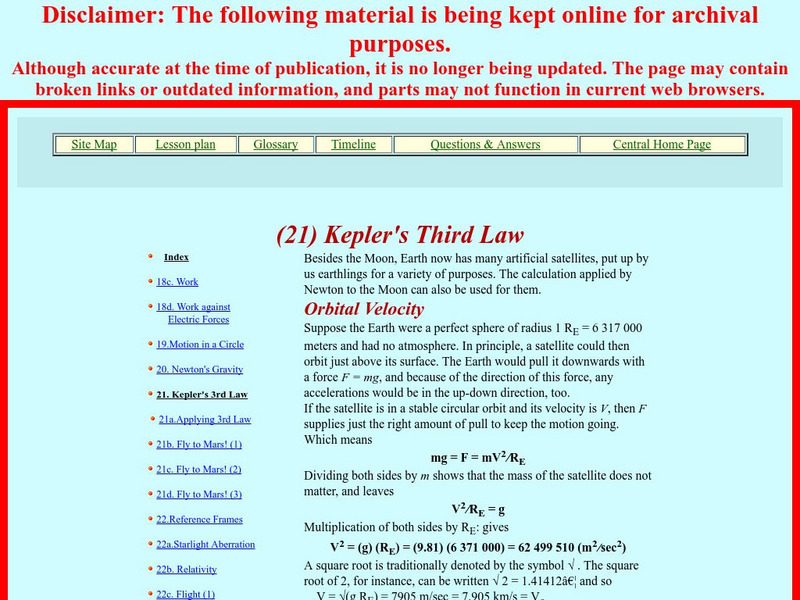
Nasa: Kepler's Third Law
This site from NASA states Kepler's third law of motion and extends it to develop an equation for the velocity of an orbiting planet.
Enchanted Learning
Enchanted Learning: Mars
Many facts about Mars are presented on this comprehensive site. Planet size, surface, length of day, orbit, atmosphere, moons, are a sampling of the many topics discussed on this site. You will also find an activity book, a quiz, a...

Enchanted Learning
Enchanted Learning: Uranus
This comprehensive site provides a wealth of information about the seventh planet from the sun. Topics include rotational axis, size, mass and gravity, length of day, distance from the sun, and more. The information is supplemented with...
Enchanted Learning
Enchanted Learning: The Earth's Atmosphere
The Earth's atmosphere is a thin layer of gases that surrounds the Earth. It composed of 78% nitrogen, 21% oxygen, 0.9% argon, 0.03% carbon dioxide, and trace amounts of other gases. This thin gaseous layer insulates the Earth from...