Hi, what do you want to do?






PBS
Pbs Learning Media: All Planet Sizes
This illustration from the Lunar and Planetary Laboratory shows the approximate sizes of the planets relative to each other. Note that the planets are not shown at appropriate distances from the Sun.
Nine Planets
The Nine Planets: The Moon
Explore the mythology, structure, observational history, gravitational force, and orbit of Earth's Moon.

American Institute of Biological Sciences
Action Bioscience: Looking for Life on Mars and Beyond
Learn some of the characteristics of Mars. These characteristics lead some people to believe that life forms may be found on the fourth planet from the Sun.

Ducksters
Ducksters: Space Science: Astronomy for Kids
Kids learn about astronomy, the study of outer space including the stars, planets, comets, black holes, and the Solar System. History and astronomers in this astronomy for teachers and kids section.
University of Virginia
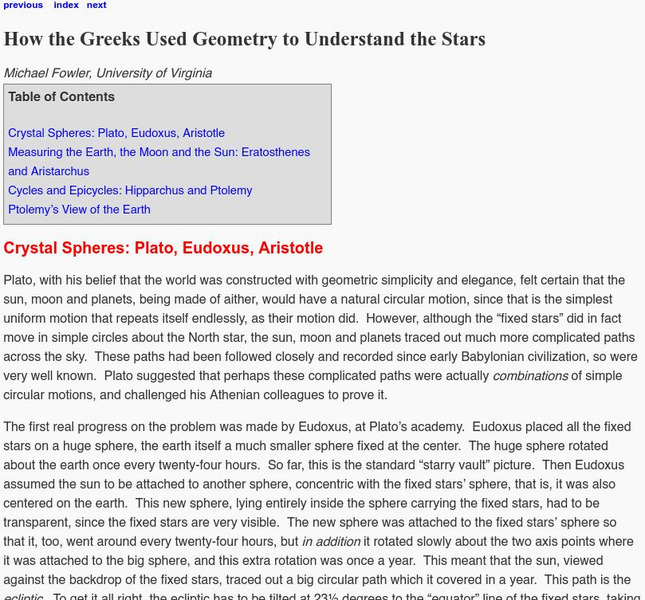
University of Virginia: How the Greeks Used Geometry to Understand the Stars
An article explaining how the Greeks were able to use their science and mathematics to predict where astronomical objects such as the Planets could be found in the nighttime sky even though their underlying premise was that the earth did...

Ducksters
Ducksters: Astronomy for Kids: The Planet Earth
This site is astronomy for kids and teachers! Here students can learn about the planet Earth of the Solar System including fun facts, mass, day, year, and distance from the Sun.
Other
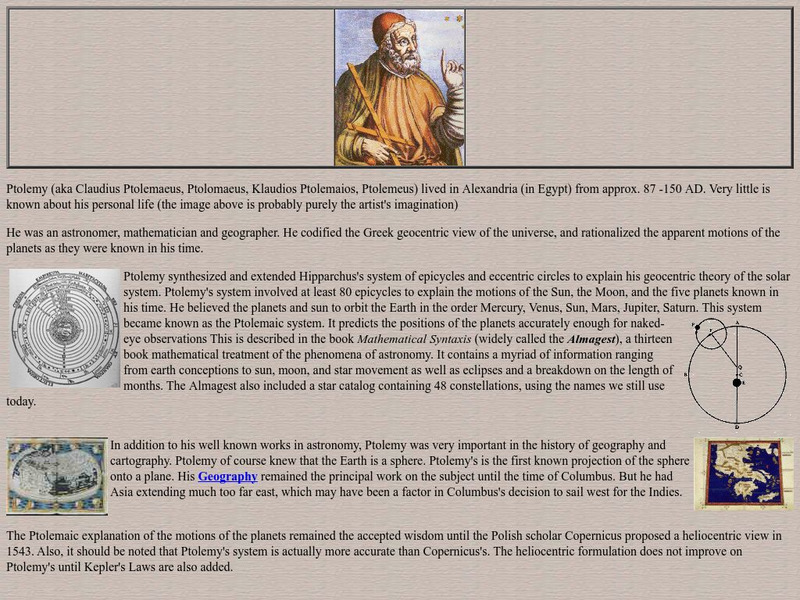
Nine planets.org: Ptolemy
This site from the University of Arizona provides a background of Ptolemy's profound influence in the areas of astronomy, geography, and cartography. Includes good pictures and related links.
Other
Christopher Crockett: The Astronomy Word of the Week Is "Barycenter"
While astronomers and philosophers have long mused on the possibility of other solar systems, the first planets confirmed to orbit a star other than our Sun weren't found until 1992. The reason it took so long is that it's really hard!...
Science Buddies
Science Buddies: Catching Stardust
How do astronomers collect stardust? They design and build satellites that are launched into space to collect particles on specially designed panels. Satellites can be sent to orbit around an object of interest: a planet, moon, or comet....
NASA
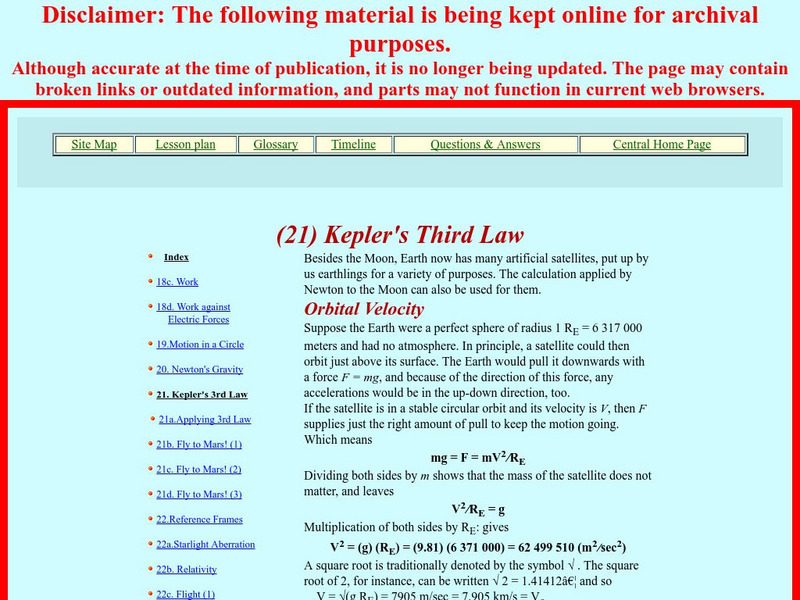
Nasa: Kepler's Third Law
This site from NASA states Kepler's third law of motion and extends it to develop an equation for the velocity of an orbiting planet.
Enchanted Learning
Enchanted Learning: All About Plate Tectonics
Simple discussion of plate tectonics and Pangaea. Includes maps and interactives.
Enchanted Learning
Enchanted Learning: Zoom School: Oceans
Find out why the oceans are blue and what causes waves by clicking here. There is a table of information about the four oceans as well as interesting facts on waves, salinity, and tides.