Hi, what do you want to do?





Other
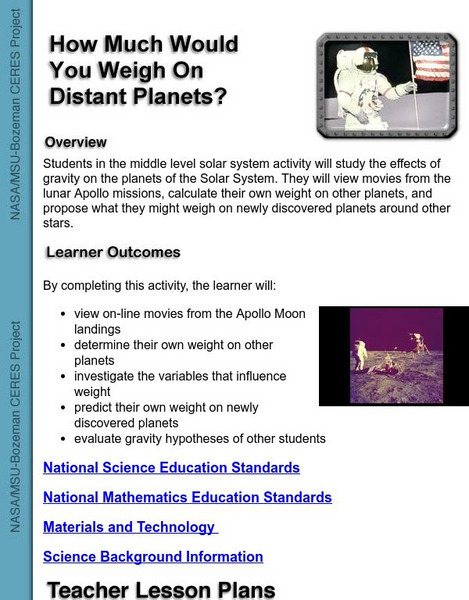
Montana State University: How Much Would You Weigh on Distant Planets?
This resource contains a lesson plan in which students study the effects of gravity on the planets of the Solar System. They will view movies from the lunar Apollo missions, calculate their own weight on other planets, and propose what...

Other
Sandburg Center for Sky Awareness: What Are the Shapes of the Planets' Orbits?
In this lesson plan investigation students learn about the shapes of the planetary orbits by experimenting with ellipses of different proportions.

Education.com
Education.com: The Solar System: Learning About Planets
[Free Registration/Login Required] Learn all about the components of the solar system with this downloadable lesson plan. Includes several student handouts and a research activity.
American Geosciences Institute
American Geosciences Institute: Earth Science Week: Places on the Planet: Latitude and Longitude
Students learn how citizen scientists involved in the Geological Society of America's EarthCaching project use GPS technology and latitude and longitude coordinates to find special places on the Earth.
Smithsonian Institution
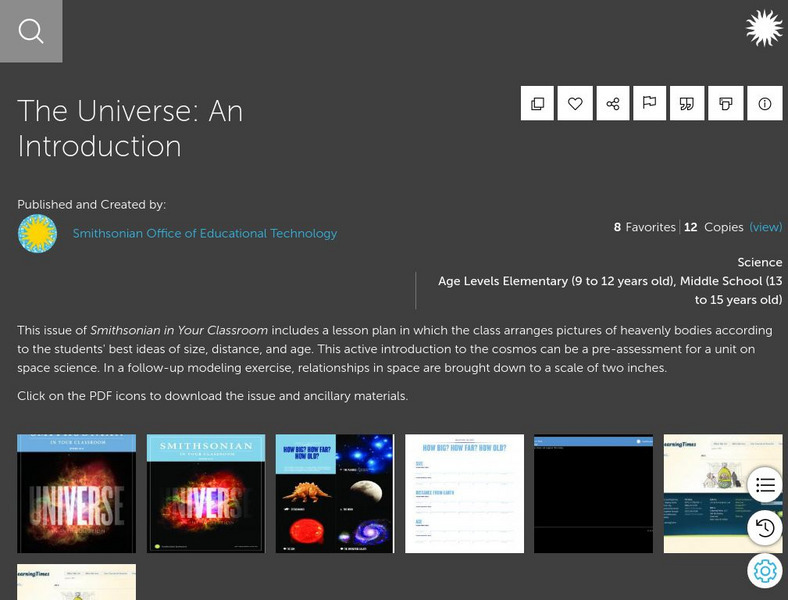
Smithsonian Learning Lab: The Universe, an Introduction
Start with the questions all students ask: How big is the universe, how far away are the planets and stars, how did they form and when, how do they move and why? Build on their natural curiosity. The Smithsonian, in cooperation with...

University of Texas at Austin
The University of Texas Mc Donald Observatory: Solar System Science
Each student becomes the "ambassador" for a planet and prepares by researching their planet, then meets with other ambassadors to form new mini-solar systems.

Alabama Learning Exchange
Alex: Protect Our Planet Piece by Piece
In this lesson from "The Friends of Auntie Litter", (www.auntielitter.org), food webs and their significance will be explored. This lesson is one from the "Take Pride Statewide" series. *Lesson provided by Julie Danley and Pam Walston.
Better Lesson
Better Lesson: Our Sky
What objects are in the day sky and the night sky? How do they seem to move? Come and explore with us as we discover the sun, moon, planets and stars! This detailed lesson plan includes pictures and videos of the lesson in action,...

Alabama Learning Exchange
Alex: Note Names on the Staff
Lesson plan teaching students the notes on the treble staff. Students learn slogans and practice using a flipchart from Promethean Planet.
Utah Education Network
Uen: Trb 3:1 Investigation 1 Comparing the Earth & Moon
Third graders compare the earth and the moon in this activity.

Alabama Learning Exchange
Alex: Earth: We're in It Together!
In this lesson from "The Friends of Auntie Litter", (www.auntielitter.org), conservation and describing ways to protect the Earth will be explored. Young scholars will also create a mural of ways to protect our planet. This lesson is one...

Alabama Learning Exchange
Alex: Take Pride in America Auntie Litter Needs You!
In this lesson plan from "The Friends of Auntie Litter", (www.auntielitter.org)in celebration of Earth Day, the meaning of Earth Day will be explored. Students will also learn the words to a song honoring our planet. This lesson plan is...

Alabama Learning Exchange
Alex: Edible Plate Tectonics
As we stand on the top layer of our planet it is a little difficult to get hands-on with plate tectonics. This activity uses layered cake to allow students an up close representation of how major land features have been created.
Utah Education Network
Uen: Where Did the Matter in the Universe Come From?
Students use various articles about how atoms are made and spread throughout the universe starting with the Big Bang. They will study the articles as groups and will then present their information to the class.

Alabama Learning Exchange
Alex: Earth, We're in It Together!
In this lesson from "The Friends of Auntie Litter", (www.auntielitter.org), Earth Day will be explored. This lesson is one from the "Take Pride Statewide" series. *This lesson is provided by Lana Holmes.

PBS
Pbs Teachers: Mysteries of the Universe
Consider the issues surrounding the world of space exploration including the new fields of archaeoastronomy and astrobiology. Investigate zero gravity, the Big Bang theory, life in space and how sound travels in a vacuum.
Other popular searches
- Lesson Planet
- Planet Earth
- Inner and Outer Planets
- Worksheets Planets
- Paper Mache Planets
- Inner Planets
- Nine Planets
- Planet Earth Dvd Series
- The Planets
- Imaginary Planets
- Planet Acrostic Poem
- Laws of Planetary Motion