Hi, what do you want to do?






Alabama Learning Exchange
Alex: To Infinity and Beyond Magazine of Planets
This is a student led activity in which students have to accomplish the task of choosing the most entertaining way to relay written expository information. Art/self expression along with technology are utilized to develop a classroom...
TeachEngineering
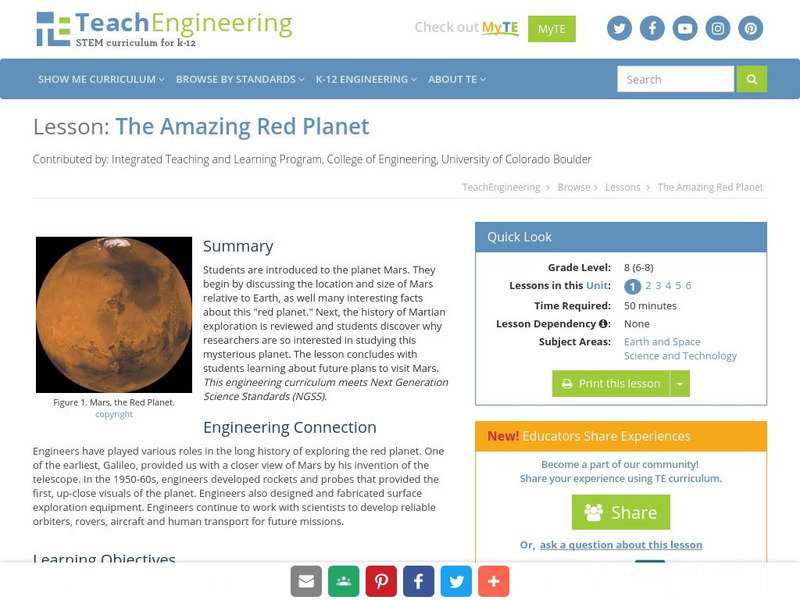
Teach Engineering: The Amazing Red Planet
The purpose of this lesson is to introduce students to the planet Mars. This lesson will begin by discussing the location and size of Mars relative to Earth, as well as introduce many interesting facts about this red planet. Next, the...

Alabama Learning Exchange
Alex: Inner and Outer Planets of the Solar System
In this science lesson students will work collaboratively to learn and introduce the eight planets, sizes, characteristics, and their order. They will use size comparisons, research a planet, design a poster and create a PowerPoint...

TeachEngineering
Teach Engineering: The Outer Planets
Students explore the outermost planets of our solar system: Saturn, Uranus and Neptune. They also learn about characteristics of Pluto and its interactions with Neptune. Students learn a little about the history of space travel as well...
Better Lesson
Better Lesson: A Day to Celebrate Our Planet Earth
Students will compare an informational text versus a narrative text about Earth Day. Included in this lesson are videos and pictures of the lesson in action, a printable Earth Day Venn Diagram, and a recycling activity.

PBS
Pbs Learning Media: Precipitation on the Planet
Precipitation affects many aspects of our lives, from drinking water and food to devastating rain or snow storms. NASA gathered information from satellites to study factors that influence precipitation. View these narrated and unnarrated...
University Corporation for Atmospheric Research
Ucar: Planet Magnet
Learners use iron filings to explore the magnetic field around a magnet and record their observations then apply their experience with the magnet to understand the magnetic field around Earth.
Better Lesson
Better Lesson: Comparing Temperatures
Second graders should be able to recognize what makes one number greater or smaller than another, using place value understanding which is crucial to Common Core mastery. This instructional activity combines math and science by having...
TeachEngineering
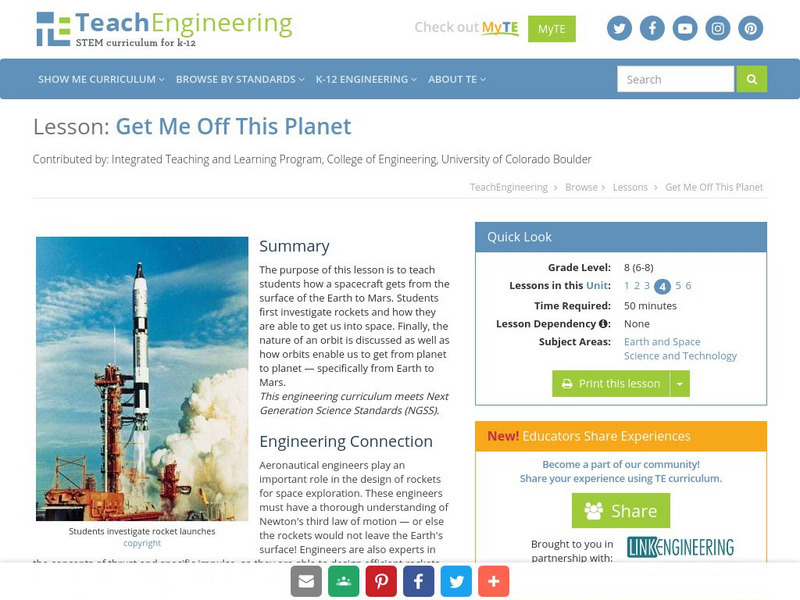
Teach Engineering: Get Me Off This Planet
The purpose of this lesson is to teach students about how a spacecraft gets from the surface of the Earth to Mars. The lesson first investigates rockets and how they are able to get us into space. Finally, the nature of an orbit is...
PBS
Pbs Learning Media: Solar System Scale Model
Teach the concept of scale models and the size of the solar system through this extensive lesson plan. Students will learn about scale models, estimate which objects to use to create a scale model of Earth and Sun, and figure out how far...
Other
Lunar and Planetary Institute: Explore! Jupiter's Family Secrets
A variety of hands-on activities, investigations, and explorations designed to engage learners in discovering planet Jupiter.

Michigan State University
Michigan State University: Lets Net: Global Connection: Art Across the Planet
Art unit in which students draw their homes and share these drawings with students in a foreign country Includes unit description, list of materials, and links to lesson plans.
TeachEngineering
Teach Engineering: The Great Gravity Escape
Learners use water balloons and a length of string to understand how gravity and the velocity of a spacecraft balance to form an orbit. They see that when the velocity becomes too great for gravity to hold onto an object, the object...
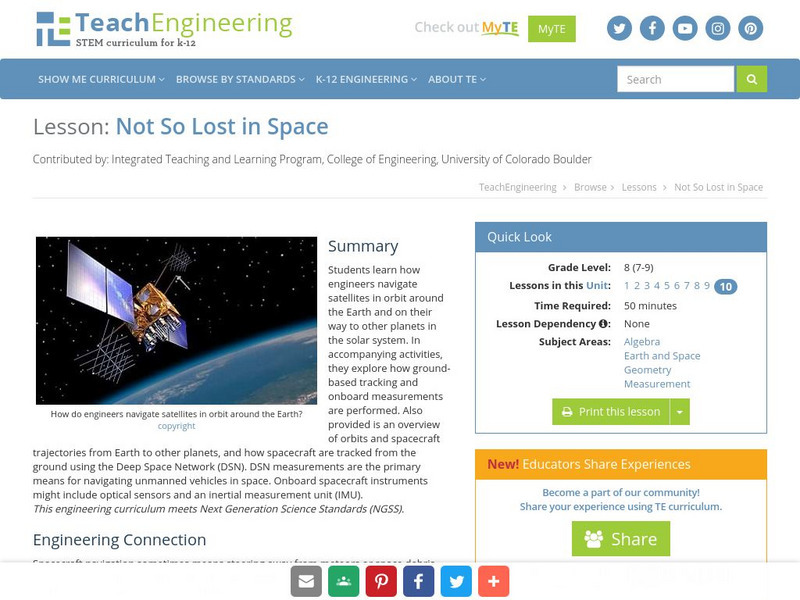
TeachEngineering
Teach Engineering: Not So Lost in Space
Learners learn how engineers navigate satellites in orbit around the Earth and on their way to other planets in the solar system. In accompanying activities, they explore how ground-based tracking and onboard measurements are performed....
TeachEngineering
Teach Engineering: Our Big Blue Marble
Students are introduced to the fabulous planet on which they live. Even though we spend our entire lives on Earth, we still do not always understand how it fits into the rest of the solar system. Students learn about the Earth's position...
TeachEngineering
Teach Engineering: How Should Our Gardens Grow?
In this instructional activity, young scholars will learn about types of land use by humans and evaluate the ways land is used in their local community. They will also consider the environmental effects of the different types of land...
TeachEngineering
Teach Engineering: Naturally Disastrous
Students are introduced to natural disasters, and learn the difference between natural hazards and natural disasters. They discover the many types of natural hazards - avalanche, earthquake, flood, forest fire, hurricane, landslide,...
TeachEngineering
Teach Engineering: Beyond the Milky Way
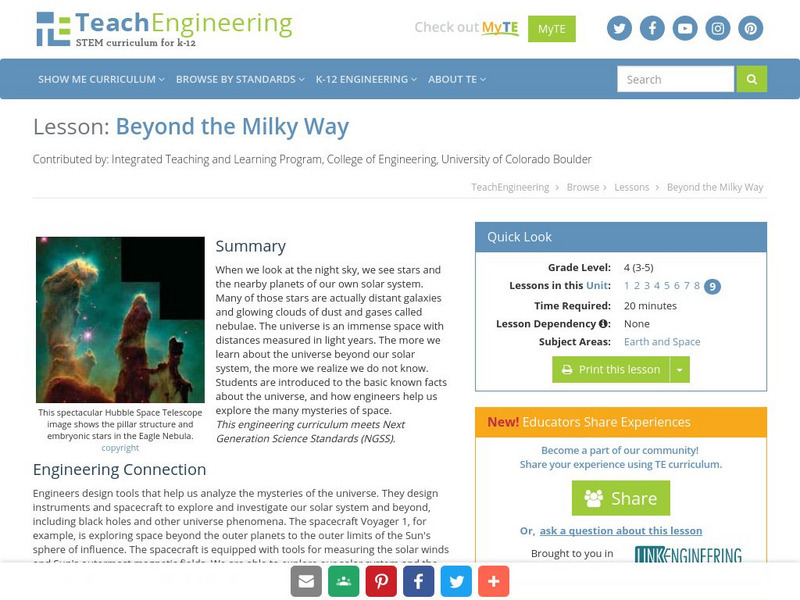
When we look at the night sky, we see stars and the nearby planets of our own solar system. Many of those stars are actually distant galaxies and glowing clouds of dust and gases called nebulae. The universe is an immense space with...
TeachEngineering
Teach Engineering: Fresh or Salty?
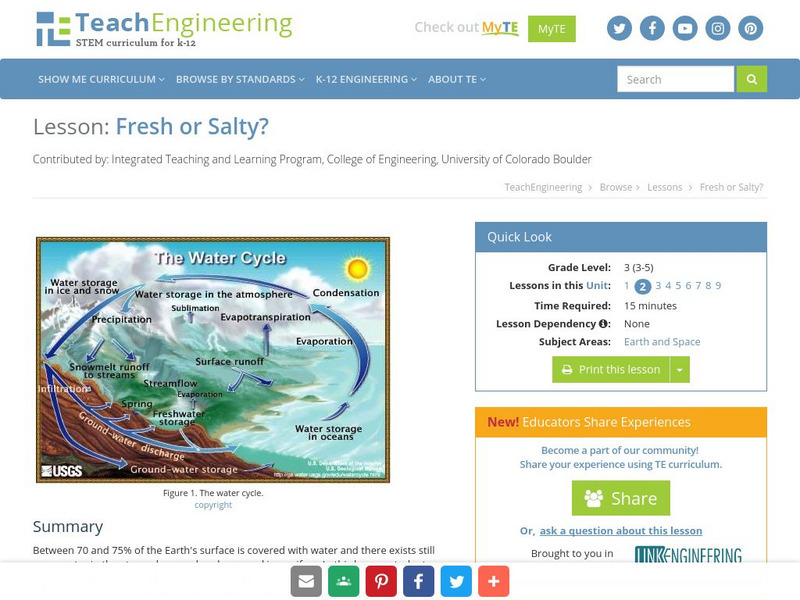
Between 70 and 75% of the Earth's surface is covered with water and there exists still more water in the atmosphere and underground in aquifers. In this lesson, young scholars learn about water bodies on the planet Earth and their...
Council for Economic Education
Econ Ed Link: Destination: Mars
Look up! Can you ever imagine standing on another planet and looking down at earth? We've been to the moon - now lets launch an expedition to Mars. Imagine all the preparation you will have to go through in order to have a safe and...

Alabama Learning Exchange
Alex: Endangered Species
The topic of endangered species is one that needs to be addressed with every student. As more and more plants and animals become extinct, students, as inhabitants of this ecosystem, need to be aware that human actions affect the planet....

Alabama Learning Exchange
Alex: What's Going on and Where Am I?
In this lesson, students write a descriptive essay about an historical event as seen through the eyes of an alien from a different planet and time. The lesson encourages the use of colorful and exciting adjectives, adverbs, and verbs in...

Alabama Learning Exchange
Alex: Lost in Space a Solar System Study
During this technology based instructional activity, students navigate the Internet to learn interesting information about the solar system. They use the information to complete a worksheet and to create a puzzle or challenge for their...
University of South Florida
Fcat: Human Coordinate Plane: Teacher Notes
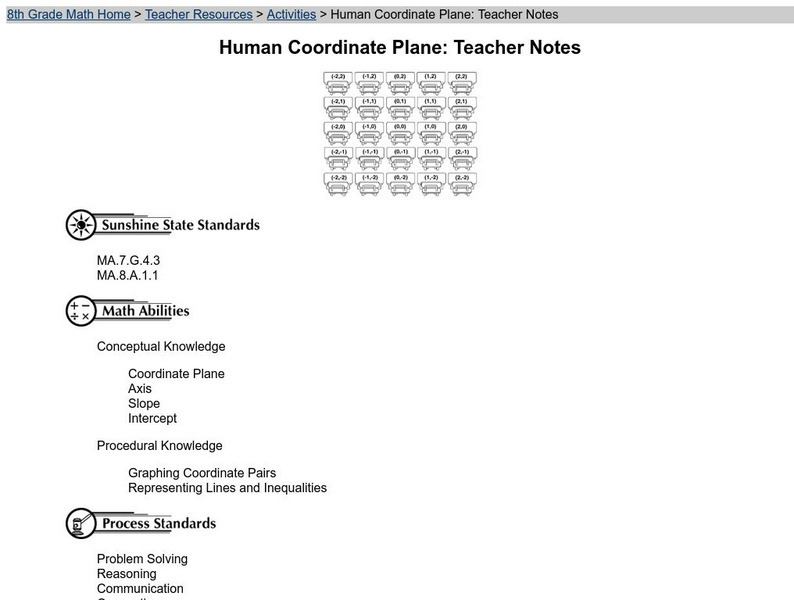
Learners participate as a class in this activity using their desks as points on the coordinate plane. The teacher leads them in the activity, increasing their understanding of the characteristics of the coordinate plane.
Other popular searches
- Lesson Planet
- Planet Earth
- Inner and Outer Planets
- Worksheets Planets
- Paper Mache Planets
- Inner Planets
- Nine Planets
- Planet Earth Dvd Series
- The Planets
- Imaginary Planets
- Planet Acrostic Poem
- Laws of Planetary Motion