Hi, what do you want to do?






American Museum of Natural History
Train of Thought
Hop aboard the train of thought. A remote learning resource has learners consider thought experiments to consider scientific theories. It provides two examples, one on orbiting bodies and the other on the speed of light, for them to work...
NASA
Nasa: Rockets Educator Guide: Applying Newton's Laws
Learn how Newton's Laws apply to rocketry. Discover how rockets work, including the engines and propellants.
Internet History Sourcebooks Project
Fordham University: Modern History Sourcebook: Isaac Newton
This site from Fordham University links to excerpts of Newton's major works. Please scroll down to find the section on Newton titled "The Creation of Classical Physics." You will be able to actually read some of Newton's work! Read...
NASA
Nasa: Rockets Educator Guide: How Rockets Work
In this article, learn how rockets work. Discover Newton's Law of Motion and learn how it supports rocketry.

Other
Physics Quests
This resource links to many web-based activities which allow students to explore and examine physic principles and concepts on their own. Links to other good physics sites are also here.

Learn AP Physics
Learn Ap Physics: Physics B: Gravitation
A site dedicated to help students prepare for the AP Physics B test. This specific site reviews gravitation including Newton's Law of Gravity, orbits of planets and satellites, and Kepler's three laws. Site contains links to video...

Physics Classroom
The Physics Classroom: Centripetal Force Requirement
Animation depicting the effect of a centripetal force on the motion of an object. Newton's laws are used to explain why circular motion requires an inward-directed force.

NASA
Nasa: Beginner's Guide to Aerodynamics
Includes exhaustive information and a wealth of activities pertaining to aerodynamics and the physics of flight.
NASA
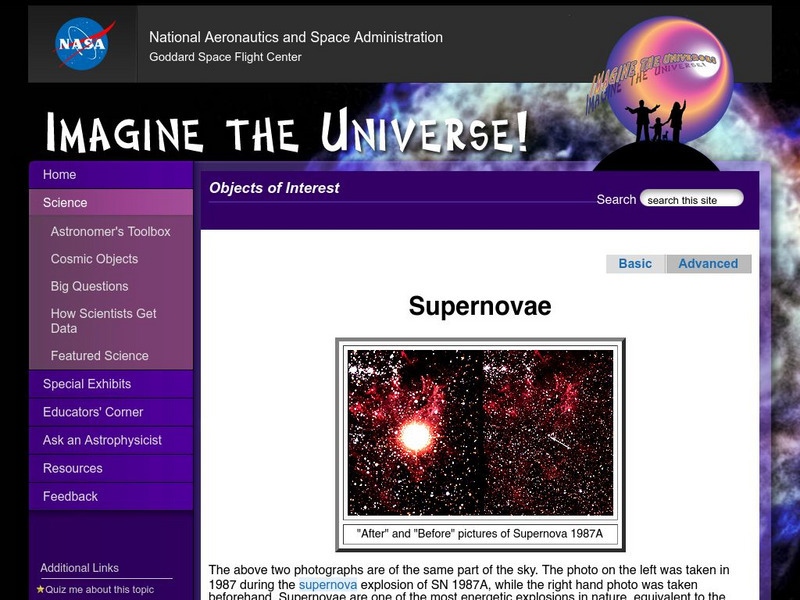
Nasa: Imagine the Universe: Supernovae (Advanced)
Supernovae are divided into two basic physical types, including a description of supernova types and how they are classified based on the existence of hydrogen spectral lines. Definitions of key terms are provided.
University of Virginia
Uva Physics: Using Vectors to Describe Motion
Background information on vectors and their use in describing motion in two dimensions. A comparison of Aristotle's and Galileo's perspectives on force and motion is given.

Ducksters
Ducksters: Physics for Kids: Laws of Motion
Kids learn about the science behind the basic three Laws of Motion. Forces theory discovered by Isaac Newton.
University of Maryland
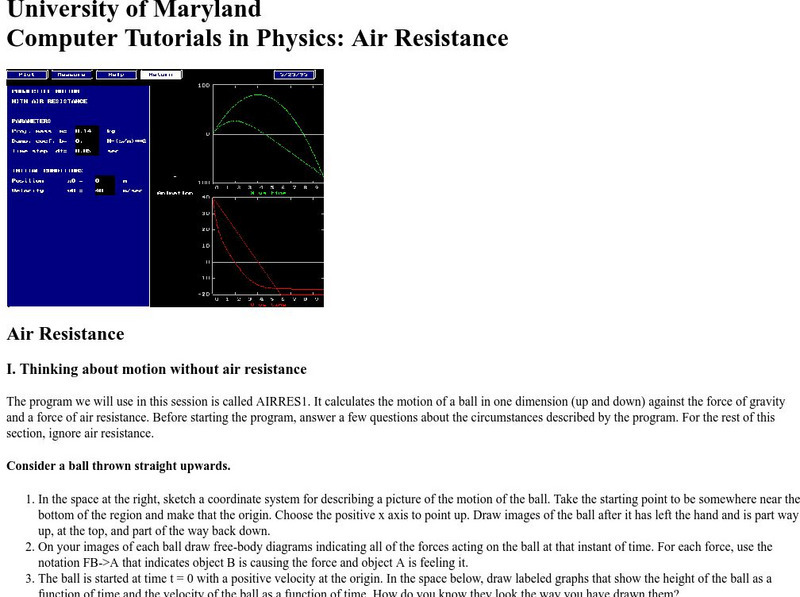
University of Marylad: Computer Tutorials in Physics: Air Resistance
This site has a discussion of a college physics project in which the motion of an object under the influence of air resistance was modeled and studied. Procedure and modeling software are described and the results and the findings are...

Ducksters
Ducksters: Biography for Kids: Scientist: Isaac Newton
Investigate Isaac Newton's biography on this site. Learn how he was a scientist who discovered gravity, the three laws of motion, and calculus. He is considered one of the great scientists in history.

University of St. Andrews (UK)
University of St. Andrews: Orbits and Gravitation
A page describing the physics, mathematics, and historical figures associated with planetary motion, satellite motion, and universal gravitation.
Curated OER
Zona Land: Galileo and Inertia
A tutorial with accompanying animations on classical mechanics. Well-illustrated. Good navigation.
PBS
Pbs: Nova: Top Gun Over Moscow
An online exhibit investigating the sensations experienced by a cockpit pilot in a Russian aircraft. Focuses on G-forces and apparent weightlessness.