Hi, what do you want to do?






BSCS Science Learning
Bscs: Bscs Middle School Science
BSCS Middle School Science is a standards and inquiry-based program comprised of four units: Earth/Space Science, Life Science, Physical Science, and Science and Society. The curriculum is available free online for teachers.
Science Buddies
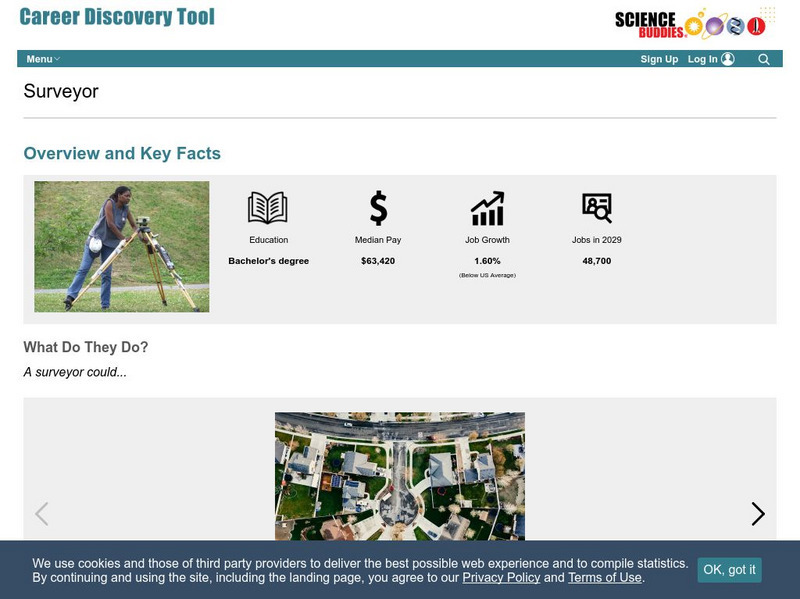
Science Buddies: Career Profile: Surveyor
George Washington started out as a surveyor. This career has potential in many areas above ground, underground, and even in space. Find out about the nature of the work of a surveyor as well as the educational requirements in this...
Science Buddies
Science Buddies: Using Laser Pointer to Measure Data Track Spacing on C Ds, Dv Ds
You've probably noticed the colorful patterns "reflecting" from the shiny surface of a CD disk. What you are seeing is actually diffraction of white light, and the rainbows of color are diffraction patterns. In this project you'll learn...
Science Buddies
Science Buddies: How the Strength of a Magnet Varies With Temperature
Physicists sometimes study matter under extreme conditions. For example, think of the emptiness of interstellar space vs. the unimaginable crush of pressure at the center of a neutron star, or an object dipped in liquid nitrogen vs. the...
Science Buddies
Science Buddies: How Does Color Affect Heating by Absorption of Light?
Light is an example of an electromagnetic wave. Electromagnetic waves can travel through the vacuum of interstellar space. They do not depend on an external medium-unlike a mechanical wave such as a sound wave which must travel through...
NASA
Nasa: Reaching for the Stars
Find the latest news on research and development underway to use antimatter as a fuel for space vehicles. (April 12, 1999)
Science Buddies
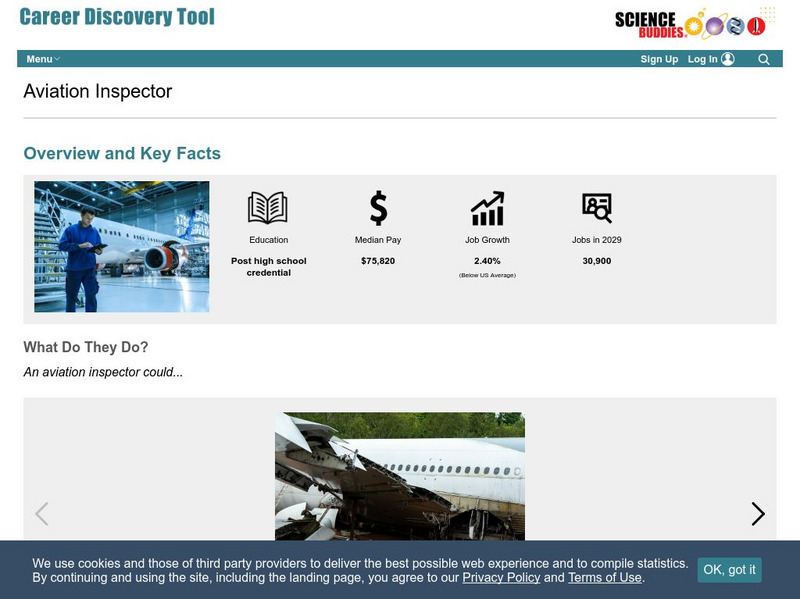
Science Buddies: Career Profile: Aviation Inspector
Because of the necessity of air travel of all types, there is a need for the aviation inspector. Read about the requirements for this career, the work environment, and the education requirements. Included is a video that shows an...
Other
Elementary Science Program: Astronomy, Gr. 5 8
"Astronomy is the science that studies the Earth, the Moon and other objects in space. It has helped us discover our place in the physical universe. It is still making discoveries." This landing page gives options for students and...

Open Curriculum
Open Curriculum: Relativity and Magnetism
Understand and learn about the properties of space and time and the concept of relativity.
NASA
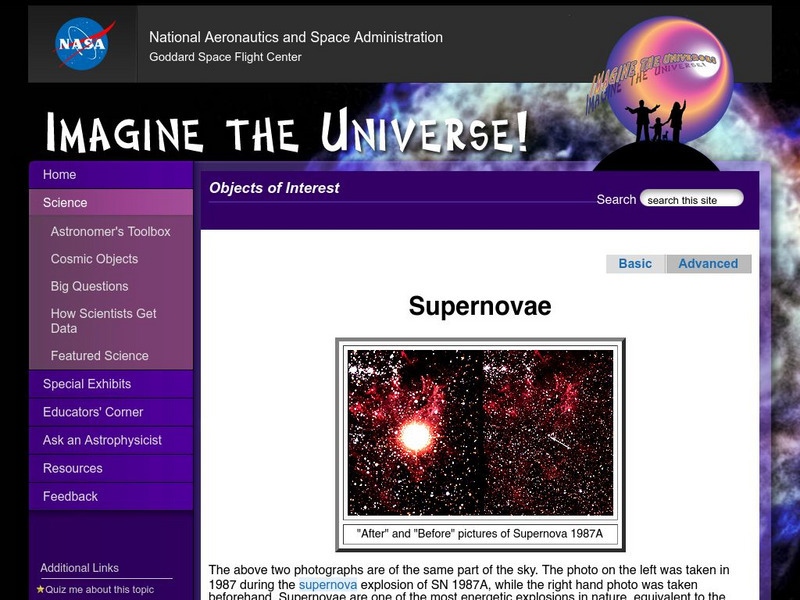
Nasa: Imagine the Universe: Supernovae (Advanced)
Supernovae are divided into two basic physical types, including a description of supernova types and how they are classified based on the existence of hydrogen spectral lines. Definitions of key terms are provided.
My Hero Project
My Hero: Stephen Hawking
Use this resource to learn about Stephen Hawking's famous contributions to the world of science and science theory despite his crippling battle with Lou Gehrig's disease.
National High Magnetic Field Laboratory
Magnet Academy: Timeline of Electricity and Magnetism: 1960 1979
Computers evolve into PCs, researchers discover one new subatomic particle after another and the space age gives our psyches and science a new context.
NASA
Nasa: Imagine the Universe: Gamma Rays From Supernovae and Supernova Remnants
Astronomers use gamma decay to study the lives of the stars.
Read Works
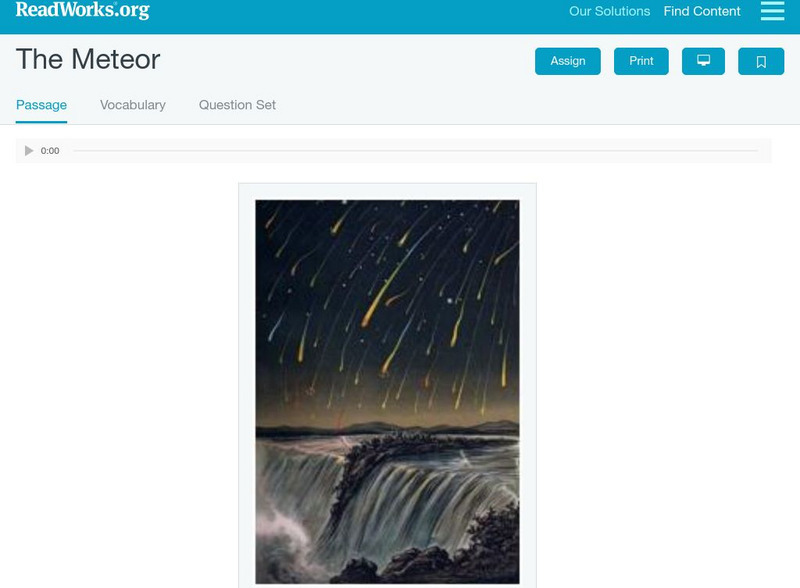
Read Works: The Meteor
[Free Registration/Login Required] An informational text about a meteor that fell to Earth in 2013 and the witnesses who documented it. A question sheet is available to help students build skills in reading comprehension.