Hi, what do you want to do?





Science Buddies
Science Buddies: How the Strength of a Magnet Varies With Temperature
Physicists sometimes study matter under extreme conditions. For example, think of the emptiness of interstellar space vs. the unimaginable crush of pressure at the center of a neutron star, or an object dipped in liquid nitrogen vs. the...

University of Florida
Florida Museum of Natural History: Kitchen Science
This guide focuses on everyday substances and how we can change their properties by adding heat or cold, physically manipulating them, or mixing them together.

PBS
Pbs Learning Media: Matter's Physical Properties: Interactive Lesson
In this interactive lesson, learn what the "physical properties" of matter are and how can they be measured and observed.
Nobel Media AB
The Nobel Prize: Press Release: The Nobel Prize in Physics 2016
The Royal Swedish Academy of Sciences has decided to award the Nobel Prize in Physics 2016 with one-half to David J. Thouless of University of Washington and the other half to both F. Duncan M. Haldane of Princeton University and J....

Alabama Learning Exchange
Alex: What's the Matter: Concentration Game
What's the Matter? is a guided inquiry lesson on classification of matter, physical and chemical properties, and physical and chemical changes. There are two parts to this lesson: (a) concentration game for definitions and (b)...

Alabama Learning Exchange
Alex: What's the Matter: A Sinker or Floater?
Students will explore matter that sinks or floats when submerged in water and that matter is categorized as either a sinker or a floater. Students will work actively in small, cooperative learning groups as well as gather in a whole...
Science Struck
Science Struck: Basics of Quantum Mechanics for Dummies
A good explanation of basic quantum theory.

Open Curriculum
Open Curriculum: Simplifying the Energy Zoo
Physics students find out how to effectively define and clarify kinetic and potential energy.

Open Curriculum
Open Curriculum: The Ray Model of Light
Students will understand the concept of the ray model of light and how light interacts with matter and reflections.
University of California
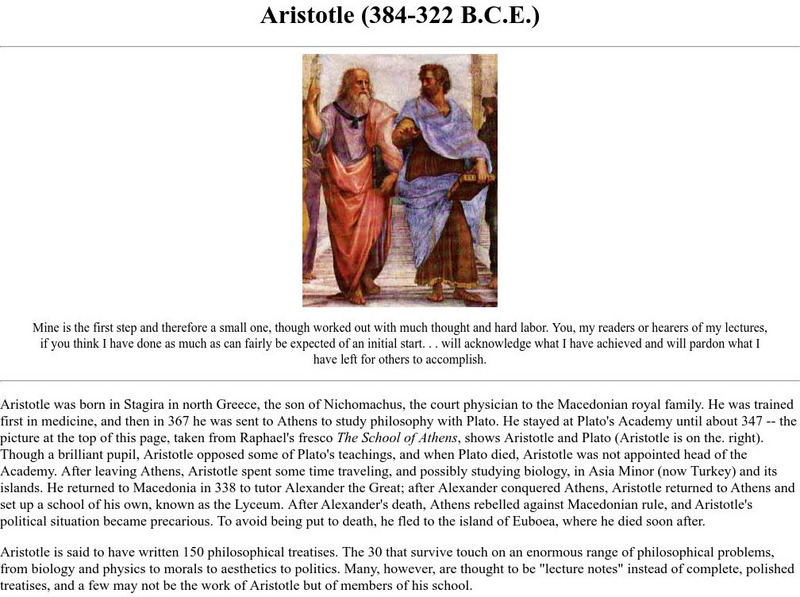
Ucmp: Aristotle
The life and philosophical treatises of Aristotle (384-322 BCE) are surveyed, including his writings on biology, zoology and physics.

Open Curriculum
Open Curriculum: Acceleration and Free Fall
These notes and illustrations will help you understand the concept and properties of acceleration.

Open Curriculum
Open Curriculum: Analysis of Forces
This study information helps students apply Newton's third law and understand forces.

Open Curriculum
Open Curriculum: Capacitance and Inductance
Students learn about capacitors and inductors and their role in electrical circuits.

Open Curriculum
Open Curriculum: Conservation of Momentum
This article helps students understand and apply Newton's third law and the conservation of momentum.

Open Curriculum
Open Curriculum: Electricity and Circuits
This article helps students understand the concepts of electricity and circuits.

Open Curriculum
Open Curriculum: Force and Motion
This article helps students learn about Newton's laws of motion and the properties of force.

Open Curriculum
Open Curriculum: Free Waves
With this article, students can learn about and understand the concept of wave motion.

Open Curriculum
Open Curriculum: General Relativity
Read this article to help understand and describe Einstein's general theory of relativity.

Open Curriculum
Open Curriculum: Newton's Laws in Three Dimensions
Students can use this article to learn about forces and motions in three dimensions.

Open Curriculum
Open Curriculum: The Nonmechanical Universe
Students learn about the fields of force and gravity in this illustrated article.

Open Curriculum
Open Curriculum: Thermodynamics
Students learn about the conservation of energy, aspects that affect energy in a system such as pressure and temperature, and to gain a better understanding of concepts such as entropy.

Open Curriculum
Open Curriculum: Vectors and Motion
Learn more about the properties of velocity, acceleration, and force vectors in this illustrated article.

Open Curriculum
Open Curriculum: Bounded Waves
To understand how bounded waves behave and how reflection of waves affects the wave components.

Open Curriculum
Open Curriculum: Circular Motion
Students learn about uniform and non-uniform circular motion in this illustrated article.