Hi, what do you want to do?





University of Florida
Florida Museum of Natural History: Physical Science
This guide focuses on four physical science topics that fascinate children and scientists alike. They are motion, magnets, sound, and light. With your guidance and support, these topics provide children with many opportunities to explore...
Exploratorium
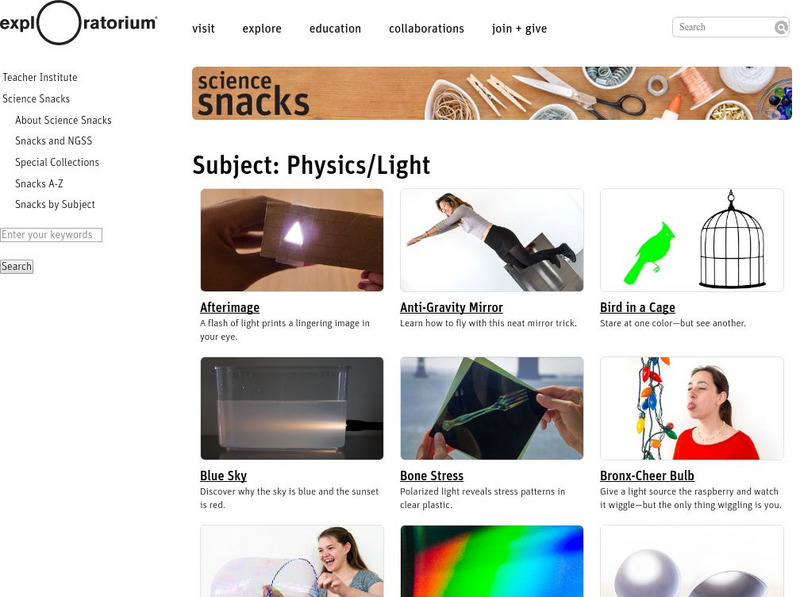
Exploratorium: Science Snacks: Physics/light
Here is a large collection of simple science class activities for understanding the physics of light.
Science Buddies
Science Buddies: How Does Color Affect Heating by Absorption of Light?
Light is an example of an electromagnetic wave. Electromagnetic waves can travel through the vacuum of interstellar space. They do not depend on an external medium-unlike a mechanical wave such as a sound wave which must travel through...
Science Buddies
Science Buddies: Measuring Light Intensity Using the Inverse Square Law
You've probably heard that compact fluorescent light bulbs are more efficient than incandescent bulbs. More of the electricity they use goes into producing light, and less into producing heat than with incandescent bulbs. How much more...
Science Buddies
Science Buddies: Measuring the Speed of 'Light' With a Microwave Oven
In this experiment, you will measure the speed of light using a microwave oven, some egg white, and a ruler. This short project proves to be an extremely interesting choice for a science lab, with pictures for illustration, and thorough...
Science Buddies
Science Buddies: Absorption of Radiant Energy by Different Colors
In this science fair project, use an infrared thermometer to measure the temperature of differently colored paper exposed to sunlight, and calculate energy emission using the Stefan-Boltzmann equation. Find discussion questions, a list...
Science Buddies
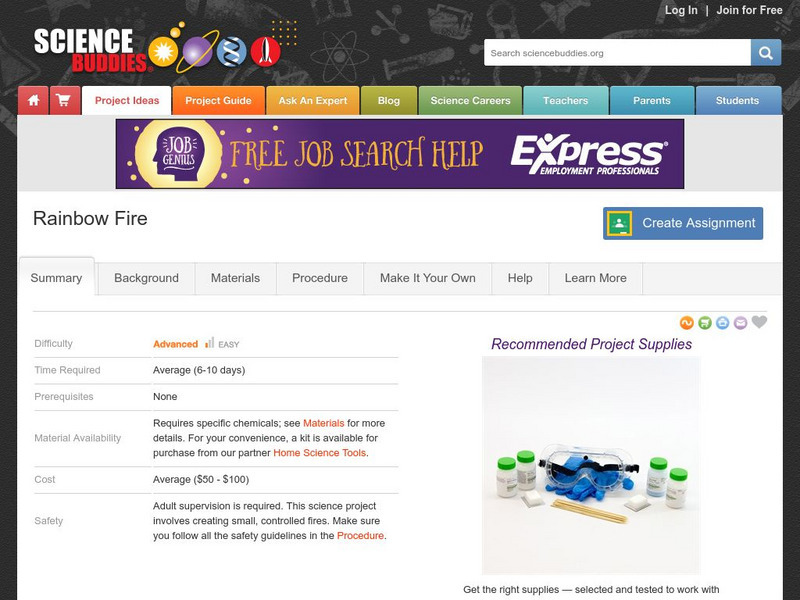
Science Buddies: Rainbow Fire
Astronomers can determine the atomic composition of distant stars by measuring the spectrum of light emitted by the star. Sound cool? Well in this project you can do something similar by observing the color of flames when various...
Science Buddies
Science Buddies: Project Ideas: How Primary Colors Combine to Make New Colors
In this science fair project, paint color pie slices onto a wheel and spin the wheel on an electric drill. See how colors add together to make new colors. The Science Buddies project ideas are set up consistently beginning with an...
Science Buddies
Science Buddies: Don't You Fret! Standing Waves on a Guitar
In this project, you will investigate the physics of standing waves on guitar strings. You will learn about the different modes (i.e., patterns) of vibration that can be produced on a string, and you will figure out how to produce the...
Utah Education Network
Uen: I'm So Bright! I Wear My Shades Indoors!
This lesson engages students in learning about light through multiple sources. Students will learn how light is produced, reflected, refracted, and separated. Students will communicate their findings through an independent project that...

Ducksters
Ducksters: Physics for Kids: Behavior of Light as a Wave
Kids learn about the behavior of light as a wave in the science of physics including reflection, refraction, and diffraction.

Ducksters
Ducksters: Physics for Kids: Light Spectrum
Kids learn about the science of the light spectrum. Wavelengths and frequencies of the electromagnetic waves including visible light, primary colors, and subtractive colors.
Nobel Media AB
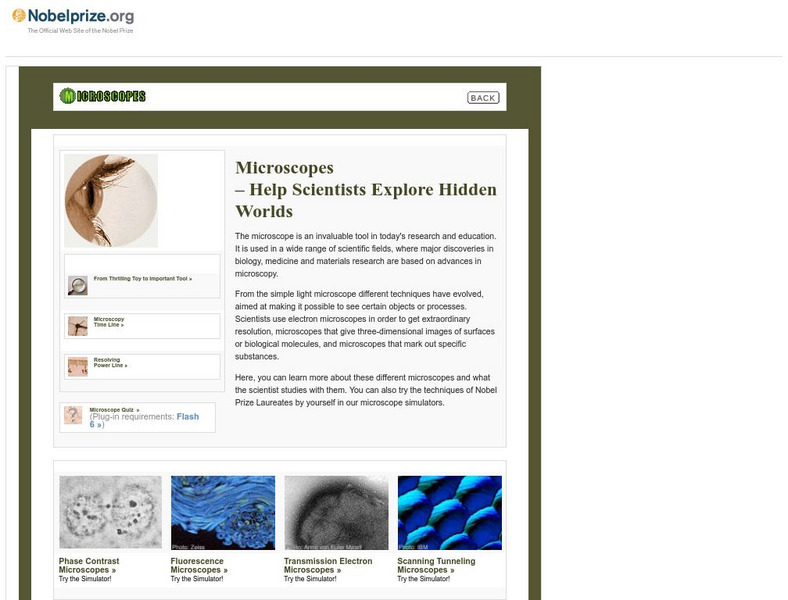
The Nobel Prize: Microscopes Help Scientists Explore Hidden Worlds
This is a site full of information about various microscopes and the objects and processes scientists study with them. Includes timelines and interactive simulations.
TED Talks
Ted: Ted Ed: How Quantum Mechanics Explains Global Warming
You've probably heard that carbon dioxide is warming the Earth. But how exactly is it doing it? Lieven Scheire uses a rainbow, a light bulb and a bit of quantum physics to describe the science behind global warming. [5:01]