Hi, what do you want to do?





Science Buddies
Science Buddies: Centripetal Force
What keeps you in your seat of a giant loop-de-loop roller coaster? Surprisingly, it is not the seatbelt but the seat. It works because of something called centripetal force and it does much more than make a great roller coaster. In this...
Science Buddies
Science Buddies: Getting Critical Over Colloids
What is a colloid? If you have made Oobleck out of corn starch and water, then you know that a colloid is a mixture that acts like a solid and a liquid at the same time. This activity helps you determine the critical factors that...

American Chemical Society
American Chemical Society: Science for Kids: Chemical and Physical Change
Engaging hands-on science lessons for grades 2-6 on chemical and physical changes.

Science Buddies
Science Buddies:brain Body Connection: Can Exercise Make Our Brains Work Better?
We all know physical exercise is important to keeping our bodies fit. But how important is physical exercise to your brain? In other words, is there any connection between an active body and increased brain power? This is an easy project...

Science Buddies
Science Buddies: Heart Health: How Does Heart Rate Change With Exercise?
Your heart starts beating before you are born and keeps right on going through your whole life. Over an average lifetime, the human heart beats more than 2.5 billion times. Keeping your heart healthy means eating right, not smoking, and...

Science Buddies
Science Buddies: Investigate Alien Genetics
In this activity, you will use an alien model to demonstrate how genes or physical traits are passed on from parents to their offspring.
Other
Science Hobbyist: Sticky Electrostatics
A series of activities focusing on charge interactions, charging methods, and the conservation of charge. Activities utilize scotch tape and other readily available items. Includes explanations of what is happening.
Exploratorium
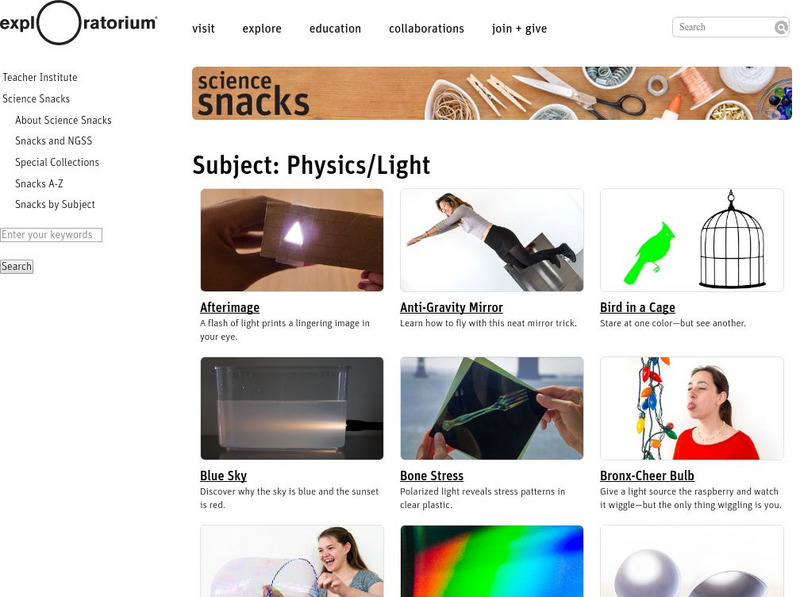
Exploratorium: Science Snacks: Physics/light
Here is a large collection of simple science class activities for understanding the physics of light.
Centers for Disease Control and Prevention
Centers for Disease Control: Science Ambassador Fellowship: Lesson Plans
This site gives many lesson plans for teaching middle and high school students about current and relevant science topics like autism, ADHD, Diabetes, Fetal Alcohol Syndrome, birth defects, genetics, and more. The lessons are based on...
Other
Arbor Scientific: Haunted Laboratory: Halloween Physics
This resource presents a collection of experiments for the science classroom that focuses on physics concepts for Halloween. Activities include mirror ghost with a concave mirror, apple oscillators with pendulums, and a pumpkin pendulum....
American Geosciences Institute
American Geosciences Institute: Earth Science Week: Properties of Fluids in Reservoirs
This investigation will help students understand the physical relationships between natural gas, oil, and water in a reservoir and how these relationships can affect recovery.

Alabama Learning Exchange
Alex: Let's Get Physical! (Or Chemical Weathering)
This lesson helps learners learn the differences between physical and chemical weathering. Students will complete various activities in which they identify and describe the type of weathering that is taking place.This lesson plan was...
CPALMS
Help Pick Your Class Pet
[Free Registration/Login Required] During this MEA simulation, kindergarten students will be given the power of slelecting a classroom pet. Students, working in collaborative groups, must collect data about different potential classroom...
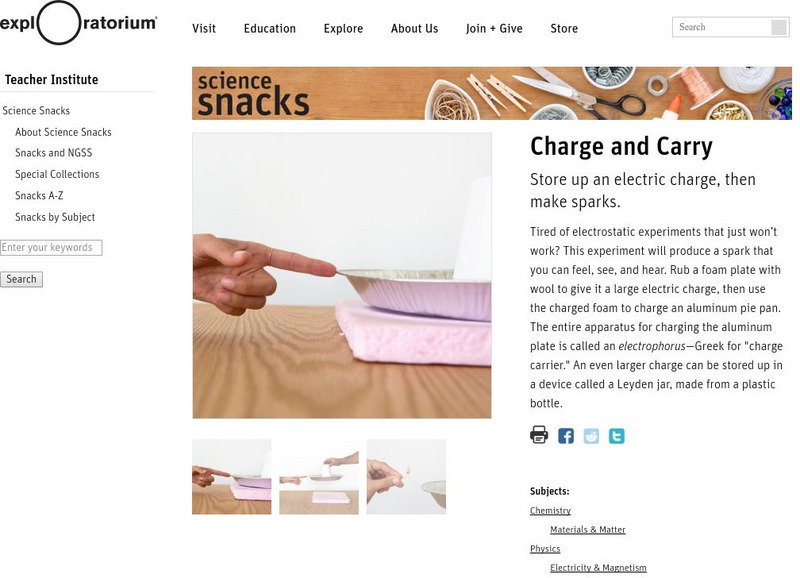
Exploratorium
Exploratorium: Science Snacks: Charge and Carry
This site from The Exploratorium Museum is a full description of a short activity. An electrophorus plate and a Leyden jar are made. The electrophorus is charged by induction. Its charge is transferred to the Leyden jar by conduction...
TeachEngineering
Teach Engineering: Riding the Gravity Wave
Students write a biographical sketch of an artist or athlete who lives on the edge, riding the gravity wave, to better understand how these artists and athletes work with gravity and manage risk. Note: The literacy activities for the...
Other
Science Alive: Synthetic vs. Natural: What's the Difference?
Explains the difference between a synthetic compound and one found in its natural state. Uses the example of Percy Julian and Josef Pikl making the compound physostigmine, a medicine that was used in the treatment of glaucoma, in their lab.

OpenStax
Open Stax: Catherine Schmidt Jones: Sound and Music
Introduce some activities that introduce students to the physics of sound. They will also learn how various instruments produce sound. Included are downloadable pdf worksheets and answer sheets to use.
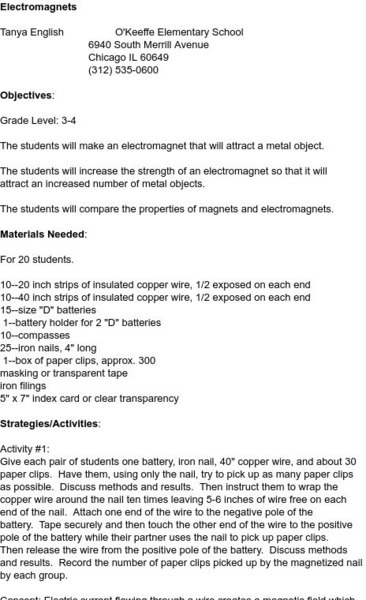
Science and Mathematics Initiative for Learning Enhancement (SMILE)
Smile: Electromagnets (Grades 3 and 4)
This lesson helps learners to understand the difference between magenets and electromagnets. They will also create an electromagnet.
PBS
Pbs Learning Media: Floating and Sinking: Hot Air Balloons
Why do hot air balloons float? This resource from the NOVA Web site offers a series of interactive activities that illustrates the physics of hot air balloons.
PE Central
Pe Central: Pe Lesson Ideas: Aerobic Frisbee Golf
The physical activity described at this website combines cardiovascular fitness exercises (frisbee, push-ups, jumping jacks) and academic subjects math and science.
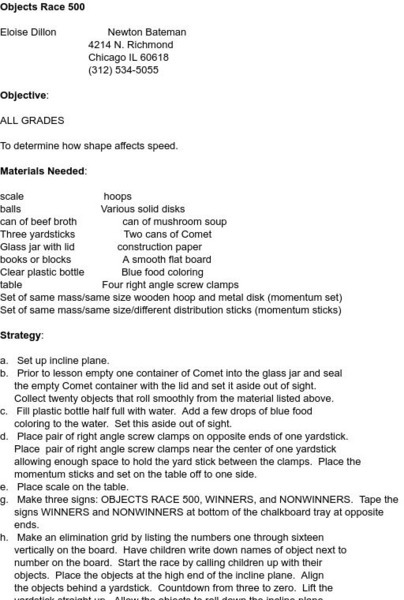
Science and Mathematics Initiative for Learning Enhancement (SMILE)
Smile: Objects Race
In this lesson plan grab a slope and different objects. Roll the objects down the slope and record which is the fastest. Students analyze the features of the objects that make them slow or fast.
Science and Mathematics Initiative for Learning Enhancement (SMILE)
Smile: Colliding Spheres
This lab activity from the Illinois Institute of Technology lets students investigate the impact of collisions upon the velocity and momentum of the colliding objects. Requires understanding of vectors.

Alabama Learning Exchange
Alex: The Study of Human Geography
Geographers are social scientists who are interested in human activities as well as the physical environment. Human geography includes a wide range of topics, such as the study of languages, religions, customs, economics, and political...
Science and Mathematics Initiative for Learning Enhancement (SMILE)
Smile: Potential Energy: How Is It Related to Kinetic Energy
After creating three different ramps with various heights, students will release toy cars from the tops of each ramp. Based on the elementary age level, students will collect data and analyze it.