Hi, what do you want to do?






Curated OER
Graphing San Diego Tides
Pupils observe the tides in San Diego for one month. Using this information, they graph the tides on a chart along with the phases of the moon. They answer questions related to the graph to end the lesson.

Curated OER
Energy Defined
Fourth graders complete activities to study the sources of energy and forms. In this energy lesson, 4th graders discuss the origin of energy and define it. Students participate in several experiments to further study energy including a...

Curated OER
The Interactive Periodic Table of the Elements
Students study the different types of metals. In this investigative instructional activity students watch a demonstration on the effects of temperature on atoms and take a tour through baone matter.

LABScI
Viscosity: The Fluid Lab
There's more to fluids than meet the eye—they include gases, liquids, and polymers, too! Scholars complete three hands-on activities exploring different properties of fluids. They explore viscosity by measuring the resistance, or...

Curated OER
Science Jeopardy
Make reviewing evolution, cell division, genetics, cell structure, and scientific method more fun! Science Jeopardy allows teams to choose a category for the question they will address. If you complete the entire game, learners will have...

Curated OER
Melting Ice is Hot Stuff!
Fourth graders determine the amount of energy required to melt ice using a calorimeter. They calculate the Molar Heat of Fusion of Ice.

Curated OER
Physical and Chemical Properties of Matter
Students identify the physical and chemical properties of matter. They review the types of matter. Students list the four states of matter (Solid, Liquid, Gas and Plasma). They recognize and describe the different types of matter.

Chem Tutor
Chemtutor: Walking Up the Phase Change Graph
Good exercise graphing a phase change graph from solid to liquid to graph. Includes temperatures and all energy changes for water through this process.
Frostburg State University
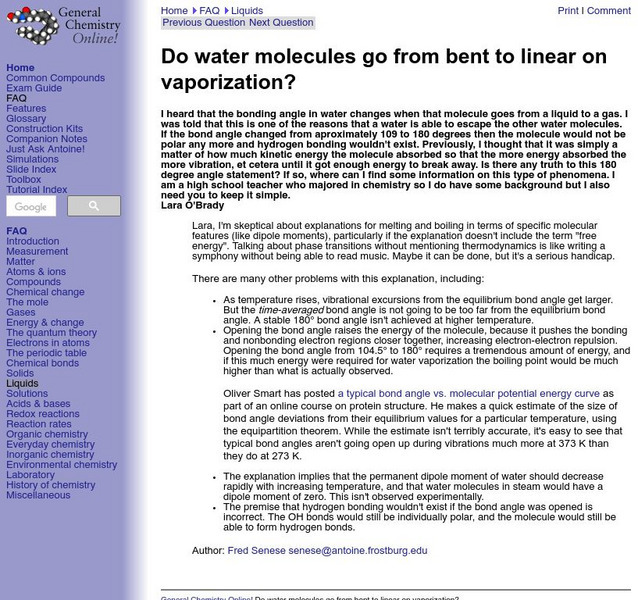
Frostburg State Chemistry Online: Water Bond Angles & Phase Changes
Describes the bond angle of the water molecule during the transition from liquid to gas state. Also provides several examples and explanations for responses and answers given.
National Association of Geoscience Teachers
Nagt: Demonstrating Climate Change and the Water Cycle
Demonstration of the greenhouse effect and its role in climate change, discussion of the phases of water and the water cycle, and a hands-on experiment to investigate the role of temperature in phase changes of water.
University Corporation for Atmospheric Research
Ucar: Just a Phase: Water as a Solid, Liquid, and Gas
This site helps students construct a model of the arrangement of water molecules when present as solid, liquid or gas. Includes background information, lesson plans, links to standards and assessment ideas.
Chem Tutor
Chem Tutor: Chemistry: States of Matter
This lesson focuses on the states of matter: solids, liquids, and gases. It also discusses the Kinetic Theory of Matter, Thermodynamics, Triple point, Phase Change Graphs and the Heating Curve of Water. It provideds adrawing of a heating...
Other
Water on the Web: Studying Heat Budgets of Lakes
Interesting activity that discusses many aspects of the energy in a lake, including the evaporation of the water into gas.
New York University
New York University: States of Water
Use this resource to learn about the three different phases of water; solid, liquid, and gas. What happens to water as it changes into a solid or gas? Includes short and easy to do activity.
Museum of Science
The Atom's Family: Phases of Matter
Help the Phantom choose a material and observe the changes at different temperatures in the molecule chamber. What happens to the elements or molecules as the temperature changes?
University of Maryland
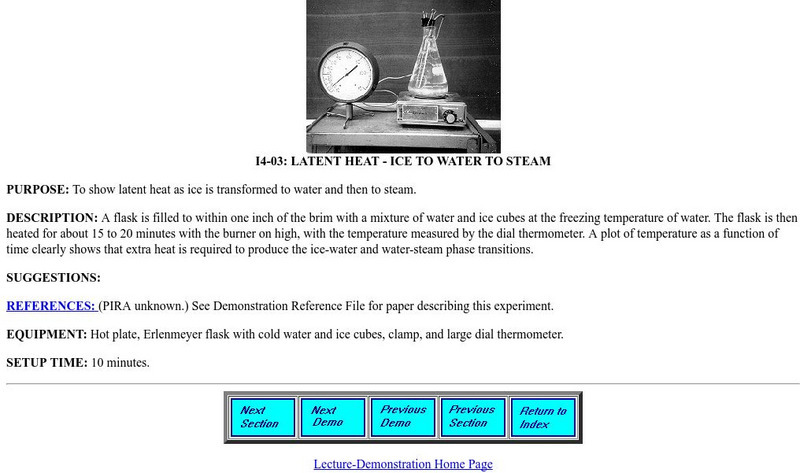
U. Of Maryland: Latent Heat: Ice to Water to Steam
A page from the University of Maryland Physics Lecture Demonstration Facility. Provides directions for a teacher demonstration of latent heat in the melting and vaporization process. Shows apparatus and set-up; provides suggestions....
University of Sydney (Australia)
University of Sydney: Structure and Properties of Materials/thermal Physics
An exhaustive set of "lecture notes" on various topics in thermal physics (including thermal expansion). Explanations are well done and more interesting than most. Includes both a mathematical and conceptual treatment of topics. Humor,...
Scientific American
Scientific American: What Is an Exothermic Reaction
Scientific American magazine, in the person of Dr. Gerald R. Van Hecke, gives a wonderfully complete answer to this question. Complete with very many hot words for additional background. And a wonderful NASA launch photo.

Science Buddies
Science Buddies: What's the Point of Boiling?
You know that water can exist in three separate phases: solid (ice), liquid (water), and vapor (steam). To change from one phase to another, you simply add (or remove) heat. When water boils, what happens to molecules (for example sugar...
TeachEngineering
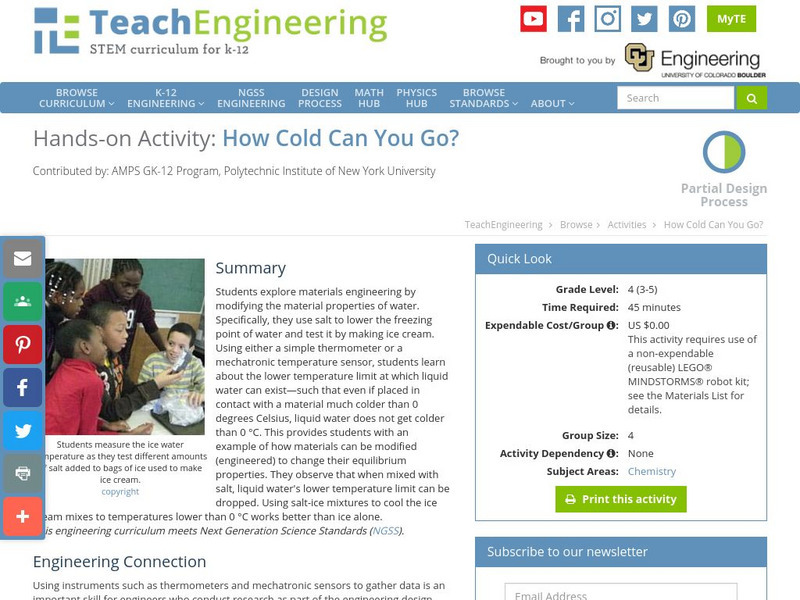
Teach Engineering: How Cold Can You Go?
Students explore materials engineering by modifying the material properties of water. Specifically, they use salt to lower the freezing point of water and test it by making ice cream. Using either a simple thermometer or a mechatronic...
TeachEngineering
Teach Engineering: Natural Disasters
Students are introduced to our planet's structure and its dynamic system of natural forces through an examination of the natural hazards of earthquakes, volcanoes, landslides, tsunamis, floods and tornados, as well as avalanches, fires,...
Other
Science Alive: Melting Point Simulation
Percy Julian and Josef Pikl used the fact that melting point-the temperature at which a substance changes from a solid to a liquid-is a characteristic property of a substance to prove that the British chemist Robert Robinson could not...