Hi, what do you want to do?






Curated OER
Plant Life Cycle
Fourth graders explore the plant life cycle. They discuss the sequence of events in the life cycle of the plant and illustrate how the life cycle never ends. Students explore the importance of water, sunlight, and nutrients during the...

Curated OER
Taking Action Against Child Labour
Students identify and clarify a problem, issue or inquiry, locate and record information from a variety of sources and identify alternative interpretations from specific historical and contemporary sources. They asses at least two...

Curated OER
Creating Public Awareness - Indoor Air Quality
Students design a poster about indoor air quality. In this indoor air quality lesson, students make a billboard that tells the occupants of a building about at least one air quality problem.

Curated OER
Identifying Indoor Environment Pollution Sources (List, Group, Label Activity)
Students identify the cause of indoor air pollution. For this indoor air pollution lesson, students list, group, and label sources of indoor pollution. They brainstorm a list of all of the indoor pollutants they can think of before...

Curated OER
Breaking News: International Coalition Attacks Libya (March 20th, 2011)
Young scholars explore current events by completing a list of worksheet activities. In this Libyan history lesson, students read a news article discussing the problems with Gaddafi in Libya and the effect it is having in the Middle East....

Curated OER
Science: Water States
First graders investigate the various forms of water. They discuss the properties of water. They discover examples of water's various states and locate other solids, liquids, and gases in their homes.

Curated OER
Once In a Blue Moon
Students review the characteristics of the planets and their moons. Using the internet, they research the relationship between the Earth and its moons. They take a template of the moon and draw craters of different colors to present to...

Curated OER
Secrets of the Ocean Realm - In the School "Star Gardens"
Learners learn to use a tide table in plotting tidal curves and create a tide calendar by plotting a month-long tidal curve on an ordinary pictorial calendar.

Curated OER
Study of the Cell
Students draw a diagram to show the fluid mosaic model of a membrane. They explain how hydrophobic and hydrophilic properties help membranes hold their shape. They identify the functions of different cell membrane proteins as well.

Curated OER
The Interactive Periodic Table of the Elements
Students study the different types of metals. For this investigative lesson students watch a demonstration on the effects of temperature on atoms and take a tour through baone matter.

Curated OER
Focused Learning Lesson: American History
Eleventh graders compare and contrast the type of immigrant that came to America during the 19th and 20th centuries. They write letters as if they were immigrants coming to America and what they faced and their hopes for the future.
TeachEngineering
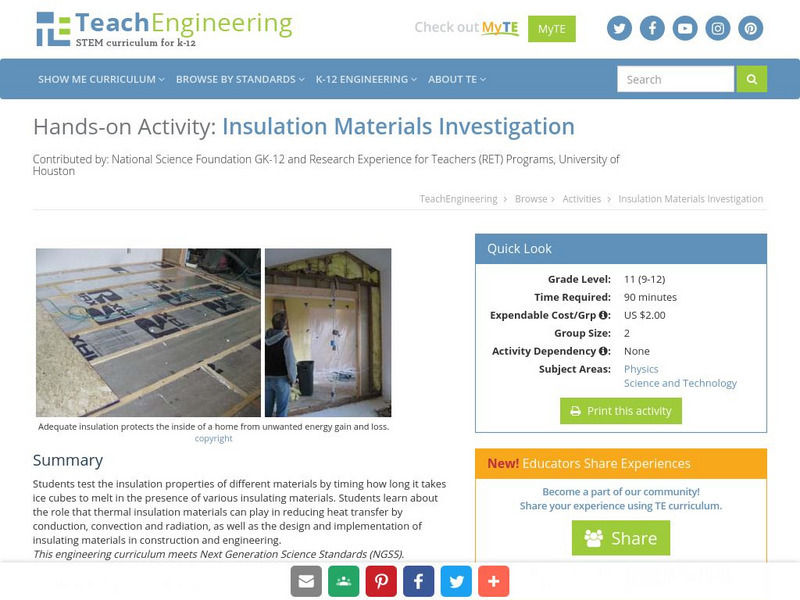
Teach Engineering: Insulation Materials Investigation
Students test the insulation properties of different materials by timing how long it takes ice cubes to melt in the presence of various insulating materials. Students learn about the role that thermal insulation materials can play in...
University of Sydney (Australia)
University of Sydney: Structure and Properties of Materials/thermal Physics
An exhaustive set of "lecture notes" on various topics in thermal physics (including thermal expansion). Explanations are well done and more interesting than most. Includes both a mathematical and conceptual treatment of topics. Humor,...

Chem Tutor
Chem Tutor: Chemistry: States of Matter
This lesson focuses on the states of matter: solids, liquids, and gases. It also discusses the Kinetic Theory of Matter, Thermodynamics, Triple point, Phase Change Graphs and the Heating Curve of Water. It provideds adrawing of a heating...
Science Buddies
Science Buddies: Project Ideas: Explore the Chemistry Within Hand Warmers
Determine how the starting temperature affects crystal growth and heat generation of a hand warmer in this chemistry science fair project. The Science Buddies project ideas are set up consistently beginning with an abstract, objective,...
TeachEngineering
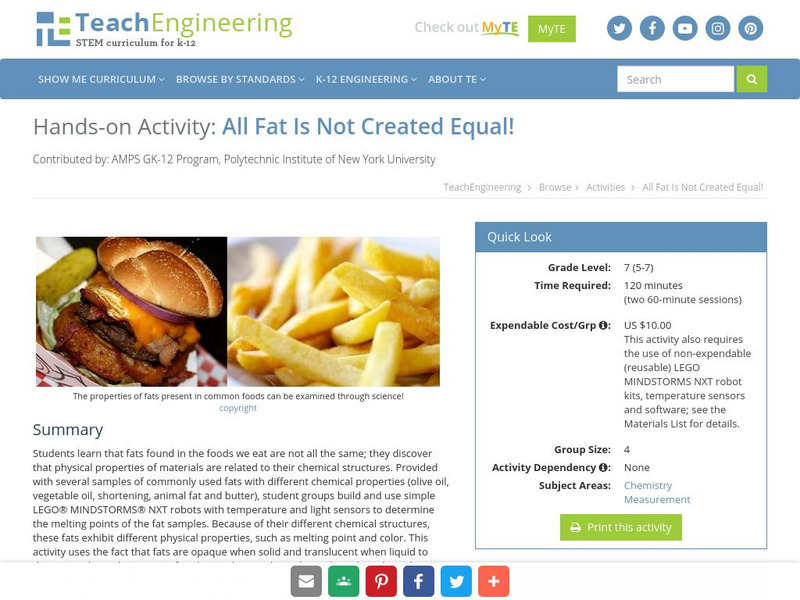
Teach Engineering: All Fat Is Not Created Equally!
Students learn that fats found in the foods we eat are not all the same; they discover that physical properties of materials are related to their chemical structures. Provided with several samples of commonly used fats with different...
Museum of Science
The Atom's Family: Phases of Matter
Help the Phantom choose a material and observe the changes at different temperatures in the molecule chamber. What happens to the elements or molecules as the temperature changes?
TeachEngineering
Teach Engineering: How Cold Can You Go?
Students explore materials engineering by modifying the material properties of water. Specifically, they use salt to lower the freezing point of water and test it by making ice cream. Using either a simple thermometer or a mechatronic...
PBS
Pbs Learning Media: The Moon Over a Month: Lesson Plan
Students observe, identify, and describe how the Moon appears to change over the course of a month. They engage with a media slideshow of real-life images to describe how the Moon appears to change in a predictable pattern each month. It...
Center of Science and Industry
Cosi Columbus: Can You Stand the Pressure
Science experiment that demonstrates the four states or phases of matter: solid, liquid, gas, and plasma. Includes full list of materials, procedures, and scientific explanation of how you change water from a liquid state to a gaseous...
TeachEngineering
Teach Engineering: Natural Disasters
Students are introduced to our planet's structure and its dynamic system of natural forces through an examination of the natural hazards of earthquakes, volcanoes, landslides, tsunamis, floods and tornados, as well as avalanches, fires,...