Hi, what do you want to do?






Davidson College
Davidson College: Visualization of Atomic Orbitals: P Orbitals
Discusses the geometry of the p orbitals and presents exercises for exploring their shape and orientations. Requires Java.
Davidson College
Davidson College: Visualization of Atomic Orbitals: S Orbitals
Discusses the geometry of the s orbitals and presents exercises for exploring their shape and orientations. Requires Java.
Davidson College
Davidson College: Visualization of Atomic Orbitals
Discusses the geometry of the d orbitals and presents exercises for exploring their shape and orientations. Requires Java.
Chem4kids
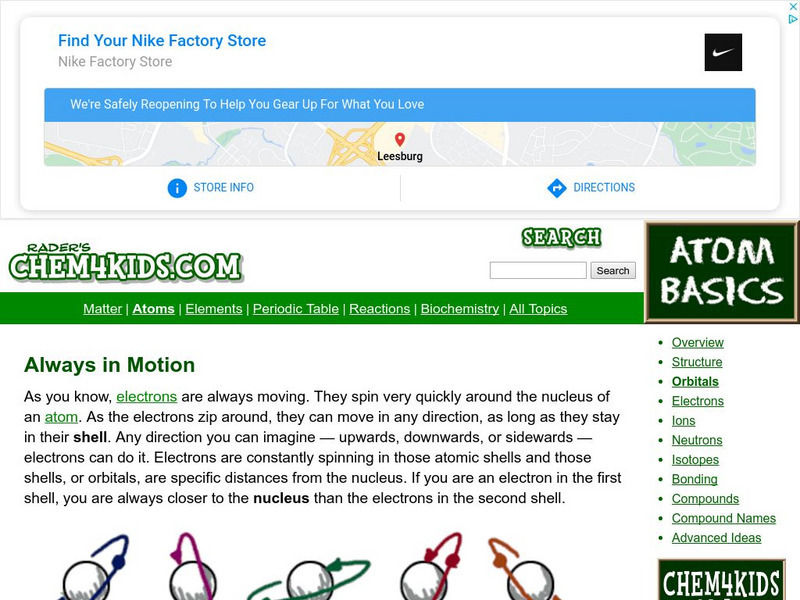
Chem4 Kids: Atoms: Orbitals
The website provides an explanation of the electrons' position in their orbitals as they spin around the nucleus. Quantum theory is also explored by explaining that the exact location of a specific electron is a not exact but a guess.
Harvard University
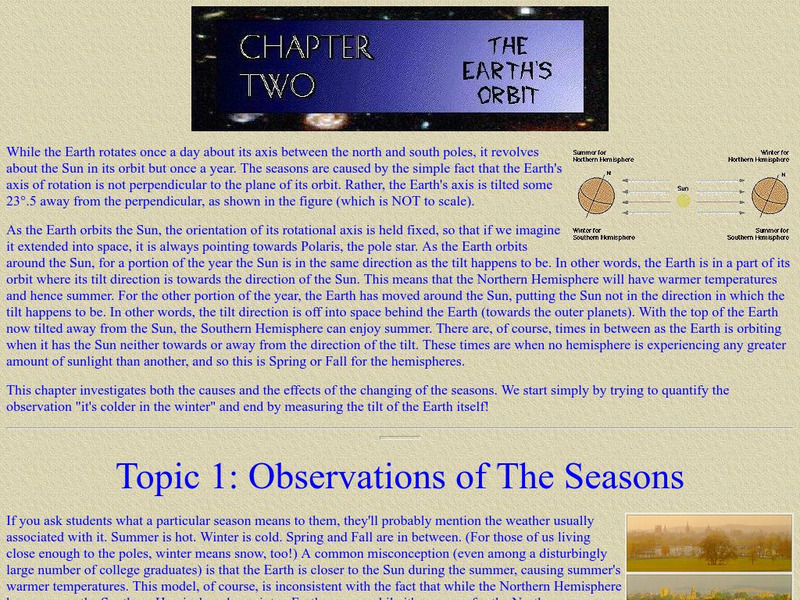
Eyes on the Sky, Feet on the Ground: The Earth's Orbit
Students perform many inquiry activities related to Earth's orbit. Included are recording daily temperatures, observing the sun's path over several weeks, tracking sunrise and sunset times, and angle of sunlight. Diagrams make lessons...
NOAA
Noaa: Satellites in Orbit [Pdf]
Construct a model that helps to show how satellites stay in orbit around the Earth. Then see how a flashlight can help explain how a satellite can send messages to different locations.
Physics Classroom
The Physics Classroom: Satellite Motion
An animation depicting the path of projectiles launched at various launch speeds from the fictional Newton's Mountain. Accompanying text discusses satellite motion and the requirements of orbital motion. Links to further information is...
Physics Classroom
The Physics Classroom: Energy Relationships for Satellites
The orbits of satellites are described and an energy analysis is performed. Kinetic, potential and total mechanical energy are explained and applied to the motion of satellites.

Arcademics
Arcademics: Orbit Integers
Select the correct answer by adding integers to advance your spacecraft.
PBS
Pbs Learning Media: Why Doesn't the Moon Fall Down?
In this animated video segment adapted from NASA, astronomer Doris Daou explains how the forces of speed and gravity keep the moon in a constant orbit around Earth. [1:36]
TeachEngineering
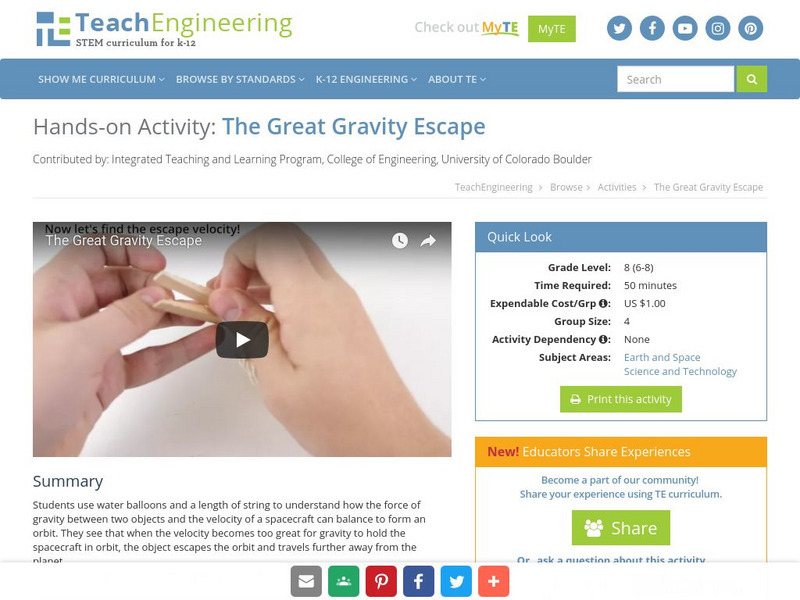
Teach Engineering: The Great Gravity Escape
Young scholars use water balloons and a length of string to understand how gravity and the velocity of a spacecraft balance to form an orbit. They see that when the velocity becomes too great for gravity to hold onto an object, the...
OpenStax
Open Stax: Satellites and Kepler's Laws: An Argument for Simplicity
In the following interactive students will begin to understand the laws of Kepler regarding planetary motion and derive the third law of Kepler for circular orbits. They will also discuss the Ptolemaic model of the universe.
Annenberg Foundation
Annenberg Learner: Moon Journal Activity
Students use the process of journaling to make discoveries about the moon. This activity involves having students write observations about the moon in a journal. Using their observations they go to an online resource and choose...
PBS
Pbs Learning Media: Solar System Scale Model
Teach the concept of scale models and the size of the solar system through this extensive lesson plan. Young scholars will learn about scale models, estimate which objects to use to create a scale model of Earth and Sun, and figure out...
Other
University of Texas: Tabled Discussion
At this University of Texas site, atomic orbital occupancy, quantum numbers, the Aufbau Principle, and periodic trends are described in detail.
NASA
Nasa: Kepler's Third Law
This site from NASA states Kepler's third law of motion and extends it to develop an equation for the velocity of an orbiting planet.

TeachEngineering
Teach Engineering: A Roundabout Way to Mars
Students explore orbit transfers and, specifically, Hohmann transfers. They investigate the orbits of Earth and Mars by using cardboard and string. Students learn about the planets' orbits around the sun, and about a transfer orbit from...
TeachEngineering
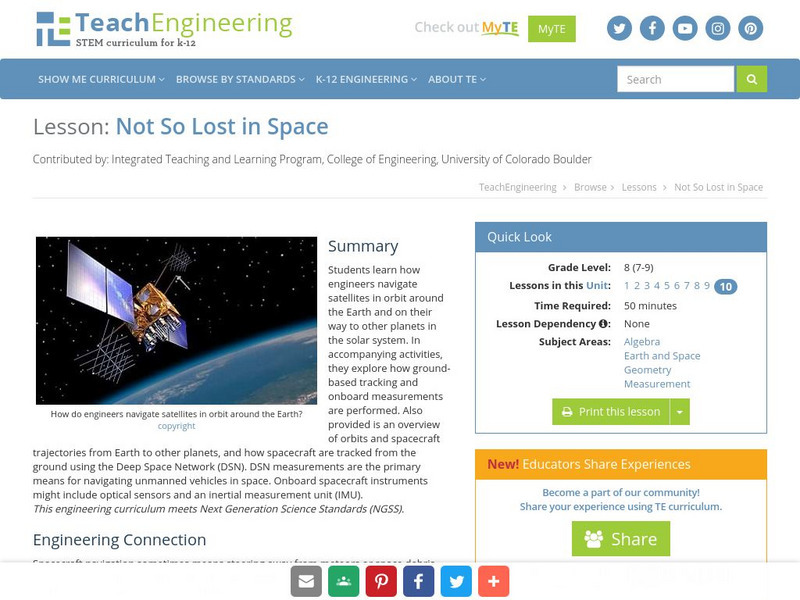
Teach Engineering: Not So Lost in Space
Students learn how engineers navigate satellites in orbit around the Earth and on their way to other planets in the solar system. In accompanying activities, they explore how ground-based tracking and onboard measurements are performed....
Extreme Science
Extreme Science: The Moon
Read about the birth of Earth's moon, its composition, orbit, visible phases, and other interesting facts. Link to a virtual moon phase interactive which shows the current lunar phase and the phase on any date in the past or future.
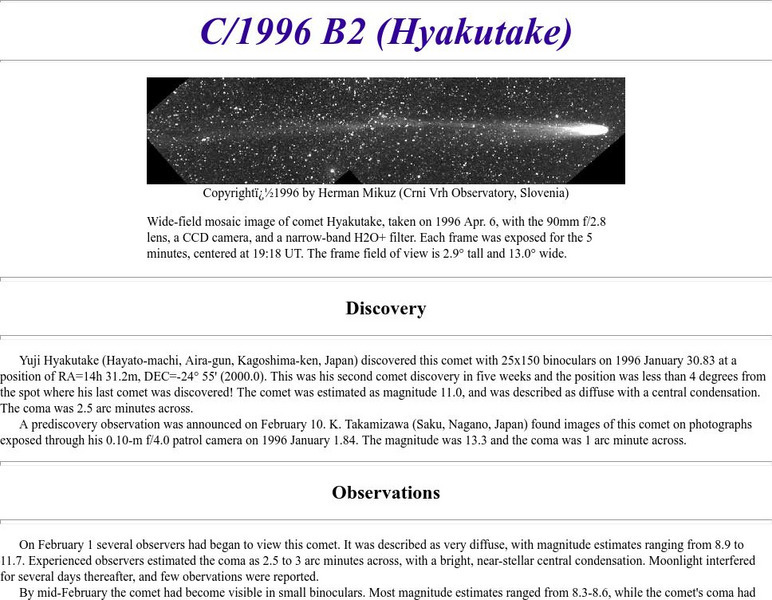
Other
Cometography.com: C/1996 B2 (Hyakutake)
This site provides a detailed overview of the comet C/1996 B2 (Hyakutake). Content includes discovery, observational, and orbit information, as well as several images.
Physics Aviary
Physics Aviary: Practice Problems: Finding Mass of a Planet
Students must determine mass of a planet based on the orbital motion of a satellite around the planet.
Science Buddies
Science Buddies: Kinesthetic Astronomy: Earth's Rotation
This kinesthetic activity will demonstrate concepts like rotation and orbit, clarify movement and direction, and help students understand why earthlings see different things in the sky.
Chiral Publishing
Chiral Publishing: An Introduction to Chemistry: Complete Electron Configurations Help
This section from the online textbook "An Introduction to Chemistry", provides some helpful hints to writing complete electron configurations. Three ways to predict the order of filling electron orbitals are given.
Other popular searches
- Orbital Diagram Atom
- Electron Orbitals
- Orbital Diagram
- Atomic Orbitals
- Orbital Space
- Orbital Notation
- Orbital Debris
- Orbital Velocity
- Hybrid Orbitals
- Orbital Motion
- Molecular Orbitals
- Orbital Geometry