Hi, what do you want to do?





Council for Economic Education
Econ Ed Link: Work, Earnings and Economics: Using Lyddie by Katherine Paterson
In reading and discussing Lyddie, by Katherine Paterson, students examine basic economic concepts and explore the growth of labor unions and the role of government in a market economy.

Council for Economic Education
Econ Ed Link: How the Crusades Led to the Finding of the New World
The lesson will help middle schoolers to discover the importance of the Crusades to the expansion of many European countries. Students will also be introduced to new products and find out why explorers were willing to risk all to locate...
Council for Economic Education
Econ Ed Link: Why Adopt a Highway?
Students learn about the successful Adopt-a- Highway program and how it can save governments and taxpayers money.
Council for Economic Education
Econ Ed Link: College: Where Am I Going to Go?
Students will use a PACED decision making grid to help them decide where they would like to attend college.
Council for Economic Education
Econ Ed Link: Trouble Is Brewing in Boston: "Colonial Voices Hear Them Speak"
It's December 16, 1773 and many of the citizens of Boston are furious with King George's new tax on tea. Young Ethan, a printer's errand boy, has been given the task of conveying information concerning an upcoming protest meeting. As he...
Council for Economic Education
Econ Ed Link: Mystery Workers: Productive Resources
This website focuses on productive resources which are divided into three categories, natural, human, and capital.
Council for Economic Education
Econ Ed Link: The Perfect Pet
Consider the economic concept of scarcity while selecting items to buy at a pet store.
Council for Economic Education
Econ Ed Link: Economic Spotter: Resources During World War Ii
In World War II pennies were made of steel and zinc instead of copper and women were working at jobs that men had always been hired to do. Why? Because during war times, scarcity forces many things to change!
Council for Economic Education
Econ Ed Link: Car Loan Project
Each student will buy (hypothetically) a car that will need to be financed. The student will need to look at different options and decide which will be the best choice for his situation. The student will need to find an advertisement for...
Council for Economic Education
Econ Ed Link: Big Banks, Piggy Banks
Use this informative economics lesson plan. Find out how to save your money. "You will read about safe places for keeping money; you also will learn about places where money can earn money."
Council for Economic Education
Econ Ed Link: Should I Use Cash or Credit?
This is a activity presented by EconEdLink that delivers the dilemma of cash or credit. Includes background information, a problem-solving grid, and great questions.
Council for Economic Education
Econ Ed Link: A Penny Saved Is a Penny at 4.7% Earned
There are lots of ways to receive income, and lots of ways to spend it. In this EconomicsMinute you will develop two budgets to help you decide how to allocate your income. Assuming you do not love making dollar bill rings.
Council for Economic Education
Econ Ed Link: A Penny Saved Is a Penny at 4.7% Earned
This is a instructional activity from EconEdLink where students learn about saving money. Includes activities and materials.
Council for Economic Education
Econ Ed Link: Green Eggs and Economics?
Economic concepts are often found in places students have never considered, like children's literature. In this lesson, students will explore the various economic concepts addressed in five of Dr. Seuss' most popular books: The Cat in...
Council for Economic Education
Econ Ed Link: Should Le Bron James Mow His Own Lawn?
This lesson will discuss absolute advantage, comparative advantage, specialization and trade with an example using professional basketball player LeBron James.
Council for Economic Education
Econ Ed Link: Specialization and the Decathlon
This lesson uses results from the 2008 Summer Olympic Games to explain that athletes specialize in sports and events for which they are most skilled for the same reasons that individuals and nations specialize in the production of goods...
Curated OER
The Production Possibilities Frontier
This site shows an good example of opportunity costs along with related production possibilities curves.
Curated OER
The Production Possibilities Frontier
This site shows an good example of opportunity costs along with related production possibilities curves.
Council for Economic Education
Econ Ed Link: No Extra Room on the Mayflower
Choose what to bring on a voyage. Space is scarce, so choices must be made about what to leave behind.

University of Nebraska Omaha
Ec Ed Web: Why Nations Trade
This lesson plan is about the reasons for International Trade.
Illustrative Mathematics
Illustrative Mathematics: 6.ee,rp 7.ee,rp Anna in d.c.
The purpose of this task is to give students an opportunity to solve a multi-step percentage problem that can be approached in many ways. Because the tax and tip in this problem are a fixed percentage of the cost of the meal, the total...
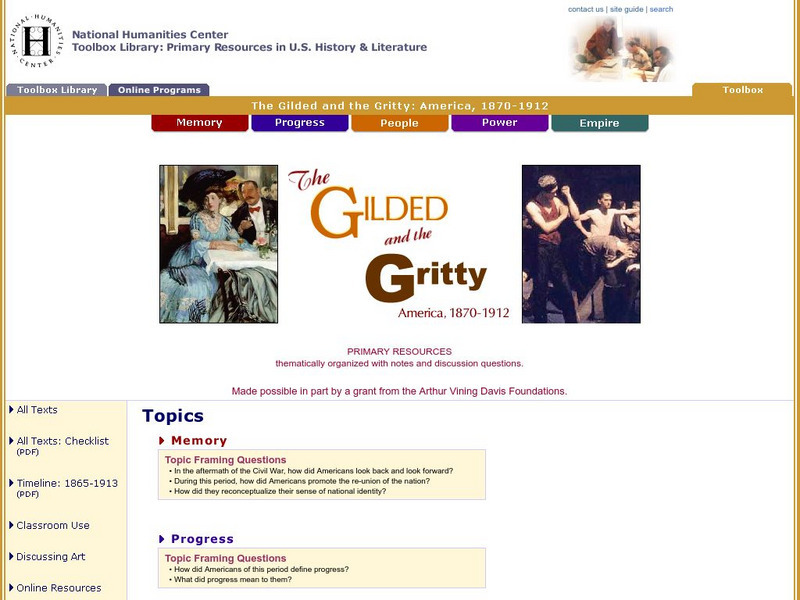
National Humanities Center
National Humanities Center: Toolbox Library: The Gilded and the Gritty: America, 1870 1912
Ninety-four primary sources-historical documents, literary texts, and visual images-that explore the challenges, opportunity, and turmoil of late-nineteenth-century America. They examine the economic expansion in an America re-united...
Scholastic
Scholastic Lesson Plan: Alexander, Who Used to Be Rich..
This multipart lesson plan the cost of opportunities when you have limited resources. It uses the hilarious children's book, "Alexander, Who Used to Be Rich Last Sunday" by Judith Viorst to drive the lesson home.
Khan Academy
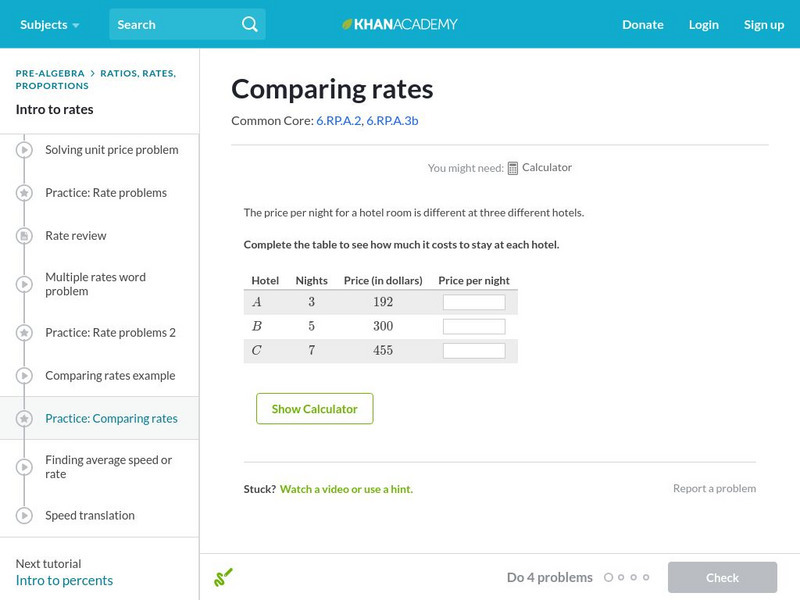
Khan Academy: Comparing Rates
Example problem: Three different stores are offering a deal on pencils. Which store has the lowest price per pencil? Students receive immediate feedback and have the opportunity to try questions repeatedly, watch a video or receive hints.
Other popular searches
- Trade Offs Opportunity Costs
- Trade Offs Opportunity Costs
- Online Opportunity Costs
- On Line Opportunity Costs
- Economics Opportunity Costs