Hi, what do you want to do?





Simon Fraser University
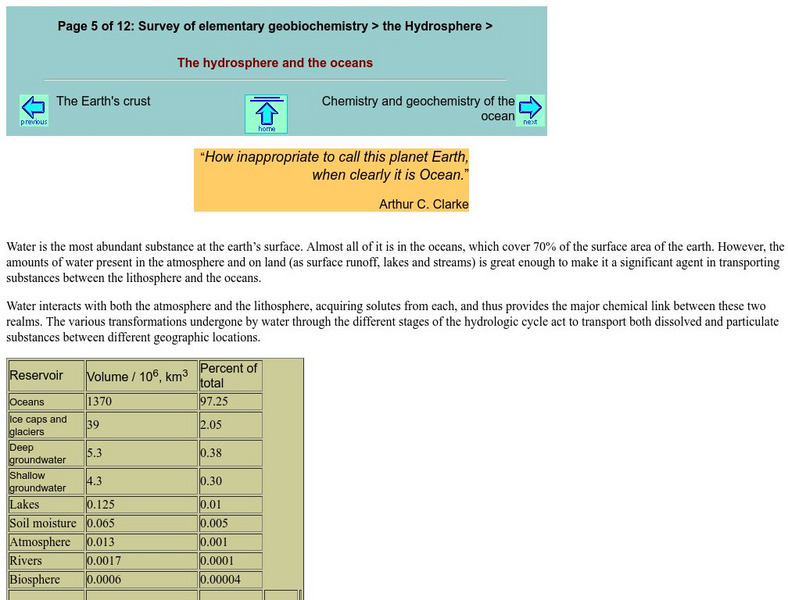
Chem1 Virtual Textbook: The Hydrosphere and the Oceans
As part of the General Chemistry Virtual Textbook, this site examines a variety of topics related to the hydrosphere and the oceans. Topics covered include where the water came from, the hydrologic cycle, Oceanic circulation, atmospheric...
American Institute of Biological Sciences
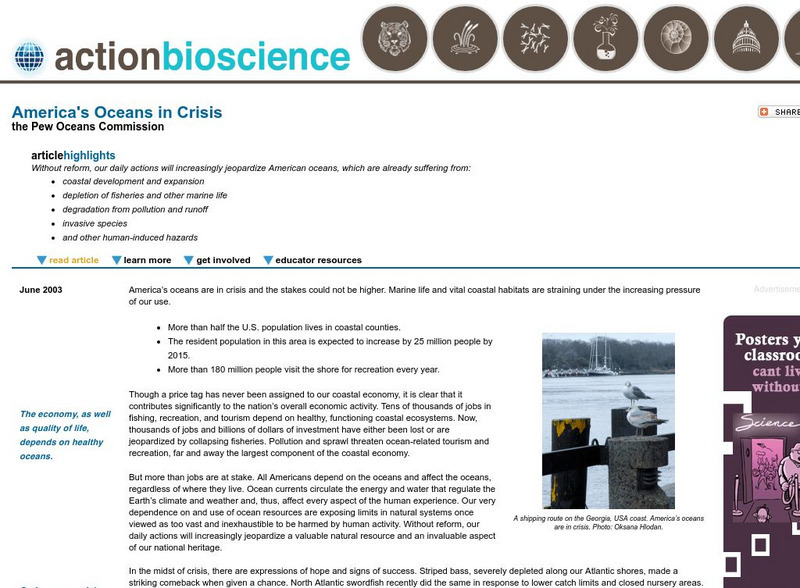
Action Bioscience: America's Oceans in Crisis
Discover some of the current problems within our oceans and how those problems could affect life on Earth.
NOAA
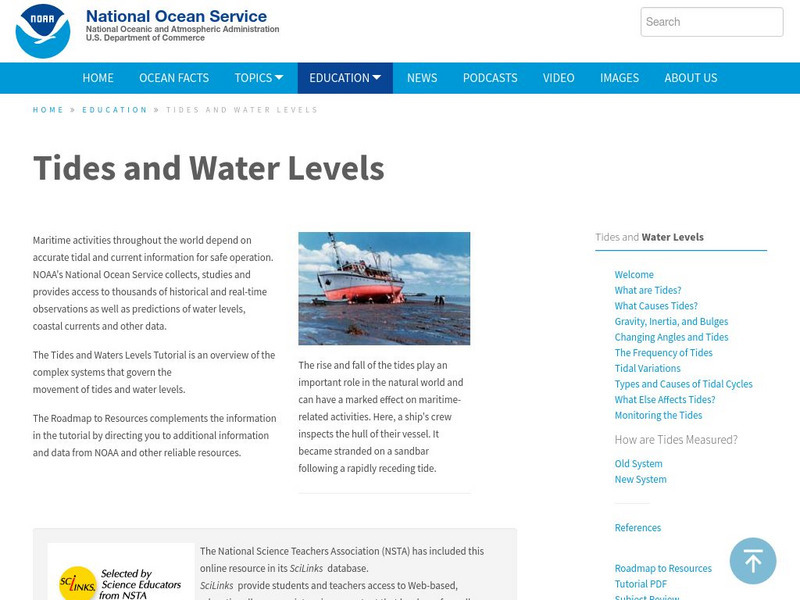
Noaa: National Ocean Service: Education: Tides and Water Levels
A great resource for explaining and understanding tides. Find out what tides are and why it is so important to monitor them. This is an extensive tutorial followed by a set of review questions. All of the information can be downloaded as...
University of Wisconsin
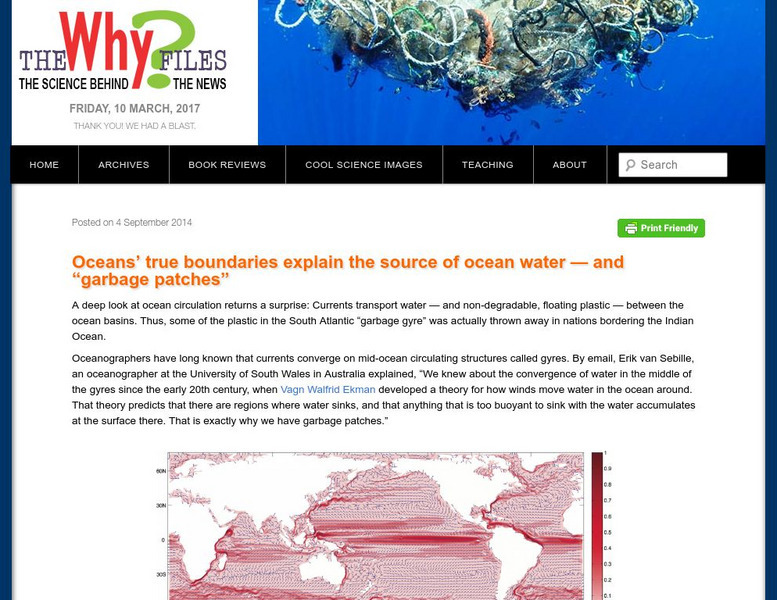
The Why Files: Oceans' True Boundaries and "Garbage Patches"
A deep look at ocean circulation returns a surprise: Currents transport water - and non-degradable, floating plastic - between the ocean basins. Thus, some of the plastic in the South Atlantic "garbage gyre" was actually thrown away in...

PBS
Pbs Learning Media: Bowhead Whaling and Its Impact
This interactive activity, adapted from material provided by the ECHO partners, explores the history of whaling in the Arctic seas and Atlantic Ocean, introducing a landmark study of whale populations spanning from 1849 to 1914.
Massachusetts Institute of Technology
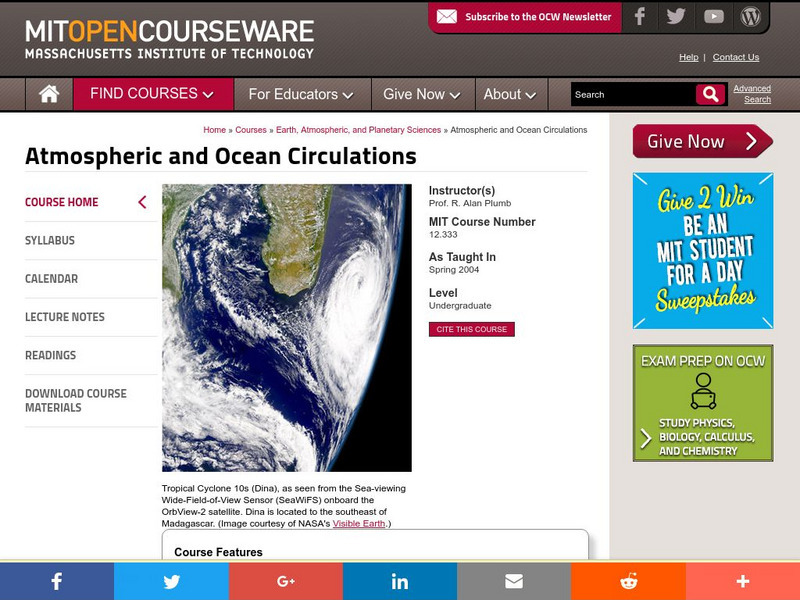
Mit: Open Course Ware: Atmospheric and Ocean Circulations
This course outline offers resources focused on the circulation of the atmosphere and ocean.

National Geographic
National Geographic: Sources, Sinks, and Feedbacks
Students will learn about how the Earth's carbon cycle works, as they examine the relationship between levels of carbon dioxide and water vapor in the atmosphere and the temperature of the ocean's surface. Includes online student...
Enchanted Learning
Enchanted Learning: Zoom School: Oceans
Find out why the oceans are blue and what causes waves by clicking here. There is a table of information about the four oceans as well as interesting facts on waves, salinity, and tides.
Exploring Nature
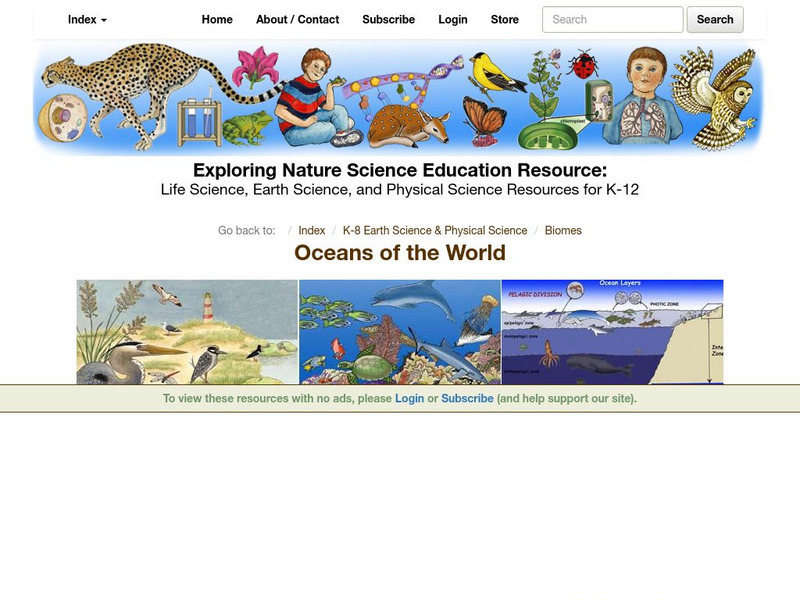
Exploring Nature Educational Resource: Oceans of the World
A set of illustrated fact pages, and some activity sheets, on coral reefs, tidal pools, and ocean ecosystems. Find maps, graphic organizers, and a movie link to tidal zones. Hyperlinks to specialized vocabulary words are also provided....
Simon Fraser University
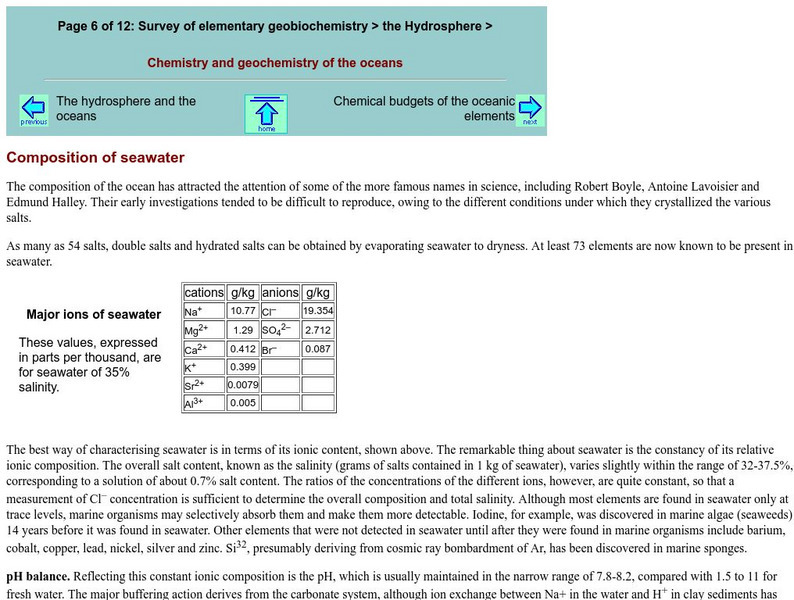
Chem1 Virtual Textbook: Chemistry and Geochemistry of the Oceans
As part of the General Chemistry Virtual Textbook, this site examines a variety of topics related to the oceans. Topics covered include composition of seawater, conservative and non-conservative substances, organic matter, and more.
Vision Learning
Visionlearning: Atmosphere and Oceans: Composition of Earth's Atmosphere
An explanation of the different parts of the atmosphere and how pressure and temperature changes at different altitudes.
Vision Learning
Visionlearning: Atmosphere and Oceans: Factors That Control Earth's Temperature
An explanation of how temperature is affected by the composition of the atmosphere and how energy flows in and out of Earth's atmosphere.
Vision Learning
Visionlearning: Atmosphere and Oceans: The Rise of Atmospheric Oxygen
An explanation of the Earth's atmosphere and how it has evolved over geologic time.
Yale University
Yale University: Tracking the Destructive Power of the Pacific Ocean's Tsunami
Expert Lori Dengler discusses the long history of tsunamis and earthquakes in the Pacific rim and Japan in particular.
Tom Richey
Tom Richey: Civil Rights and Vietnam (1948 1975)
A unit guide and primary sources supply to assist with learning about the Civil Rights Movement in America as well as the activities taking place in Vietnam. Why was America fighting for civil rights across the seas while struggling with...
US Fish and Wildlife Service
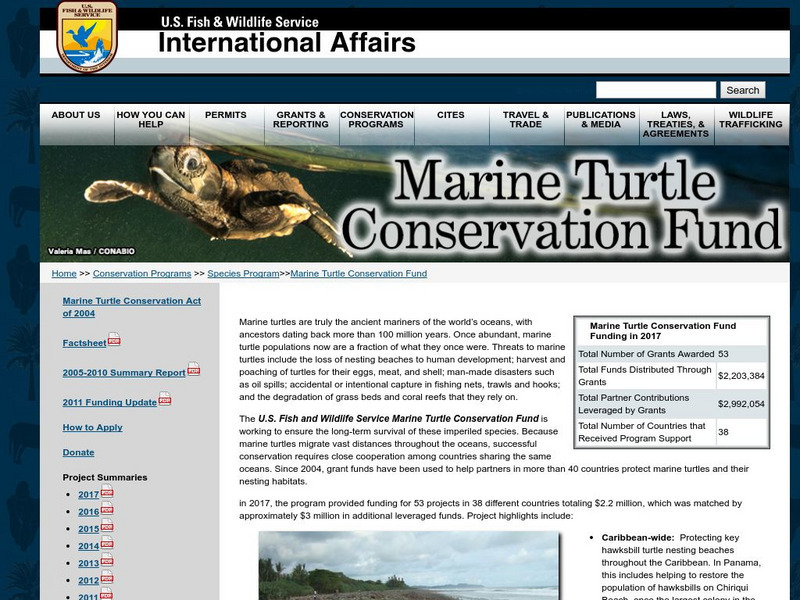
U.s. Fish and Wildlife Service: Marine Turtle Conservation Fund
Seven species of marine turtles navigate the oceans. Six of these seven species are considered endangered. Learn about the Marine Turtle Conservation Act of 2004 and a little about these ancient animals and the threats to their existence.
Understanding Slavery Initiative
Understanding Slavery Initiative: Trade and Commerce
The transatlantic slave trade lay at the heart of a complex global commerce system between Europe, Africa, and the Americas. Learn about the clash over possessions, and the disputes over each others' presence in the seas.
University Corporation for Atmospheric Research
Ucar: What Do Soda and the Oceans Have in Common?
Students will use soda to explore how carbon dioxide is able to dissolve into liquid. They will learn about Henry's law, which describes how the solubility of gas into liquids is dependent on temperature and develop hypotheses about how...
University of Groningen
American History: Outlines: War and Neutral Rights
This resource presents a brief discussion of U.S. neutrality early in World War I and of the events which brought the country closer to war.
Other
Lunar and Planetary Institute: Oceans From Space
This collection of photographs from space-shuttle missions shows some features of oceanic circulation that simply cannot be seen from any other vantage point. This site is a great resource for many different topics of study.
Other
New England Aquarium: Climate Change and the Oceans
A series of videos accompanied by student activity sheets explore the impact of climate change on the ocean and the animals that live in and around it: sea turtles, jellies, whales, shore birds, lobsters, and coral.

TED Talks
Ted: Ted Ed: The Otherworldly Creatures in the Ocean's Deepest Depths
Although the deep ocean zone seems like an inhospitable and remote corner of the planet, it is actually one of the greatest habitats on Earth. Lidia Lins explores how so many species thrive in this mysterious underwater world. [5:02]
A&E Television
History.com: Why the Construction of the Panama Canal Was So Difficult and Deadly
A staggering 25,000 workers lost their lives. And artificial limb makers clamored for contracts with the canal builders. In a quest to fulfill a centuries-old dream to connect the Atlantic and Pacific Oceans, the builders of the Panama...
Science Struck
Science Struck: What Are Ocean Trenches and How Are They Formed?
Around 72 percent of the Earth's surface is found under the oceans. It has always been contributing to the dynamically changing face of the Earth through the tectonic phenomenon occurring at its depths. Such a naturally occurring...
Other popular searches
- Identify Oceans and Seas
- Oceans and Seas Maps
- Oceans and Seas Preschool
- Balm Oceans and Seas
- Oceans and Seas Worksheet
- Blm Oceans and Seas