Hi, what do you want to do?






Curated OER
Going for the Green
Students use satellite imagery to obtain information on chlorophyll concentration at selected locations in the Earth's oceans.Students explain the relationship between chlorophyll concentration and primary production.Studen

Curated OER
The Fossil Record
Young scholars research about the animals found in Burgess Shale. In this earth science instructional activity, students evaluate the significance of fossils in human history. They create models of their chosen animal.

Curated OER
Shark Attack
Students examine the white shark. They think critically about a set of shark facts and predict whether the statements are true or false. Students describe a year in the life of a white shark living in the Red Triangle. They create a...

Curated OER
Sharkland Wiki
Learners, while researching the waters around southern Africa and viewing a video of the episode "Sharkland" from Thirteen's series NATURE, critique reliability of online resources and analyze the various components of a wiki. They...

Curated OER
Is There Seaweed/Algae in Your Food?
Students discover that seaweed/algae is a small part of the resources the oceans provide. By investigating common household products, students discover that human senses are not enough to detect the presence of seaweed/algae in food.

Curated OER
Something Fishy
Learners identify and discuss the adaptive characteristics and behaviors of fish. They view slides of fish, and design and create a model of a fish of the future, listing the ways their fish adapt to survive.

Curated OER
Survival in the Open Ocean
Students examine how scientists conduct pelagic research and identify pelagic predators as they study the open-ocean ecosystem. They discuss and conduct small group research of this environment in order to produce a presentation.

Curated OER
Pollution Solution
Students explore the topic of oil pollution and how it affects the global ocean. They discuss oil spills in recent history and use problem solving skills to decide what strategies could be used to actually clean up an oil spill. Students...

Curated OER
Water, Water, Everywhere!
Students become aware of the important role the ocean plays in our lives. Students will gain general knowledge about the ocean by reading information on the Internet. They discover the weather events generated by ocean conditions.

Curated OER
If I Can't See It, How Do I Know It's There?
Students build a model ocean using a variety of materials representing the various levels of the ocean. They collect data about the ocean floor in a partner activity. They practice working with topographical mapping grids.

Curated OER
All That Glitters...
Students study that white light (visible light) is comprised of all colors of the spectrum. They study that the quantity of light decreases with increasing depth in the ocean. They study that the quality of light changes with increasing...

Curated OER
Coral Bleaching in the Caribbean
Students use authentic satellite data on the NASA website to determine when the sea surface temperature meets the criteria to induce coral bleaching.

Curated OER
Geologic Time Scale
In this geologic time scale worksheet, middle schoolers use a word bank to complete the geologic time scale provided. Students fill in the chart as it relates to the geologic time scale.

Curated OER
Invertebrates
For this invertebrates worksheet, students read about the characteristics of the different groups of invertebrates. Then students complete 10 multiple choice questions.

Curated OER
Case Study - Paradise Island
Young scholars make a plan for the future of Paradise Island. Their recommendations should help government leaders manage the impacts of expanding tourism, while preserving the unique natural resources of this island.

Curated OER
Energy
In this energy instructional activity, students complete a crossword puzzle by determining the terms associated with the 20 given clues. Students review alternative forms of energy in this instructional activity.

Curated OER
Don't Cry Over Spilled Oil
Students study the Exxon Valdez Oil Spill while evaluating oil spill clean up activities. They discover the long term impact can have on an ecosystem by completing this experiment.
Science Buddies
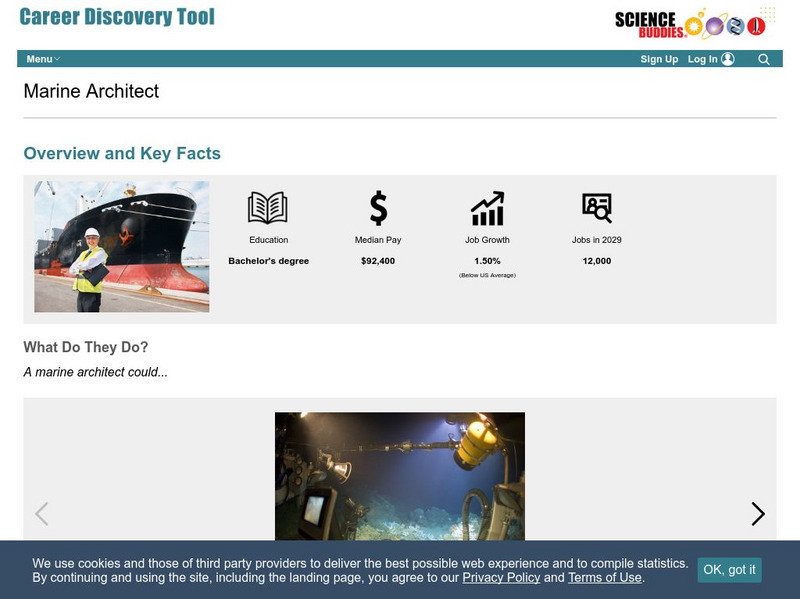
Science Buddies: Science Careers: Marine Architect
The marine architect is the one who designs many kinds of vessels which sail the seven seas. This Science Buddies site lays out the requirements needed to become a marine architect, as well as the education and job description. Included...
Read Works
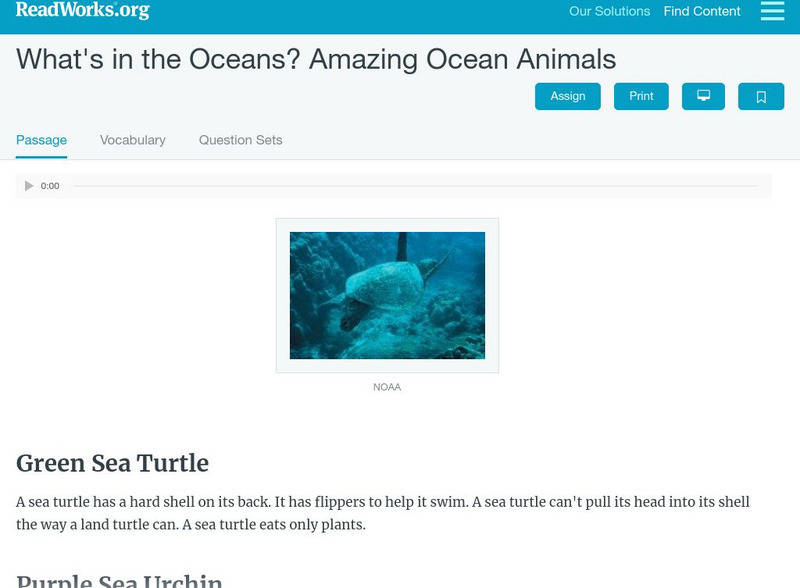
Read Works: What's in the Oceans? Amazing Ocean Animals
[Free Registration/Login Required] An informational text about some of the animals found in the ocean including: sea turtles, sea urchins, starfish, sea horses, and clownfish. A question sheet is available to help students build skills...
![Oceans [Pdf] Activity](https://static.lp.lexp.cloud/images/attachment_defaults/resource/large/FPO-knovation.png "Oceans [Pdf] Activity")
SEDL
Oceans [Pdf]
This large PDF file integrates math, science, and language into several lessons about characteristics of the oceans. Topics include ocean currents, tides, density, marine life, and pollution.
Science Struck
Science Struck: Facts About the Marine Biome
Describes the characteristics of the marine biome, the plants and animals that live in each of the four ocean zones, coral reefs and estuaries, the climate of the marine biome, and the marine food web.
Museum of Science
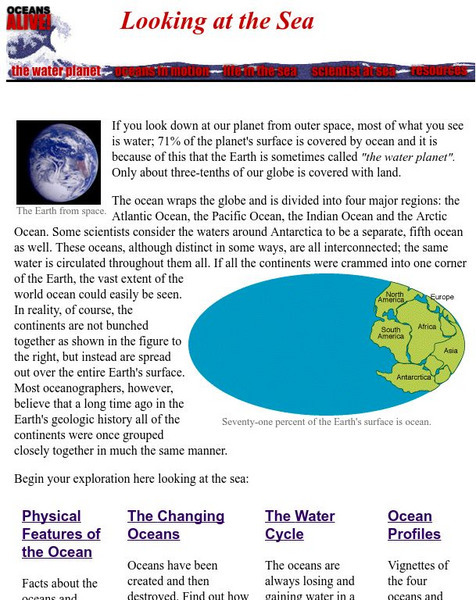
Museum of Science: Looking at the Sea
There are 5 parts to this resource. You can click on the water planet, oceans in motion, life in the sea, scientists at sea and resources. There are also activities for teachers.
Science Buddies
Science Buddies: Swimming in Acid: Understanding Ocean Acidification
The oceans are a precious natural resource, part of Earth's carbon cycle. But what happens if the oceans absorb too much carbon dioxide? Many scientists are concerned that the increased absorption of carbon dioxide is causing them to...
Museum of Science
Museum of Science: Oceans Alive
There are links to the water planet, oceans in motion, life in the sea and resources. You will learn about the physical features of an ocean, changes in the ocean and the water cycle.