Hi, what do you want to do?






National Institute of Open Schooling
Radioactive Pollution
Radioactive pollutants can enter the body through ingestion, inhalation, absorption, or injection. The last lesson in a series of 36 introduces pupils to radioactive pollution. They study its sources, both natural and man-made, its...
US Energy Information Administration
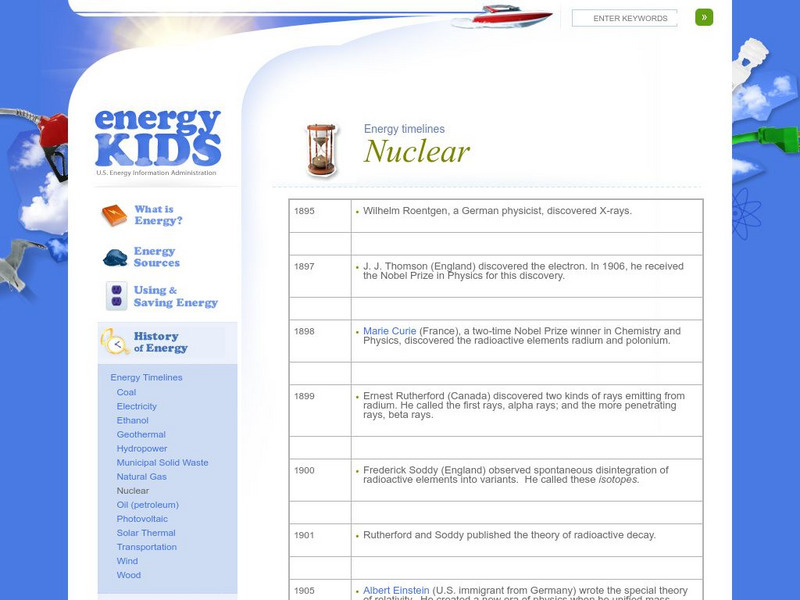
U.s. Eia Energy Kids: Timelines: Nuclear Energy
Timeline of key events in the development of nuclear energy and nuclear weapons, including early scientific discoveries related to atomic science.

Khan Academy
Khan Academy: The Manhattan Project and the Atomic Bomb
Discusses the Manhattan Project of the United States which worked on developing nuclear weapons during World War II. It led to the two atomic bombs that were dropped on Japan in August 1945, ending the war with Japan.
Massachusetts Institute of Technology
Mit: Inventor of the Week: J. Robert Oppenheimer
Credited with the creation of the atomic bomb, Robert Oppenheimer opposed the development of the hydrogen bomb. Read about Oppenheimer's education and involvement in the atomic explosions, which "changed the world forever."

Science Struck
Science Struck: Atomic Bomb Facts
Discusses lost nuclear weapons, the power of an atomic bomb, the bombing of Hiroshima and Nagasaki, the development of the atomic bomb, the making of the hydrogen bomb, the detonation of a hydrogen bomb by Russia in 1961, and the status...
Other
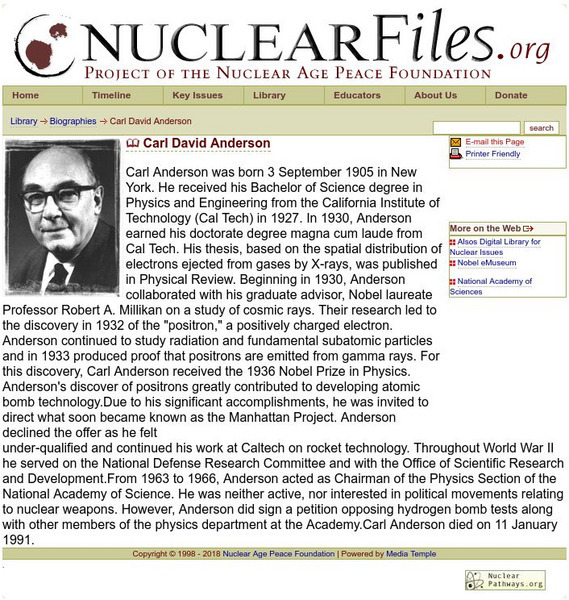
Nuclearfiles.org: Carl David Anderson
This site from Nuclearfiles.org contains a brief biography of Carl Anderson (1905-1991 CE), mentioning his involvement (or lack thereof) with nuclear weapons development.
Upper Canada District School Board
Tom Stretton's Chemistry Pages: The Story of the Atomic Bomb
Here is the story of the first ever atomic bomb, beginning with early scientific ideas, leading up to the success of this weapon.