Hi, what do you want to do?






Curated OER
Black Separatism or the Beloved Community? Malcolm X and Martin Luther King, Jr.
High schoolers interpret historical evidence presented in primary and secondary resources. In this African American history lesson, students compare and contrast the tactics employed by Malcolm X and Martin Luther...

Curated OER
A Voice for the Times
Students make connections with events of the Civil Rights Movement in the 1960's with songs made popular by Aretha Franklin.

Curated OER
RBG Dr. Martin Luther Jr. Studies Lesson Plan-Guide
Explore Martin Luther King Jr. Students listen to a speech given by Martin Luther King, and interpret his message. They discuss civil rights and how Martin Luther King Jr. exhibited good citizenship, then brainstorm ways in which...

Curated OER
The Children's March
Students watch the film, The Children's March. In this civil rights lesson, students view a video on the Civil Rights Movement in Montgomery Alabama. Students then complete a worksheet that will prompt a classroom discussion about the...

Curated OER
Do the Write Thing
Students take stands on issues that matter to them. In this philanthropy lesson, students read Anne Frank: The Diary of a Young Girl, discuss the act of advocating for others, and write letters of support for issues they belive in to...

Curated OER
A Forum on Racism
Twelfth graders compare and contrast the work of Malcolm X and Martin Luther King, Jr. In this racism lesson, 12th graders read The Autobiography of Malcolm X and discuss how Malcolm X and Martin Luther King, Jr. approached ending racism.

Curated OER
Songs of Unrest - Lesson 4
Students identify popular songs from 1968 and make connections with the year's current events. They pretend that they are producing a new CD. The CD includes four songs that comment on today's social issues. They write the liner notes.

Curated OER
You Can, Too!
Students and their parents participate in a volunteer opportunity in their community in order to solve a problem. In this problem solving lesson plan, students reflect on historical problems and see how they can solve a current problem.

Curated OER
Aahimsa in the Real World: Identifying Ahimsa
Second graders become familiar with the use of the newspaper and how it educates people. In this ahimsa lesson, 2nd graders recognize the importance of Gandhi and his beliefs. Students read articles and answer questions about ahimsa.

Curated OER
Reading Freedom on the Menu
Students apply specific reading strategies to answer questions about the selection Freedom on the Menu. For this reading comprehension lesson, students read a selection called Freedom on the Menu and use specific reading strategies to...

Curated OER
Actively Organizing Passive Resistance
Students explore organizing to resist oppressive authority without the use of violence. In this philosophy activity, students research Gandhi's approach to organizing people around a positive cause without the need to be aggressive...

Curated OER
Brother Outsider
Students view the film "Brother Outsider" and read an article by Bayard Rustin as springboards to discuss the concept of civil rights in the United States. They follow a discussion guide.

Curated OER
Martin Luther King, Jr.
Learners examine and discuss Dr. King's fight for equality and justice in the Civil Rights Movement. They locate words in a dictionary, read and interpret a poem about Martin Luther King, Jr., and discuss the holiday celebrated in his...

Curated OER
Making More Places at the Table: The American Civil Rights Movement of the 50's and 60's
Eleventh graders examine the biography of Henry B. Gonzalez. They examine primary source documents from Congressman Gonzalez's personal papers related to his contributions to the Civil Rights Movement.
PBS
Pbs Teachers: February One (Lessons on the Greensboro Sit in of 1960)
Find two lesson plans developed for a PBS documentary about the Greensboro Four, whose sit-in at a whites-only Woolworth's lunch counter was a key event in the unfolding history of the civil rights movement. The lessons ask students to...

Center For Civic Education
Center for Civic Education: Black History Month
A collection of six lessons for Grades 5 and up for Black History Month. The lesson plans explore the use of nonviolence in history, particularly with respect to the civil rights movement and African American history.
PBS
Pbs Teachers: 1963 March on Washington and Its Impact (Lesson Plan)
A lesson plan that examines the events and conditions that led to the 1963 March on Washington and the impact of the march on civil rights in the United States. Students learn about the concept of "separate but equal" and the philosophy...
![Orca Book Publishers: 'Horse Power' Teaching Guide [Pdf] Lesson Plan](http://lessonplanet.com/content/resources/thumbnails/410125/large/bwluav9tywdpy2symdiwmduymc0ynta4ms04enc4enuuanbn.jpg?1589985521 "Orca Book Publishers: 'Horse Power' Teaching Guide [Pdf] Lesson Plan")
Orca Book Publishers
Orca Book Publishers: 'Horse Power' Teaching Guide [Pdf]
in Horse Power by Canadian author Ann Walsh, Callie Powers again has to go along with her mother as she takes part in a protest to save a country school. Callie has to help her cousin Del persuade her parents not to sell a horse she...
PBS
Pbs News Hour: South Africa After Ten Years of Freedom (Lesson Plan)
A lesson for exploring the history of South Africa, the system of apartheid, and the changes that have come about since the end of the apartheid era. Lesson has broad applicability to learning about unique methods that can be used to...
PBS
Pbs Teachers: What Is the Role of Civil Disobedience Today? (Lesson Plan)
A lesson in which students examine the history of civil disobedience and analyze whether it is a viable form of protest in today's world. They will explore quotations about law versus personal conviction in order to form a group...
Stanford University
Stanford University: Lesson Plan on Martin Luther King, Jr. & Malcolm X
A comprehensive four part lesson plan exploring how the ideas of the two great African American leaders were similar and different both in their ideologies and their visions.

PBS
The March on Washington and Its Impact : Lesson Plan
Learn about the social conditions in the United States that led up to the Civil Rights Movement. Also, explore peaceful resistance and the immediate impact of the march.
National Endowment for the Humanities
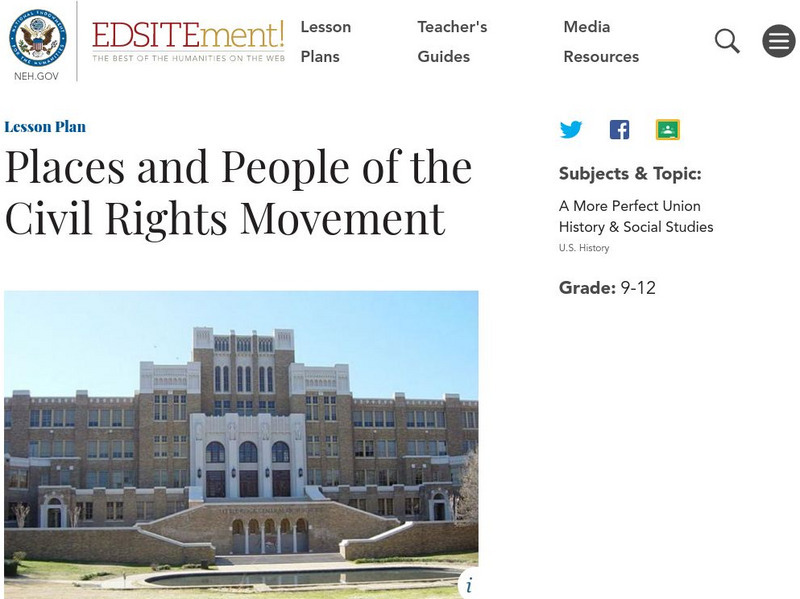
Neh: Edsit Ement: Civil Rights Movement
This lesson on the Civil Rights movement is organized into three sections: "Identifying the Need for Change," "Ordinary People in the Civil Rights Movement," and "Historic Places in the Civil Rights Movement."
PBS
Pbs Learning Media: Civil Rights Special Collection
Multimedia collection of video, primary text documents and audio on Civil Rights, especially Brown vs. Board of Education.