Hi, what do you want to do?






American Museum of Natural History
Train of Thought
Hop aboard the train of thought. A remote learning resource has learners consider thought experiments to consider scientific theories. It provides two examples, one on orbiting bodies and the other on the speed of light, for them to work...
NASA
Nasa: Rockets Educator Guide: Applying Newton's Laws
Learn how Newton's Laws apply to rocketry. Discover how rockets work, including the engines and propellants.

Other
Math Matters Every Day: Newton's Laws
Looks at how Newton's three laws of motion apply to an analysis of the forces being exerted when playing football.
Internet History Sourcebooks Project
Fordham University: Modern History Sourcebook: Isaac Newton
This site from Fordham University links to excerpts of Newton's major works. Please scroll down to find the section on Newton titled "The Creation of Classical Physics." You will be able to actually read some of Newton's work! Read...
NASA
Nasa: Drag, Lesson 4
This video [12:28] shows how Newton's law of motion relates to the drag of an airplane. Watch as an instructor shows how the molecules colliding with the airplane create drag.
NASA
Nasa: Rockets Educator Guide: How Rockets Work
In this article, learn how rockets work. Discover Newton's Law of Motion and learn how it supports rocketry.
Wolfram Research
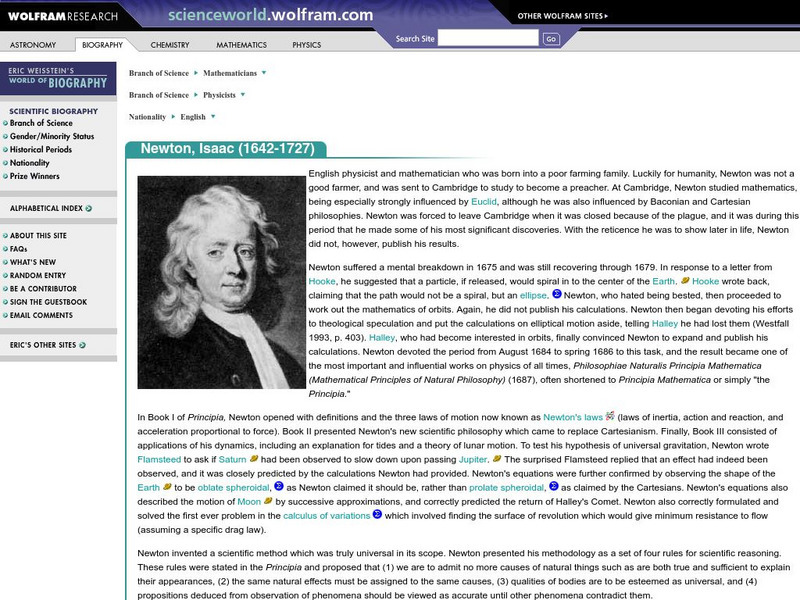
Wolfram Science World: Life of Sir Isaac Newton
This site from ScienceWorld provides an interesting biographical sketch of the English physicist and mathematician, Isaac Newton. The biography is a good size in length and very informative, with links provided throughout for additional...
NASA
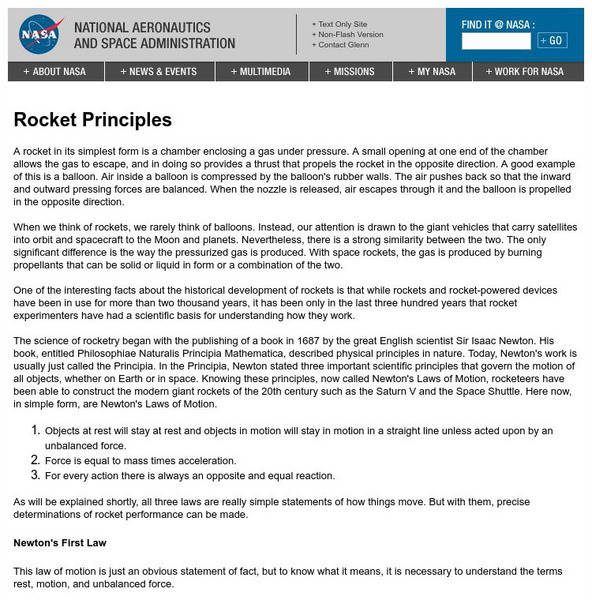
Ltp: Rocket Principles
Excellent NASA sponsored site on the principles of rockets. The site relates Newton's 3 laws to the flight of a rocket. Site also has links to activities related to rockets in addition to links about practical rocketry.

Ducksters
Ducksters: Physics for Kids: Laws of Motion
Kids learn about the science behind the basic three Laws of Motion. Forces theory discovered by Isaac Newton.

Learn AP Physics
Learn Ap Physics: Physics B: Gravitation
A site dedicated to help students prepare for the AP Physics B test. This specific site reviews gravitation including Newton's Law of Gravity, orbits of planets and satellites, and Kepler's three laws. Site contains links to video...

Ducksters
Ducksters: Biography for Kids: Scientist: Isaac Newton
Investigate Isaac Newton's biography on this site. Learn how he was a scientist who discovered gravity, the three laws of motion, and calculus. He is considered one of the great scientists in history.

Other
Physics Quests
This resource links to many web-based activities which allow students to explore and examine physic principles and concepts on their own. Links to other good physics sites are also here.
University of Virginia
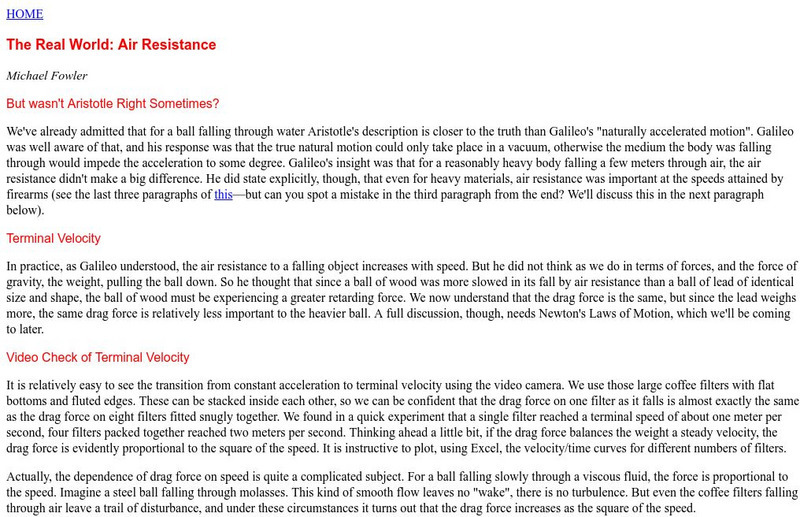
Uva: The Real World Air Resistance
A contrast of Galileo and Aristotle's view of inertia and motion. Describes air resistance force and how its reality seems to initially support Aristotle's view.

NASA
Nasa: Beginner's Guide to Aerodynamics
Includes exhaustive information and a wealth of activities pertaining to aerodynamics and the physics of flight.
Other
Nye Thermodynamics: Basic Gas Turbine Theory
Outstanding information (and a lot of it) on gas turbine (jet) engines. Describes the history behind their development and the theory behind their operation. Well written and includes very informative graphics.
NASA
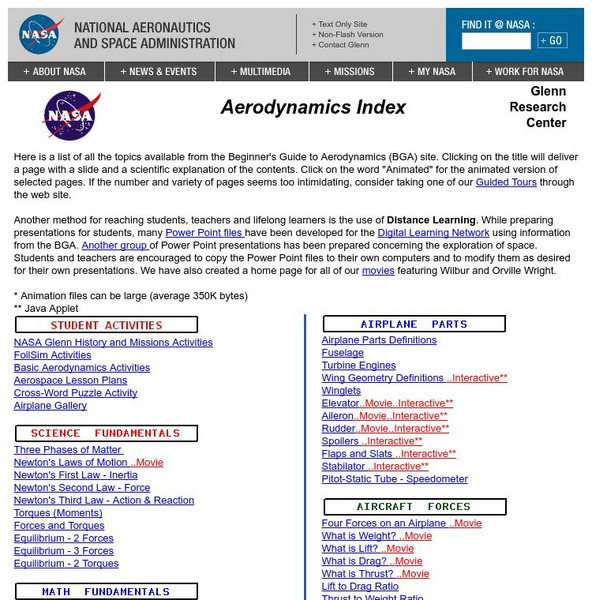
Nasa: Aerodynamics Index
Are you studying or teaching Aerodynamics? This page acts as an index to all the terminology related to this topic. Clicking on any title will open a page with a colored slide and a scientific explanation of the contents. Animated,...
NASA
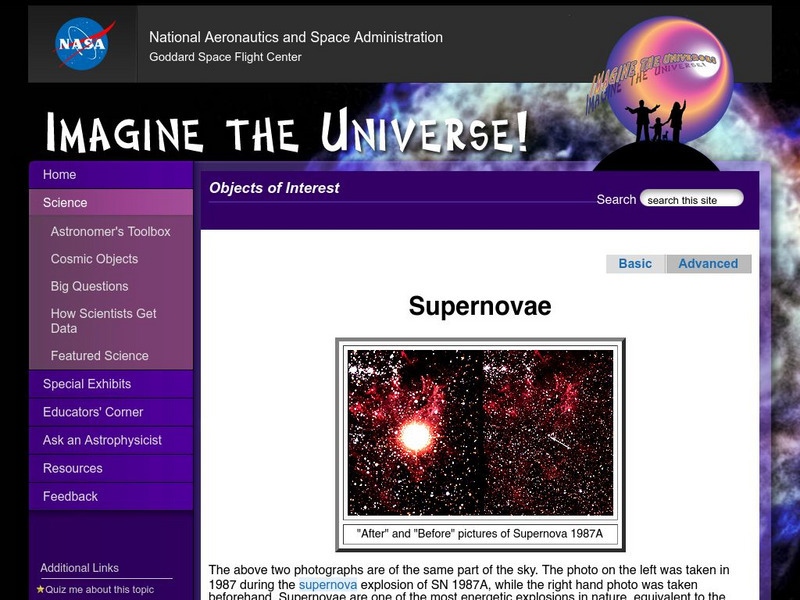
Nasa: Imagine the Universe: Supernovae (Advanced)
Supernovae are divided into two basic physical types, including a description of supernova types and how they are classified based on the existence of hydrogen spectral lines. Definitions of key terms are provided.
NASA
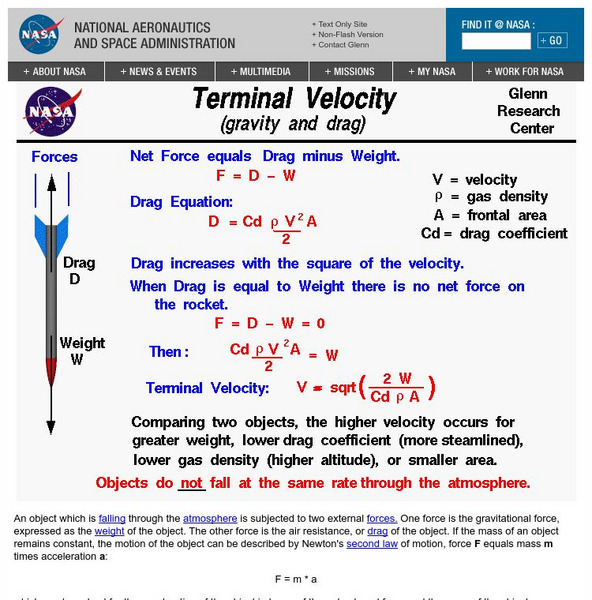
Nasa: Beginner's Guide to Aerodynamics
This site from NASA uses a colorful graphic to illustrate why objects reach terminal velocity. Provides equation for the terminal velocity of an object. Graphic is accompanied by a simple explanation.
PBS
Pbs Learning Media: Acids and Bases: Making a Film Canister Rocket
ZOOM cast members mix different amounts of baking soda and vinegar to see which combination produces the most carbon dioxide for launching a film-canister rocket. [3:23]
University of Virginia
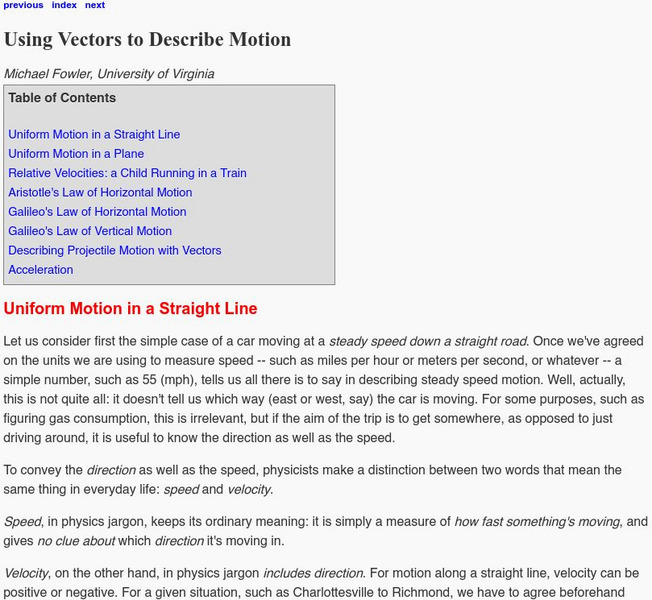
Uva Physics: Using Vectors to Describe Motion
Background information on vectors and their use in describing motion in two dimensions. A comparison of Aristotle's and Galileo's perspectives on force and motion is given.
Curated OER
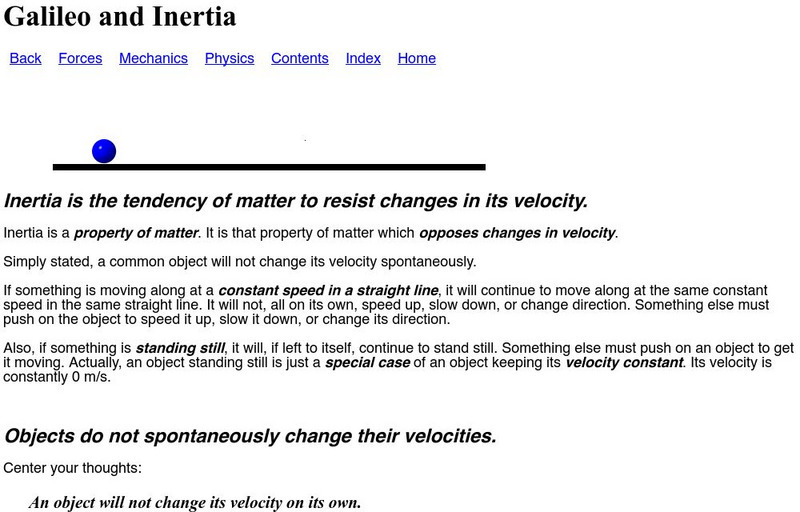
Zona Land: Galileo and Inertia
A tutorial with accompanying animations on classical mechanics. Well-illustrated. Good navigation.
Pennsylvania State University
Acoustics and Vibration Animations: Demonstrations: The Simple Pendulum
A series of graphics, downloadable animations and text describe and explain the motion of a pendulum. Some sections require an understanding of calculus.
University of Wisconsin
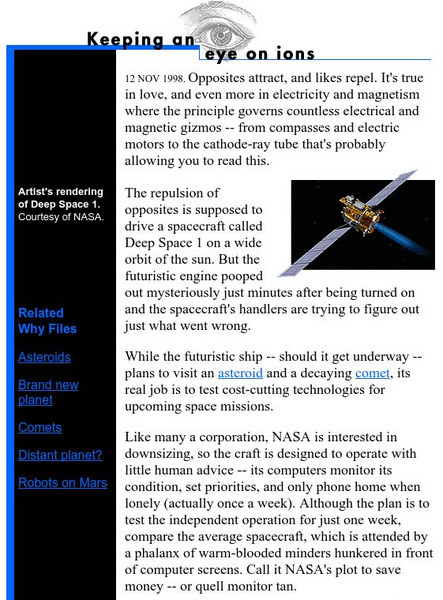
The Why Files: Keeping an Eye on Ions
Discusses the development of a new rocket engine that operates by the ion propulsion as opposed to gas propulsion. Well written and great graphics!
Physics Classroom
The Physics Classroom: Centripetal Force Requirement
Animation depicting the effect of a centripetal force on the motion of an object. Newton's laws are used to explain why circular motion requires an inward-directed force.
Other popular searches
- Newtons Laws of Motion
- Newton's Laws Labs
- Newton's Three Laws of Motion
- Newton's Laws Webquest
- Newton's Laws Review Game
- Newtons Laws Lab
- Physics Newtons Laws
- Newtons Three Laws of Motion
- Newton's Laws Test
- Newton's Laws and Inertia
- Newton's Laws Websites
- Newton's Laws of Motions