Hi, what do you want to do?






NASA
Speaking in Phases
Hear from deep space. Pupils learn how satellites transfer information back to Earth. They learn about three different ways to modulate radio waves and how a satellite sends information with only 0s and 1s. Using sound, class members...

NASA
Catch a Gravitational Wave, Dude!
It is cowabunga time! Pupils read an article about the NASA LISA mission on gravitational waves and conduct additional research on them. The class participates in a science bowl type competition about gravitational waves. Panels of four...

NASA
Taking a Cold, Clear Look at the Universe
Take a look with another perspective. Pupils read to find out what portion of the electromagnetic spectrum a space telescope sees and the difficulties of viewing infrared radiation from other objects in space. Individuals discover how...

College Board
Seeing Is Believing
Students read about AP calculus online. In this calculus lesson, students learn real life usage for calculus. They read about instructors and their experience teaching and incorporating calculus into the real world.
Immigration and Ethnic History Society
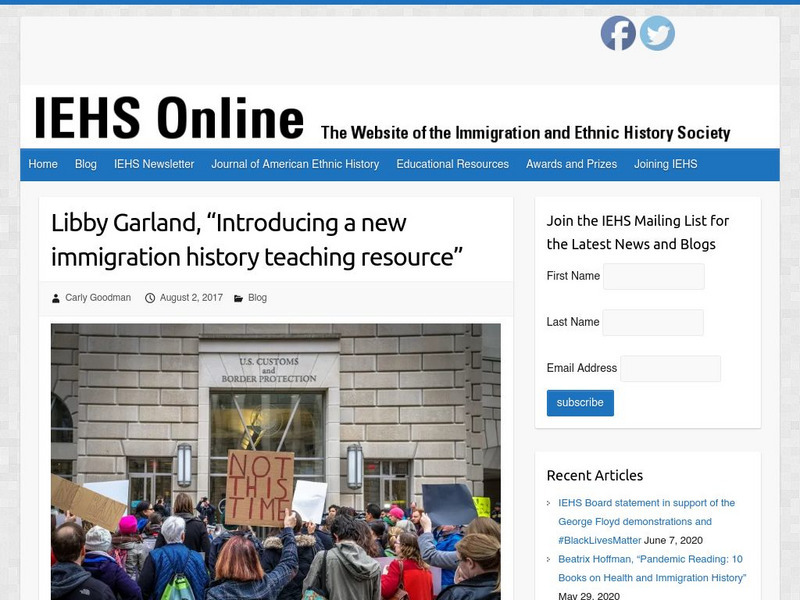
Iehs: Libby Garland, "Introducing a New Immigration History Teaching Resource"
This article focuses on a guide for teaching immigration. It is a guide to smart, accessible materials on U.S. immigration for teachers to use, as well as advocates, activists, and others. The guide consists of a thematically-organized...
NPR: National Public Radio
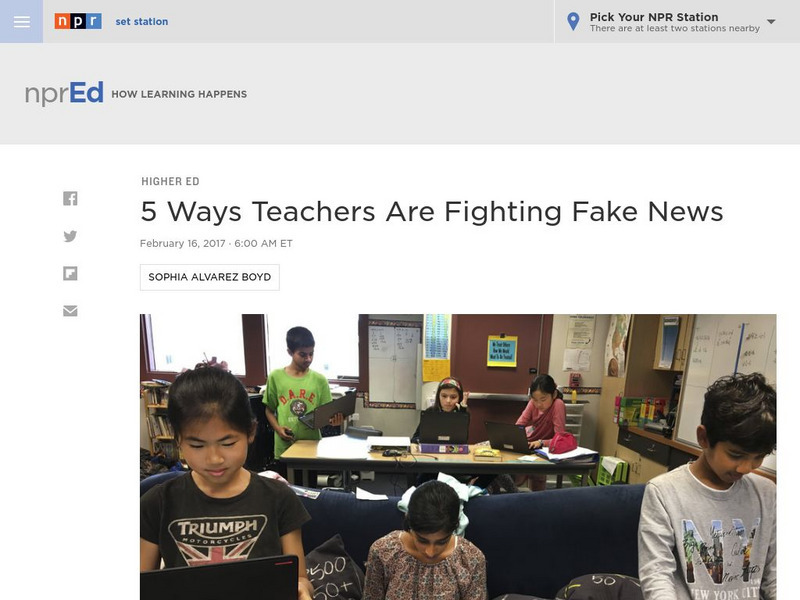
Npr: Five Ways Teachers Are Fighting Fake News
Since a recent Stanford study showed that students at practically all grade levels can't determine fake news from the real stuff, the push to teach media literacy has gained new momentum. This article gives five quality examples of...
National Humanities Center
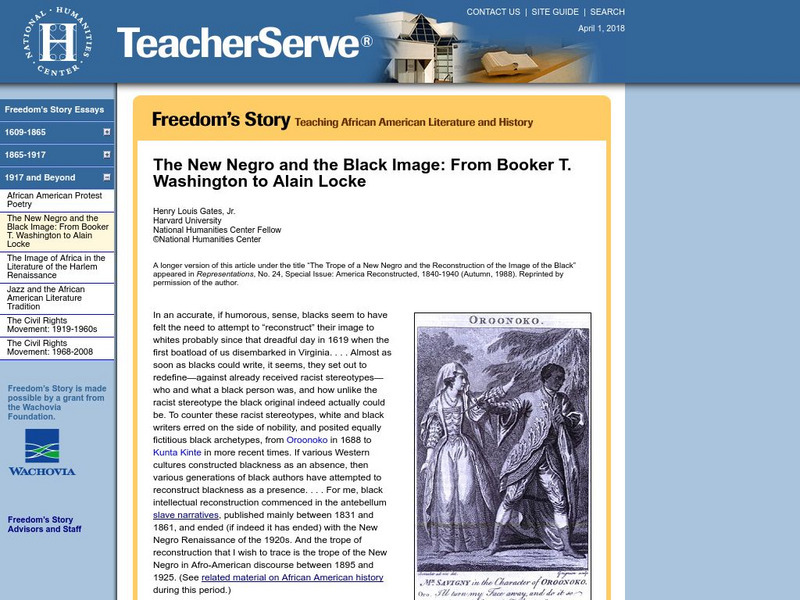
National Humanities Center: Teacher Serve: The New Negro and the Black Image: From Booker T. Washington to Alain Locke
This essay explores how Booker T. Washington and others used the term "New Negro" as an attempt to recreate the race by suggesting education, refinement, money, assertiveness, and racial consciousness.

Other
Edublogs: Mark Gleeson: Teachers, Do You Have Good or Bad Habits of Mind? (2)
In the continuation of this blog post for educators, this resource discusses helping students to apply positive habits they've learned to new situations.

Scholastic
Scholastic: New York Times Upfront: The Civil War: Ten Things You Should Know
Article written on the 150th anniversary of Fort Sumter, the beginning of the American Civil War, in which the author presents little known Civil War facts about topics such as, Americans during that time, slavery, new technologies,...
Edutopia
Edutopia: Redefining the Role of the Teacher
This article from Edutopia focuses on how students learn in the classroom. It discusses the shift in teaching from lecture-based in favor of student directed instruction.
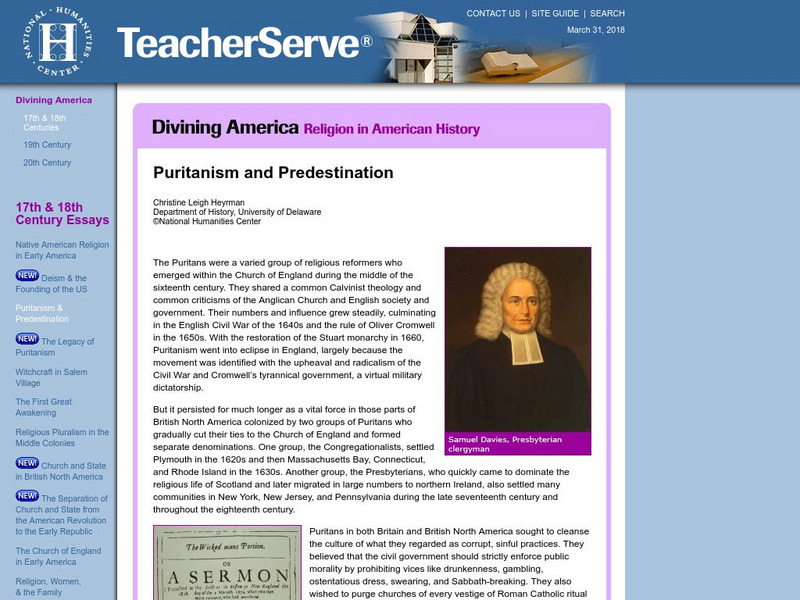
National Humanities Center
National Humanities Center: Teacher Serve: Divining America: Puritanism and Predestination
The Puritans came to the New World in search of religious freedom. This National Humanities Center article tells what they did with that freedom. Site also offers topics for discussion with students.
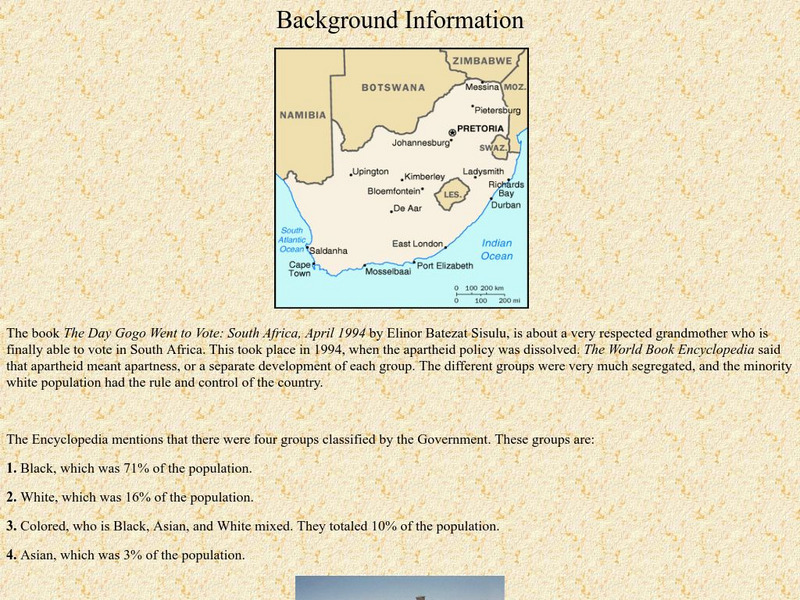
Utah State University
Teacher Link: South Africa: The Day the Apartheid Ended: Background Information
This article provides background information about the end of the South African Arpatheid in April of 1994. It mentions the book The Day Gogo Went to Vote: South Africa, April 1994 by Elinor Batezat Sisulu which is about a respected...

Scholastic
Scholastic: New York Times Upfront: 1936: The Nazi Olympics
Hitler's plans for the 1936 Olympics didn't turn out exactly like he had planned due to American track and field star Jesse Owens. Read about the beginning of the politicization of the Olympics.
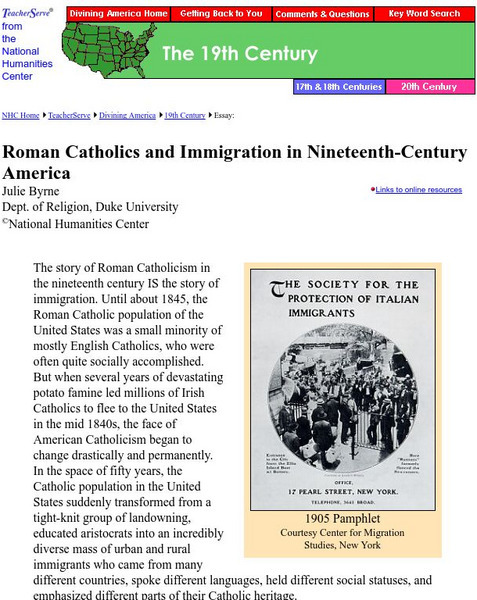
National Humanities Center
National Humanities Center: Teacher Serve: 19th Century: Roman Catholics & Immigration in 19th Century America
Essay answers the question, "Why did so many Catholics come to the United States at this time?" The potato famine, urban industrialization, chance for a new life, are among some of the answers.
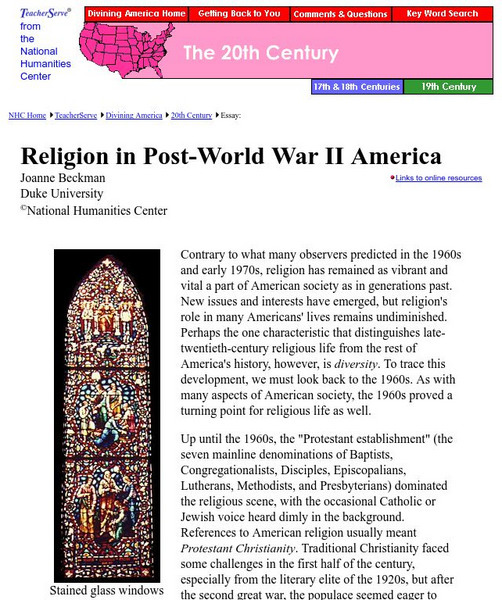
National Humanities Center
National Humanities Center: Teacher Serve: 2oth Century: Religion in Post World War Ii America
Despite the dire predictions in the 60s about the future of religion in America, the role of religion in American life has remained strong. Essay describes the 60s and 70s generation as "Spiritual seekers," and "New Age seekers." Site...
International Reading Association
Reading Online: Practice Makes Practice, or Does It?
In this journal article, the authors sought to determine the relationship between theory from teacher training programs and actual reality of what happens in an instructional setting with new teachers. The researchers concluded that...
New York Times
New York Times: Learning Network: Alaska Thaws, Complicating the Hunt for Oil
Over three decades, rising temperatures have cut the frozen season in half in Alaska. Oil-prospecting convoys in search of new deposits are allowed to crisscross the fragile tundra only when it is snowy and solid. Find out about the...
National Humanities Center
National Humanities Center: Teacher Serve: Evangelicalism as a Social Movement
Resource in which the author helps us understand Evangelicalism as a religious movement as well as a social movement that ultimately helped transfom American society. Links to online resources.
National Humanities Center
National Humanities Center: Teacher Serve: The American Jewish Experience Through the Nineteenth Century
Essay discussing immigration and acculturation of American Jews through the Nineteenth Century. Includes questions for guiding student discussion, historian debate and links to online resources.
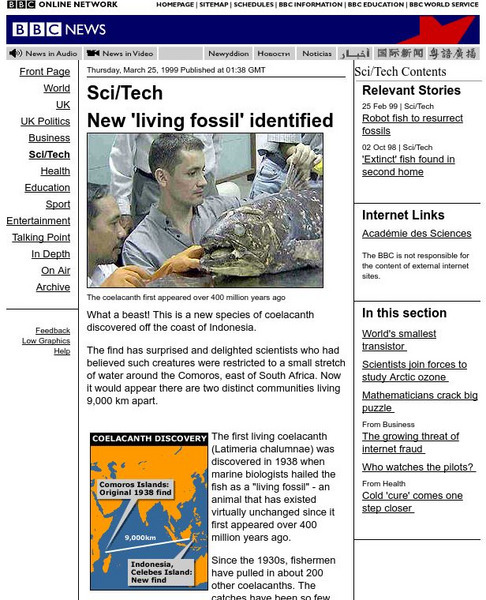
BBC
Bbc: New 'Living Fossil' Identified
Learn about the recent discovery of the the new species of coelacanth living off the coast of Indonesia.

Scholastic
Scholastic: New York Times Upfront: The New Face of America
Article examined the rising numbers of young people who identify themselves as being multiracial and provides information on the trends and implications to American society. March 14, 2011

New York Times
New York Times: Kurt Vonnegut, Counterculture's Novelist, Dies
An article from April 13, 2007 about the life and death of novelist Kurt Vonnegut.
Other
Edublogs: Mark Gleeson: Teachers, Do You Have Good or Bad Habits of Mind? (1)
In part one of this blog post for educators, learn about ways to help students form habits for success in school.

Scholastic
Scholastic: New York Times Upfront: 1991: The War Before the War
The Persian Gulf War, as seen in retrospect, set the stage for the second Iraq War. This article summarizes the brief war and also lists the "unfinished business" which led to further complications for the United States. December 13, 2010