Hi, what do you want to do?






Curated OER
Travel Brochures
Third graders divide into teams and select a country to research. They read and review "Notetaking Skills" and begin their research. Next, they work together and share the information they have located. Each team fills in a template with...
![Federal Reserve Bank of St. Louis: Tortilla Factory [Pdf] Lesson Plan](https://statictemp.lp.lexp.cloud/images/attachment_defaults/resource/large/FPO-knovation.png "Federal Reserve Bank of St. Louis: Tortilla Factory [Pdf] Lesson Plan")
Federal Reserve Bank
Federal Reserve Bank of St. Louis: Tortilla Factory [Pdf]
This lesson accompanies a story by Gary Paulsen called Tortilla Factory, and teaches students to identify the different types of resources (human, capital, natural, etc.) that go into creating corn tortillas and other products.
Council for Economic Education
Econ Ed Link: Mystery Workers: Productive Resources
This website focuses on productive resources which are divided into three categories, natural, human, and capital.
The World Bank
World Bank: Data Catalog
This resource provides statistical data on numerous categories for nearly every country in the world. A great tool for a comparative analysis. Human, natural, and capital resources are all included.
Wikimedia
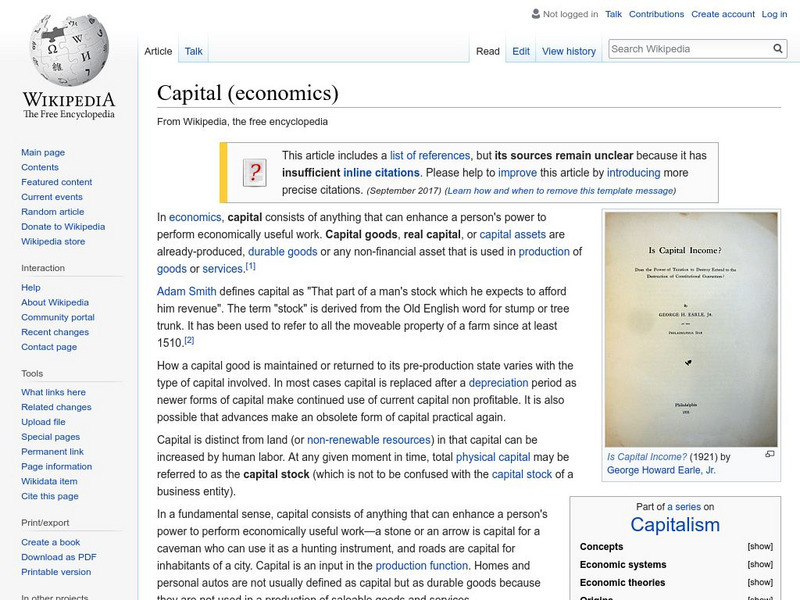
Wikipedia: Capital (Economics)
This site from Wikipedia gives a comprehensive overview of capital. Includes many economic terms with links for further clarification. A good analysis of multiple aspects of capital.
University of Nebraska Omaha
An Economics and Literature Lesson: The Goat in the Rug
This is a lesson plan geared toward first through third grades, cross-curricular, dealing with economics and literature. "Learn about economics: producers, resources (natural, human, capital), intermediate goods; and Language Arts:...
Council for Economic Education
Econ Ed Link: The Civil War: A War of Resources
The North won the Civil War in large part due to its superior resources. In this lesson young scholars will learn the difference between capital resources, human capital, and natural resources. They will investigate and compare the...
Edutopia
Edutopia: Goods and Services [Pdf]
A unit that teaches the difference between goods and services, the difference between producers and consumers, the difference between human, natural, and capital resources, and the difference between bartering/trading and buying/selling....
Council for Economic Education
Econ Ed Link: Economic Spotter: Resources During Wwii
This is a lesson that deals with scarcity during WWII. Natural, human, and capital resources are discussed.

Council for Economic Education
Econ Ed Link: The Economics of Income: Which 'Wood' You Choose?
A key turning point in a nation's economic development is when it starts to use its resources for long term versus short term purposes. A natural resource example is trees: should people use wood for cooking food or building homes?...
Council for Economic Education
Econ Ed Link: Those Golden Jeans
Check out this informative economics lesson plan designed to review the three productive resources--natural resources, human resources, and capital resources--needed to produce goods and services.
University of Minnesota
University of Minnesota: 2.1 Factors of Production: Principles of Economics
The three factors of production-labor, capital, and natural resources. Explain the role of technology and entrepreneurs in the utilization of the economy's factors. Labor is the human effort that can be applied to the production of goods...
University of Groningen
American History: Outlines: Basic Ingredients of the Us Economy
Every economic system tries to anticipate and then meet human needs through the production and distribution of goods and services. The economic system is the mechanism that brings together natural resources, the labor supply, technology,...
Other
Monthly Review: Why Socialism? By Albert Einstein
This page provides access to the essay "Why Socialism?" by Albert Einstein originally published in the first issue of Monthly Review (May 1949). Einstein argues for socialism as the way to rise above the predatory phase of human...
EL Education
El Education: Do the Green Thing
7th and 8th grade students at Capital City Public Charter School created this guide to energy efficiency as the capstone project to a seven-month expedition on Green Building. During this expedition students worked under the guidance of...
Council for Economic Education
Econ Ed Link: Economic Spotter: Resources During World War Ii
In World War II pennies were made of steel and zinc instead of copper and women were working at jobs that men had always been hired to do. Why? Because during war times, scarcity forces many things to change!
Council for Economic Education
Econedlink: Scarcity Video and Quiz
This video teaches the concept of Scarcity and includes a quiz. The total resources of society, including natural resources, human resources, capital goods and entrepreneurship, are limited, causing scarcity to exist. [1:13]
Council for Economic Education
Econ Ed Link: Music, Maestro, Please: Show Business and the Factors of Production
The city of Philadelphia, Pennsylvania recently opened a $300 million dollar center for the performing arts, the Kimmel Center. This lesson was developed for a special teacher workshop to incorporate economics and the arts to teach kids...
Council for Economic Education
Econ Ed Link: The Economics of the Family Farm
Learn about the status of farming as a career, investigate the management of a family farm, and examine one recent farm crisis in this lesson plan.