
National Nanotechnology Infrastructure Network
Making a Liquid Crystal Thermometer
Introduce your classes to a fourth state of matter! Liquid crystals have a colorful sheen that changes based on different physical factors. Learners use this information to create a liquid crystal thermometer where the color of the...

National Nanotechnology Infrastructure Network
Small Scale Stenciling: Mask Lab
Investigate the procedure for developing computer chips! Learners use solar print paper to create both positive and negative images. They observe the effects of single and multiple exposures and compare results.

National Nanotechnology Infrastructure Network
The Effects of Colloidal Silver on Microbial Growth: Investigating Snake Oil Science
Can your classes solve the problem of the smelly sweat sock? Young scientists complete a lab investigation that begins by using electrochemistry to generate colloidal silver. They use their solutions to test the rate of microbial growth...

National Nanotechnology Infrastructure Network
The Right Tool for the Job
Is a saw a tool? What about a thermometer? Discover the applications of various tools with a worksheet that accompanies a matching card game. Learners search for tools from a stack of cards and circle its match on their...

Institute of Electrical and Electronics Engineers
Waterproof that Roof!
Learners design and build model houses, with an emphasis on waterproof roofs. They perform tests to see if their models are as waterproof as they think.

Curated OER
A New Century Of Flight
Students analyze an article about fight traffic and answer questions. In this investigative lesson students study flight and fill out a worksheet pertaining to the information that they just learned.

Curated OER
Nanofibers: Why Go Small?
Students explain the advantages of nanotechnology. In this chemistry lesson, students investigate pretzels' average diameter and circumference. They graph their result and compare with other groups.

National Nanotechnology Infrastructure Network
Is Measuring an Art or a Science?
Not only do future engineers learn the difference between accuracy and precision, they also get some hands-on experience using different measuring tools.

Curated OER
Processing the Future: Innovations in Computer Technology
Students visit a website that takes them inside of a computer to see how it works. They investigate the people who contributed to computer technology.

Curated OER
Comparing Notes: a Mathematical Exploration of the Piano
Students examine the history of equal temperament, the modern standard of tuning a piano. Proportion calculations of octaves and perfect fifths are utilized to calculate the frequency of each note in a major scale.

TeachEngineering
Teach Engineering: Nanotechnology as a Whole
Students are given a general overview of nanotechnology principles and applications, as well as nanomaterials engineering. Beginning with an introductory presentation, they learn about the nano-scale concept and a framework for the...
TeachEngineering
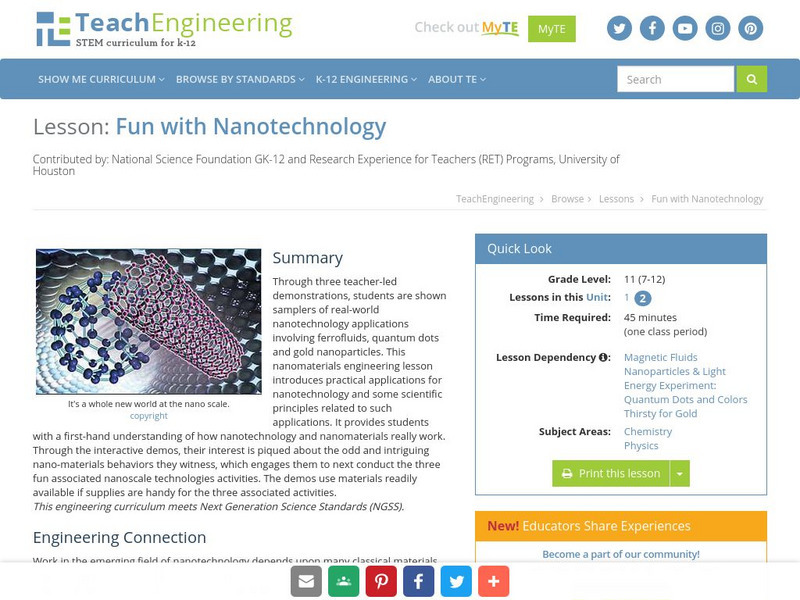
Teach Engineering: Fun With Nanotechnology
Through three teacher-led demonstrations, students are shown samplers of real-world nanotechnology applications involving ferrofluids, quantum dots and gold nanoparticles. This nanomaterials engineering lesson introduces practical...
TeachEngineering
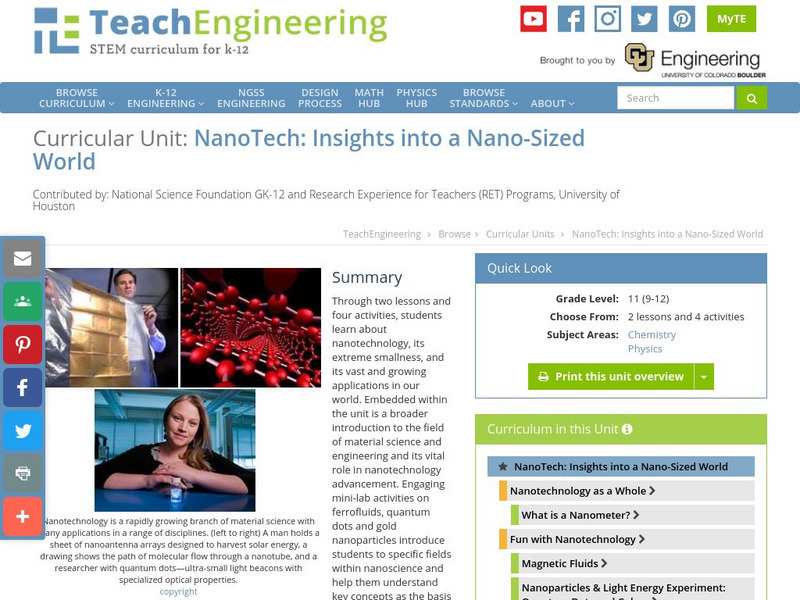
Teach Engineering: Nano Tech: Insights Into a Nano Sized World
Through two lessons and four activities, students learn about nanotechnology, its extreme smallness, and its vast and growing applications in our world. Embedded within the unit is a broader introduction to the field of material science...
TeachEngineering
Teach Engineering: Engineering Out of Harry Situations
Under the "The Science Behind Harry Potter" theme, a succession of diverse complex scientific topics are presented to students through direct immersive interaction. Student interest is piqued by the incorporation of popular culture into...

University of Wisconsin
University of Wisconsin: Exploring the Nanoworld: Teaching Modules
A collection of lesson plans and student handouts on teaching students about the "nanoworld."

National Geographic
National Geographic: Properties of Matter: Macro to Nano Scale
In this lesson, students learn how properties of matter for common materials may change when examined at the nanoscale level. Includes student handouts, video resources, and a glossary.
TeachEngineering
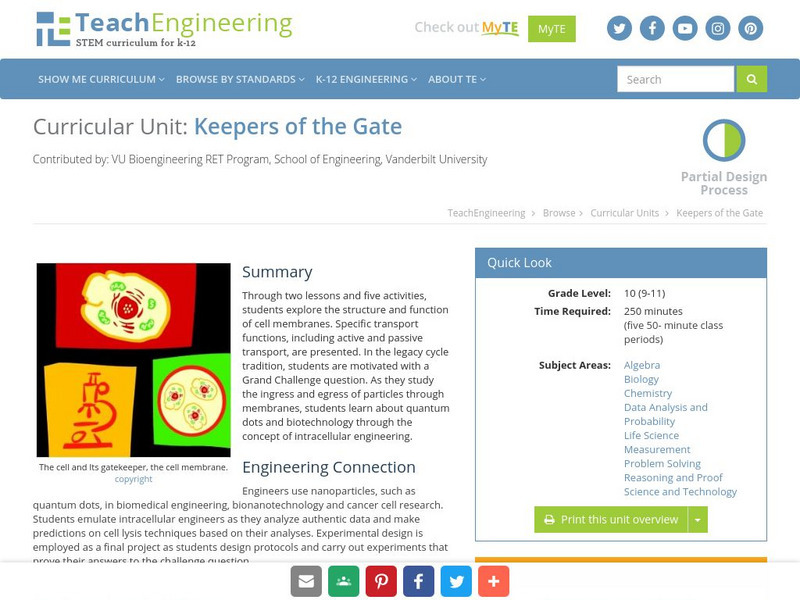
Teach Engineering: Keepers of the Gate
Through two lessons and five activities, students explore the structure and function of cell membranes. Specific transport functions, including active and passive transport, are presented. In the legacy cycle tradition, students are...
TryEngineering
Try Engineering: The Power of Graphene
In this engineering lesson, learners learn about nanotechnology, graphene, and its electrical properties and applications. Teams of students test graphene to determine whether it is an electrical conductor or insulator, then develop...
TryEngineering
Try Engineering: Nano Waterproofing
Lesson investigates the modification of a material at the nanoscale to enhance it with properties such as water and stain resistance.
Stanford University
Stanford University: Invisible Rays
This lesson focuses on investigating the electromagnetic spectrum using ultraviolet beads. Students learn how material properties change as the size of the material decreases to the nanoscale.

TeachEngineering
Teach Engineering: The Keepers of the Gate Challenge
Students are presented with a real-life problem as a challenge to investigate, research and solve. Specifically, they are asked to investigate why salt water helps a sore throat, and how engineers apply this understanding to solve other...
Discovery Education
Discovery Education:nanotechnology,biological Engineering and Biosensors [Pdf]
A lesson plan where students use their innovative thinking skills to design biosensors for a future use. During the lesson, students will learn about nanotechnology and biosensors.