Hi, what do you want to do?






PBS
Earthquakes and Volcanoes
Earth's surface constantly changes thanks to a variety of geological forces; in fact, Australia currently moves faster than GPS technology. Scholars connect the idea of continental drift to earthquakes and volcanoes with the help of an...

CK-12 Foundation
Topographic and Geologic Maps: Topographic Maps
Maps are great for helping you get where you're going, but what does that place actually look like? Geology scholars compare and contrast the features of topographical and geologic maps using an interactive lesson. The resource describes...

NOAA
Seamounts
How do chains of islands form? Young oceanographers explore the mountains of the deep in the final installment in a 13-part series. The interactive compares types of seamounts based on their overall height and height under the water, as...

Curated OER
Types of Volcanoes
In this types of volcanoes quiz instructional activity, learners complete an on-line quiz, clicking on questions and matching answers, scoring 1 point for each correct answer. A printed version is available.

University of Colorado
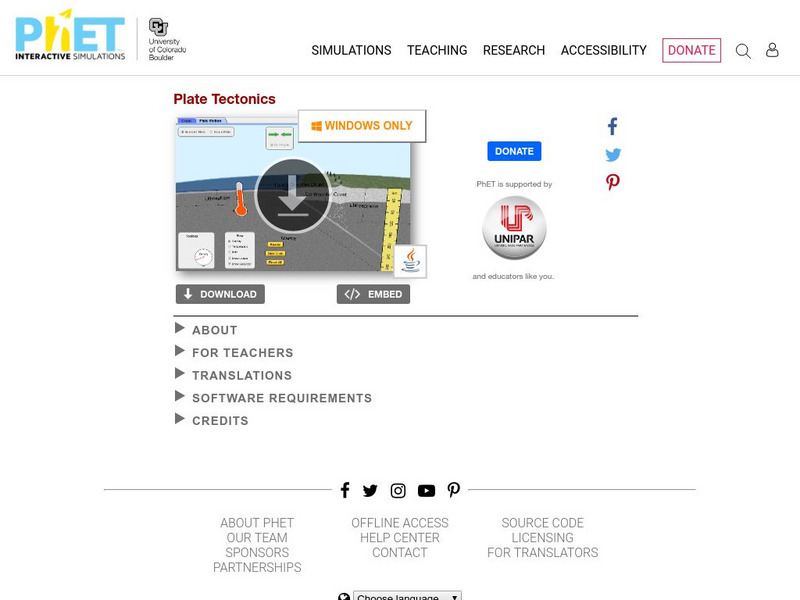
University of Colorado: Ph Et Interactive Simulations: Plate Tectonics
Explore how plates move on the surface of the earth. Change temperature, composition, and thickness of plates. Discover how to create new mountains, volcanoes, or oceans! Java is required.
University of Colorado
University of Colorado: Ph Et Interactive Simulations: Ph Et: Interactive Simulations: Plate Tectonics
Students studying plate tectonics will better understand its concepts with this virtual experiment that tests how plates move on the surface of the earth. Temperature, composition, and thickness of plates can be changed to create new...