Hi, what do you want to do?





University of Colorado
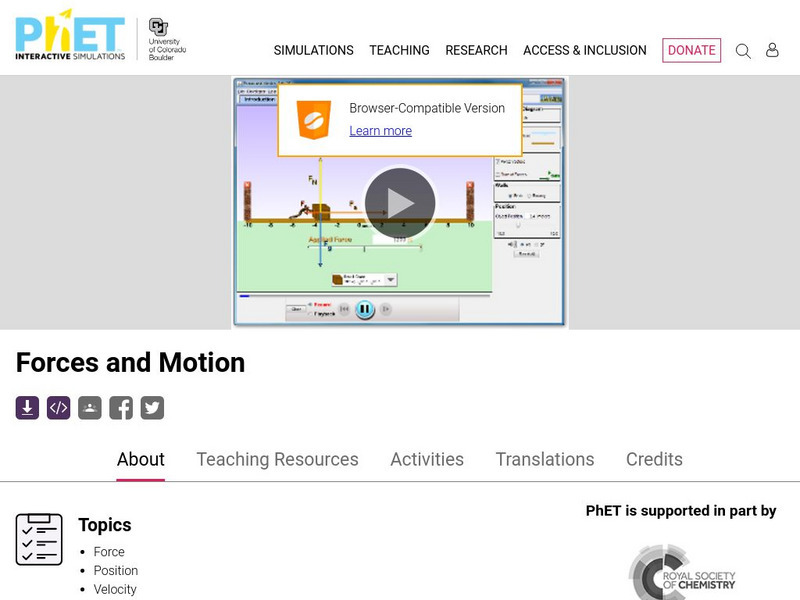
University of Colorado: Ph Et Interactive Simulations: Forces and Motion
Explore the forces at work when you try to push a filing cabinet. Create an applied force and see the resulting friction force and total force acting on the cabinet. Charts show the forces, position, velocity, and acceleration vs. time....

University of Colorado
University of Colorado: Ph Et Interactive Simulations: Forces and Motion: Basics
See how forces affect various items that are pushed or pulled.

Other
Bscs: Forces and Motion Content Background Document
In this document, we will try to answer a fundamental question of physical science, "Why do things start to move, slow down, speed up, stop moving or change direction?" In answering these core questions we can develop concepts that can...
University of Colorado
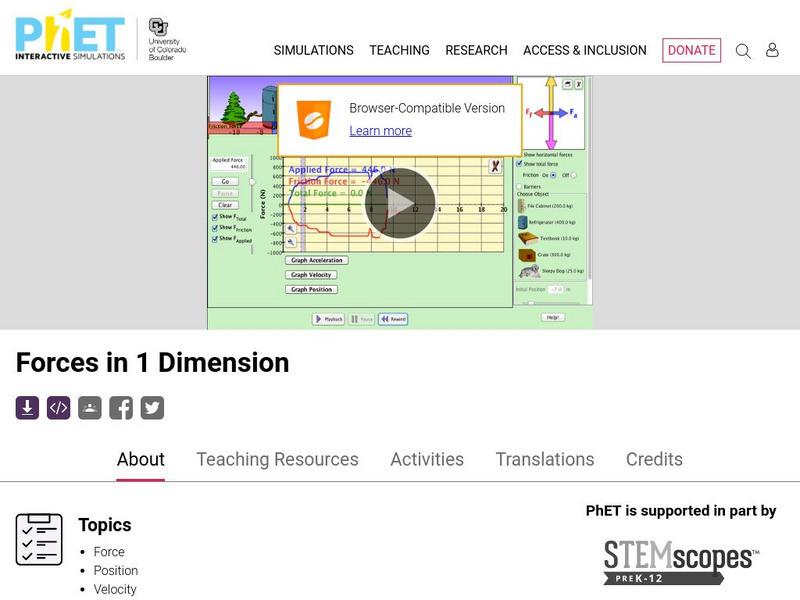
University of Colorado: Ph Et Interactive Simulations: Forces in One Dimension
Use this simulation to see the results of applying a force to move an object. Analyze forces and friction using graphs.
TeachEngineering
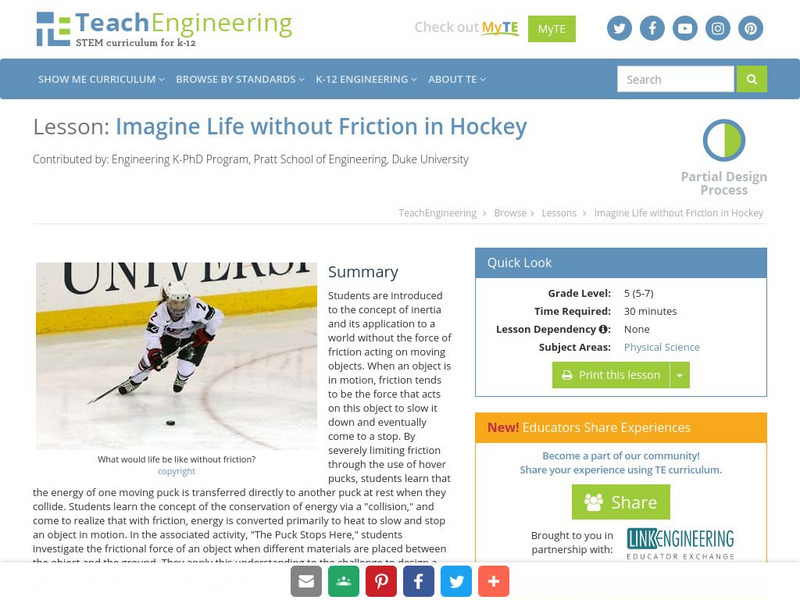
Teach Engineering: Imagine Life Without Friction
Students are introduced to the concept of inertia and its application to a world without the force of friction acting on moving objects. When an object is in motion, friction tends to be the force that acts on this object to slow it down...

TeachEngineering
Teach Engineering: Ramp and Review (For High School)
In this hands-on activity - rolling a ball down an incline and having it collide into a cup - the concepts of mechanical energy, work and power, momentum, and friction are all demonstrated. During the activity, students take measurements...
TeachEngineering
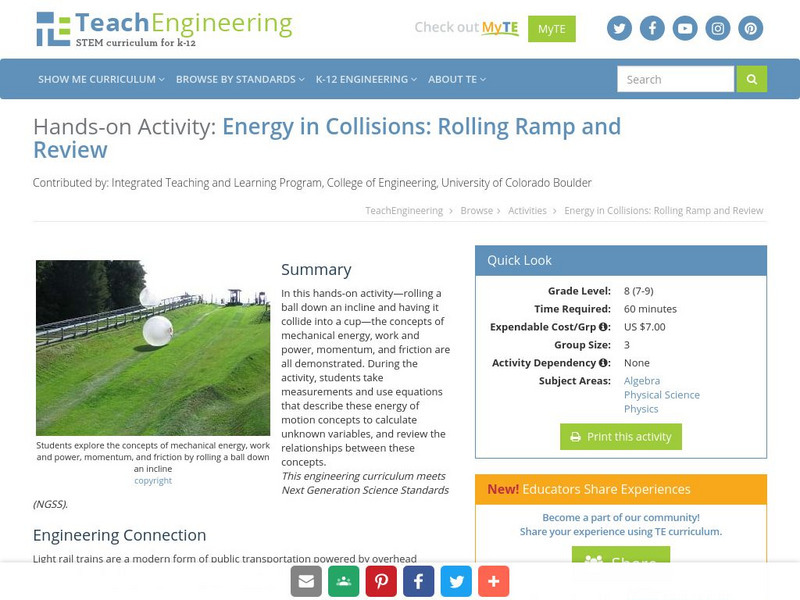
Teach Engineering: Ramp and Review
In this hands-on activity - rolling a ball down an incline and having it collide into a cup - the concepts of mechanical energy, work and power, momentum, and friction are all demonstrated. During the activity, students take measurements...
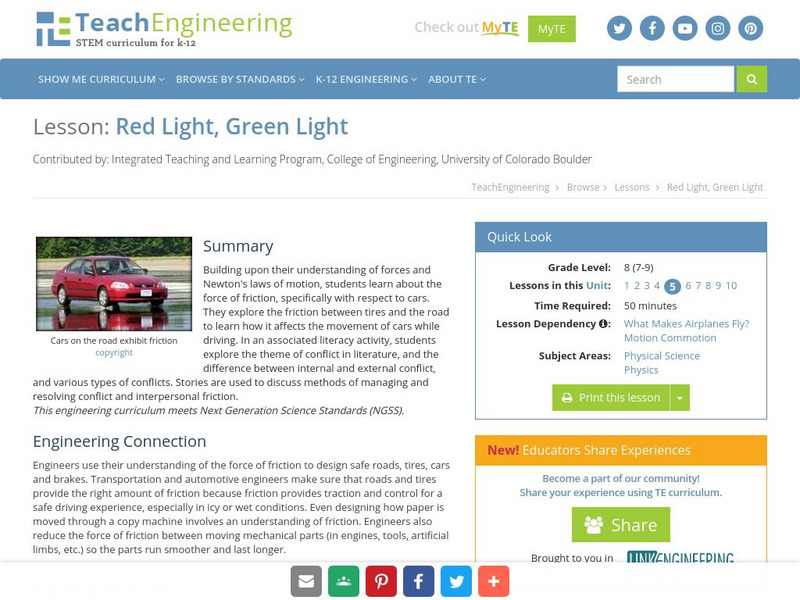
TeachEngineering
Teach Engineering: Red Light, Green Light
Building upon their understanding of forces and Newton's laws of motion, students learn about the force of friction, specifically with respect to cars. They explore the friction between tires and the road to learn how it affects the...
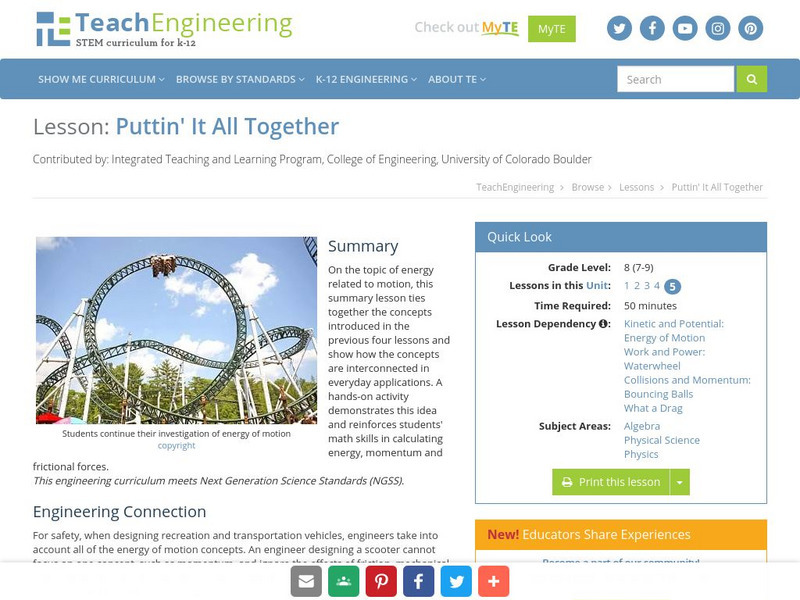
TeachEngineering
Teach Engineering: Puttin' It All Together
On the topic of energy related to motion, this summary lesson is intended to tie together the concepts of work, power, collisions, momentum and drag. A hands-on activity demonstrates this idea and reinforces students' math skills in...
Physics Classroom
The Physics Classroom: Newton's Laws: Finding Individual Forces
Through illustrated examples and interactive practice problems, students find the value of forces acting upon objects using force equations.
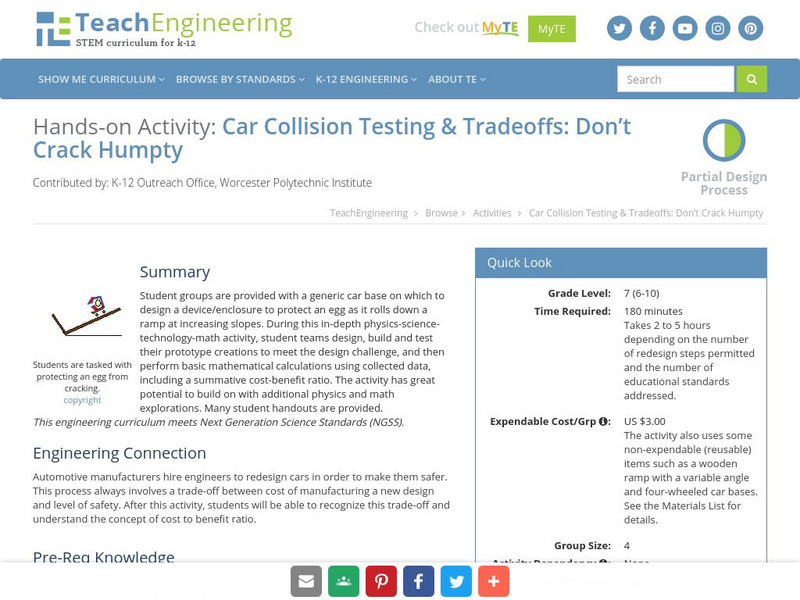
TeachEngineering
Teach Engineering: Car Collision Testing & Tradeoffs: Don't Crack Humpty
Student groups are provided with a generic car base on which to design a device/enclosure to protect an egg as it rolls down a ramp at increasing slopes. During this activity, student teams design, build and test their prototype...
Physics Classroom
The Physics Classroom: Newton's Second Law of Motion
Learn more about finding acceleration through the practices found in this lesson. "The process of determining the acceleration of an object demands that the mass and the net force are known." Check out this comprehensive site.
Physics Classroom
The Physics Classroom: Newton's First Law of Motion
A clear explanation of Newton's First Law of Motion, the law of inertia, with diagrams and real-world examples. Useful for both students and teachers. Written by a high school physics teacher.
Science Buddies
Science Buddies: Do Submarines Need Fins?
In this science project, you can investigate how submarines use stabilizing fins to move forward. Exploring friction and buoyant force you will get closer to understanding how these large ships function. Research resources are included...
Cosmo Learning
Cosmo Learning: Newton's Laws
Do you need to review any of Newton's three laws? This website contains a video collection on Newton's Law from a physics course at East Los Angeles College. In twelve lectures, each law is explained with examples. Also discussed is...