Hi, what do you want to do?






American Chemical Society
Middle School Chemistry: Lesson Plans: Why Does Water Dissolve Salt?
Learners use their own model of a salt crystal and water molecule to show how water dissolves salt. Then, they relate their observations to the structure of salt, water, and alcohol on the molecular level.
Concord Consortium
Concord Consortium: Protein Folding
Generate all polar, all nonpolar, or random proteins and observe how the protein folds in response to these molecular properties. Explore how the potential energy of the system changes over time to draw conclusions about how proteins...
Concord Consortium
Concord Consortium: Oil and Water
Mix polar and nonpolar molecules together and observe changes in potential energy.
Michael Blaber, PhD
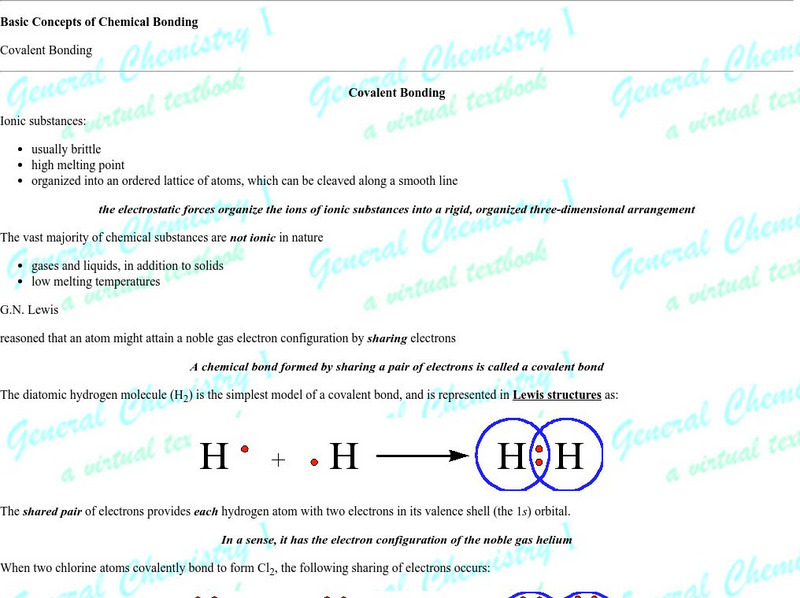
Florida State University: Basic Concepts of Covalent Bonding: Covalent Bonding
Good introduction and graphics make this a solid page for understanding the orbital role in bonding and molecular geometry. The author is a professor at Florida State University.
Concord Consortium
The Concord Consortium: Molecular Workbench: Hypocycloid
View a hypocycloid being created in this simulation.
Other
Solubility of Things: Factors Affecting Solubility
Find out how temperature, polarity, pressure, molecular size, and stirring affects the speed of dissolving.
Concord Consortium
Concord Consortium: Mixing Liquids
Experiment with mixing liquids and observing the volume they take up.
American Chemical Society
Middle School Chemistry: Lesson Plans: Temperature Changes in Dissolving
Media-rich lesson in which learners discover that it takes energy to break bonds, and that energy is released when bonds are formed during the process of dissolving. They also determine whether dissolving is either exothermic or...
University of Arizona
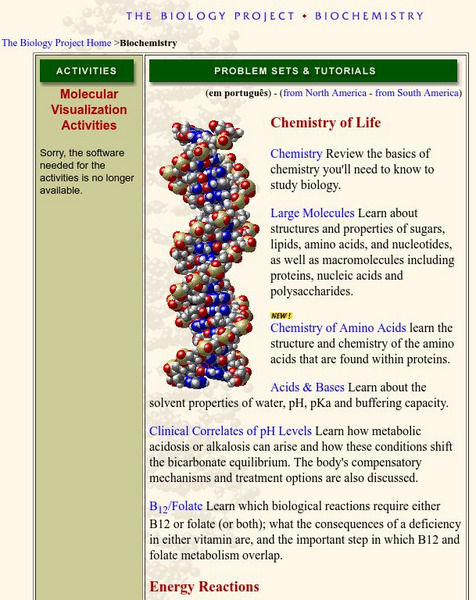
University of Arizona: Biochemistry
Problem sets, tutorials, and activities related to biochemistry.
Concord Consortium
Concord Consortium: Micelles
Select an oil or water environment for molecules and observe how they are affected by interactions with their environment and each other.
Concord Consortium
Concord Consortium: Protein Folding Exploring
Discover how peptides fold into stable conformations.