Hi, what do you want to do?






NOAA
Please Pass the Salt
Salinity is the focus of two experimenters that work to answer the question, How does salt change the physical properties of water? Super scientists compare the freezing rate of salt and fresh water, combine the two waters to...

US Department of Energy
Solar Distiller
Explore the sun's ability to distill contaminated water with this simple set of classroom experiments. After filling two glass bowls, one with muddy water and the other with salt water, they are covered with plastic wrap and placed...

Curated OER
Sore Throats, Variation 1
Why does Nia's water taste saltier than Trey's if she put more into her cup than he did? Math masters set up proportions in order to compare the mixtures. This task effectively has learners apply the concepts of ratio and proportion to a...

Curated OER
Make Your Own Recipe
Students make their own recipe. In this art lesson, students mix dry ingredients with a little water and see the changes made.

Curated OER
Treasure Rocks
Students mix ingredients together until it forms a soft dough. In this art lesson, students flatten the dough out and put small trinkets, wrapped candy or anything else they would want to hide in the rock. Students form dough up and into...

Illustrative Mathematics
Sore Throats, Variation 2
What does math have to do with a sore throat? When you mix water and salt you have a great review of how to represent proportional relationships by an equation or graph. Here the proportions of the mixtures may be different, but the...

Curated OER
Child's Lasting Hand Print
Students make something that will last forever. In this art lesson, students make a handprint out of clay.

DiscoverE
Squishy Circuits
Make electricity flow through Play-Doh. Individuals create animals or other creatures using Play-Doh. The engineering aspect? Eyes that light up and Play-Doh that conducts electricity.

Curated OER
Fun Crystal Activities
Students complete a variety of activities to learn about crystals. In this crystals lesson plan, students paint with a crystal solution, pan for crystals, grow crystals, and more.
TeachEngineering
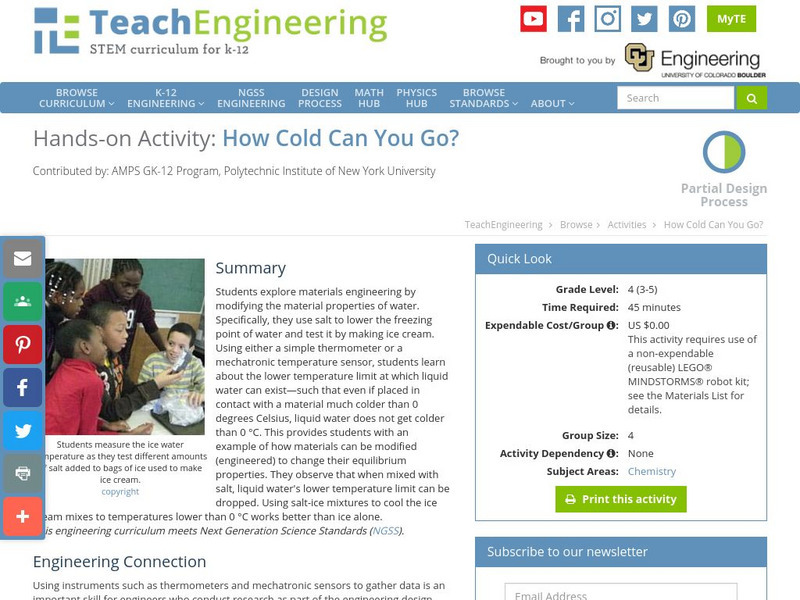
Teach Engineering: How Cold Can You Go?
Students explore materials engineering by modifying the material properties of water. Specifically, they use salt to lower the freezing point of water and test it by making ice cream. Using either a simple thermometer or a mechatronic...
TeachEngineering
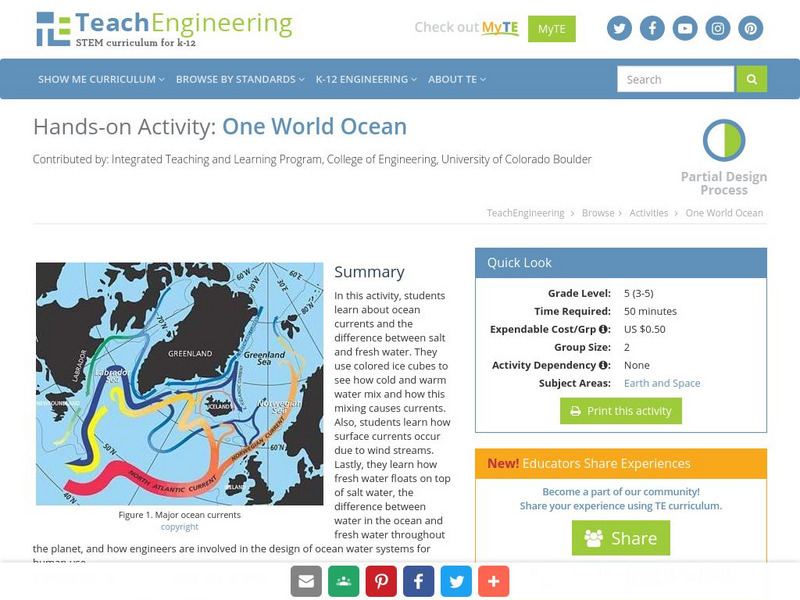
Teach Engineering: One World Ocean
In this activity, students learn about ocean currents and the difference between salt and fresh water. They use colored ice cubes to see how cold and warm water mix and how this mixing causes currents. Also, students learn how surface...