Hi, what do you want to do?






Science Struck
Science Struck: A Study of the Microscope and Its Functions
Uses illustrations with labels to complement a detailed examination of the parts and functions of a light microscope and an electron microscope.
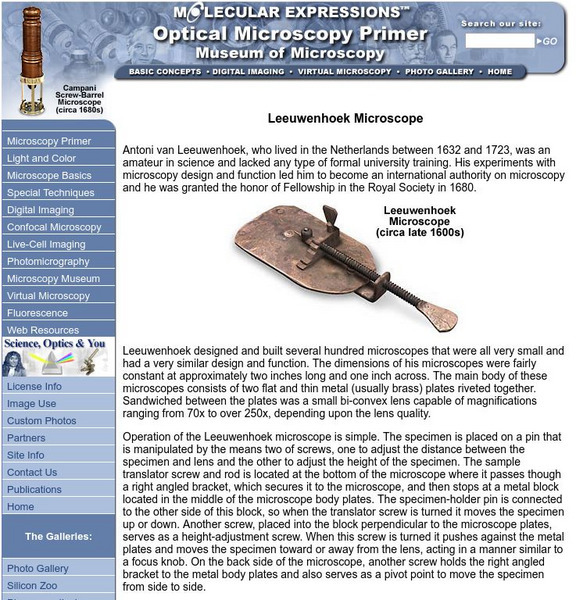
Florida State University
Florida State University: The Leeuwenhoek Microscope
Microscope pioneer and amateur scientist Leeuwenhoek built a number of tiny microscopes with a variety of lenses.
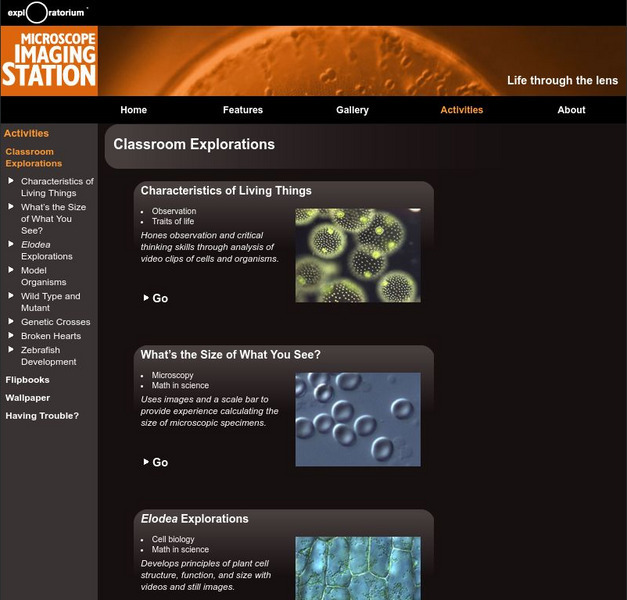
Exploratorium
Exploratorium: Microscope Imaging Station: Classroom Explorations
These microscope activities provide students with lots to explore. Activities include the characteristics of living things, math in science, cell biology, genetics, physiology, and mitosis.
OpenStax
Open Stax: Anatomy & Physiology: Microscopic Anatomy of the Kidney
Students learn about the renal structures that conduct the essential work of the kidneys and cannot be seen by the naked eye.
Other
University of Bristol, Uk: Minerals Under the Microscope
In this geology course, students learn about the use of the polarizing microscope, the primary tool for examining the structure of mineral samples such as cleavage, density, fracture, color, and the like.
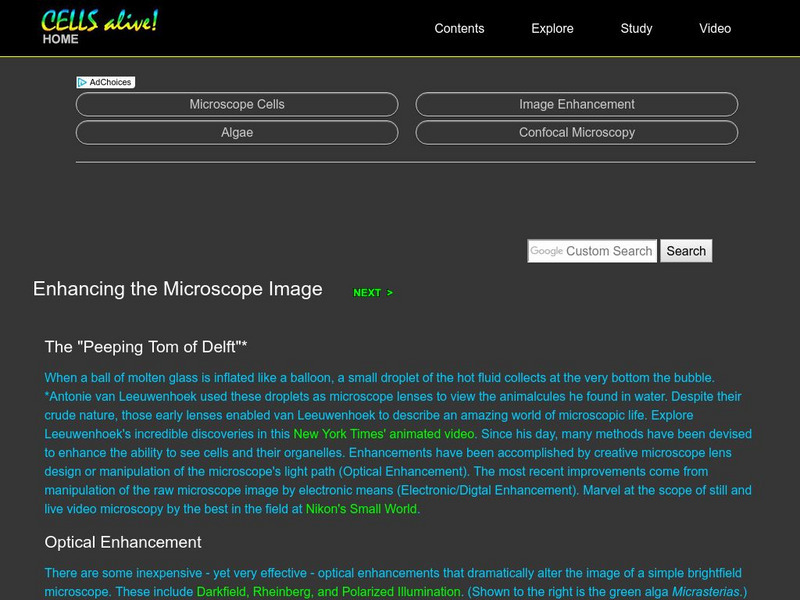
Cells Alive
Cells Alive!: Enhancing the Microscope Image
See how an enhancement of a microscopic image can change and improve its appearance.
University of North Carolina
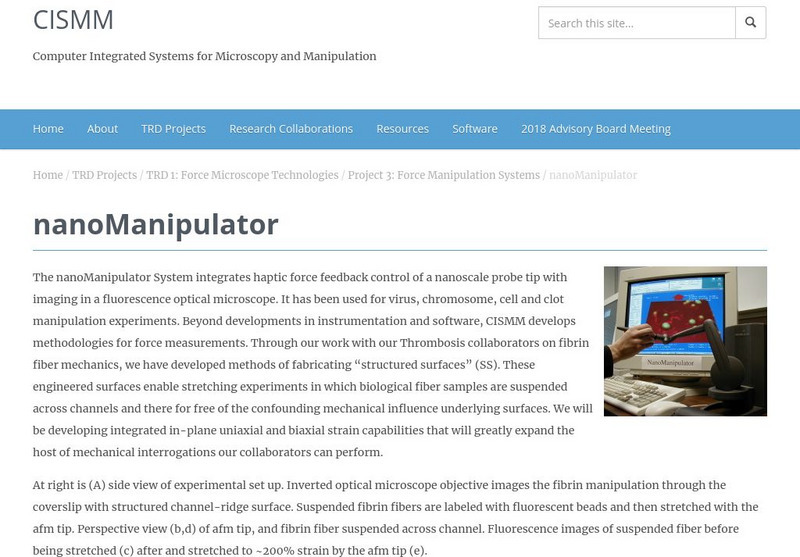
University of North Carolina: Nano Manipulator
This site from the University of North Carolina takes you through the research being done at Univ. of North Carolina with SPM. Includes an introduction to scanning probe microscope.

Other
Xtalent Art Gallery: Nanoworld Image Gallery
Microscopic gallery of various organisms and objects.
BioEd Online
Bio Ed Online: The Science of Microbes: Tools of Magnification
The invention of magnifiers that allow us to see things that are otherwise invisible to us has revolutionized science. In this lesson, middle schoolers use several types of magnifiers to investigate magnification, and record their...
National High Magnetic Field Laboratory
Magnet Academy: Gerd Binnig
Gerd Binnig co-developed the scanning tunneling microscope (STM) with Heinrich Rohrer. The STM allowed scientists entry into the atomic world in a new way and was a major advance in the field of nanotechnology. For their achievement,...

TED Talks
Ted: Ted Ed: Visualizing Hidden Worlds Inside Your Body
How do we see things too small to be detected by the human eye? What about things inside our own bodies? Dee Breger uses a scanning electron microscope to give us a glimpse of images including blood clots, thyroid glands, and lungs with...
Concord Consortium
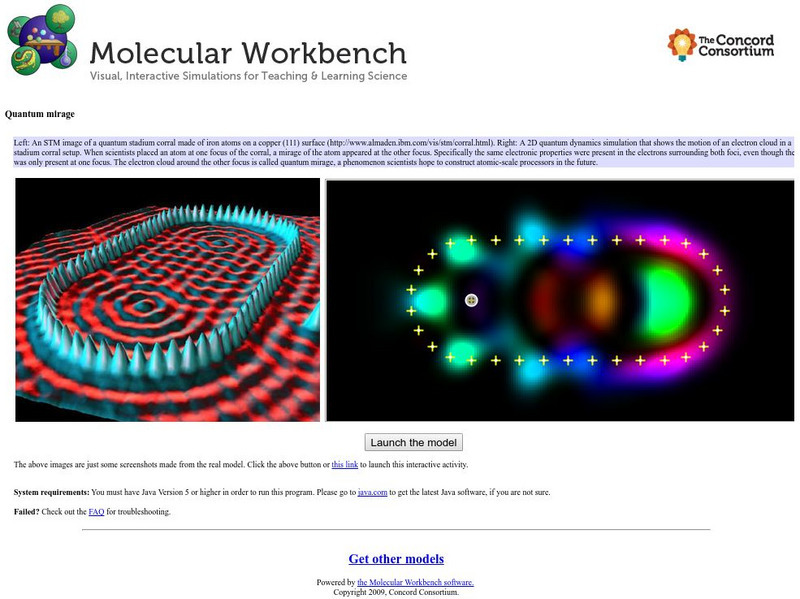
Concord Consortium: Molecular Workbench Showcase: Quantum Mirage
An animation of a scanning tunneling microscope, STM, image of a quantum stadium corral made of iron atoms on a copper surace.

TED Talks
Ted: Ted Ed: The Microbial Jungles All Over the Place (And You)
As we walk through our daily environments, we're surrounded by exotic creatures that are too small to see with the naked eye. We usually imagine these microscopic organisms, or microbes, as asocial cells that float around by themselves....
National High Magnetic Field Laboratory
Magnet Academy: Heinrich Rohrer
Swiss physicist Heinrich Rohrer co-invented the scanning tunneling microscope (STM), a non-optical instrument that allows the observation of individual atoms in three dimensions, with Gerd Binnig. The achievement garnered the pair half...
Famous Scientists
Famous Scientists: Antonie Van Leeuwenhoek
Learn about the life and work of Antonie van Leeuwenhoek, best known for his work on the improvement of the microscope, and considered to be the first microbiologist.
City University of New York
Brooklyn College: Direct Microscopic Counts
Guidelines for an activity through which you, acting as a research assistant for a wine merchant, work to grow a microbe under different conditions.
Other
Dennis Kunkel Microscopy: Microscopy
A description of the three different types of microscopy: light, transmission electron, and scanning electron
Microscopy UK
Microscopy Uk: Robert Hooke the Father of Modern Science
An excellent review of this important man in science who went unnoticed for so many years.

Bio Topics
Bio Topics: Direct Observation of Yeast Population Growth
In this classroom lab experiment, students mimic optimal growth conditions for yeast, and with the help of a microscope, observe and record results using a cell counting method.
Other
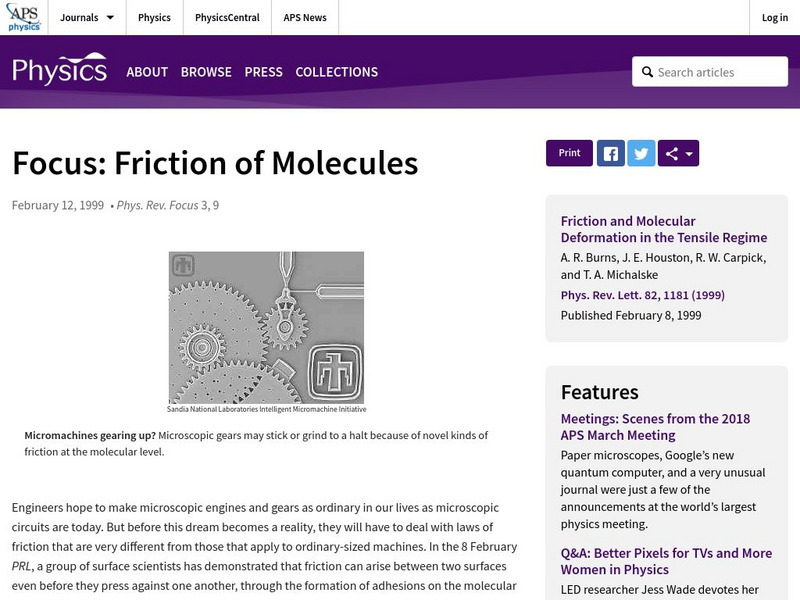
Focus Physical Review: Friction of Molecules
This is an article published by the American Physical Society on friction in microscopic gears that results from the adhesion of molecules. A great exploration of this new obstacle in science.
Science Buddies
Science Buddies: Career Profile: Microbiologist
Microbiologists spend their careers peering through microscopes in their study of microorganisms. They have plenty to look at since these are Earth's most common life-forms. Science Buddies outlines the education requirements as well as...
Other
University of Western Australia: Integumentary System
A resource for advanced anatomy and physiology classes. It contains information on the integumentary system, the epidermis, the dermis, hair, sebaceous glands, and sweat glands. Microscopic images are included.

University of South Florida
University of South Florida: Moon Rocks Through the Microscope (Image Gallery)
Examine some of the rock samples gathered by the Apollo lunar missions.
Palomar Community College District
Wayne's World: Desert Varnish and Lichen Crust
Lichens thrive in common and in very specialized and inhospitable climates. This clickable index site offers text and photographs of desert and mountain lichens.
Other popular searches
- Parts of a Microscope
- Compound Microscopes
- Label Compound Microscope
- Dissection Microscopes
- Microscope Cheek Cells
- Digital Microscope
- Microscope Lab
- Biology Lab Microscopes
- Scanning Electron Microscopes
- Cheek Cells and Microscopes
- Lesson Plan on Microscopes
- Lenses and Microscopes