Hi, what do you want to do?






Curated OER
Selecting Soil Organisms in Compost
Learners conduct an experiment to demonstrate that many of the enzyme systems needed to break down society's wastes exist in nature among the decomposers in a compost pile. They culture compost bacteria on starch agar to examine the...

Curated OER
Selecting Soil Organisms in Compost
Students demonstrate that many of the enzyme systems needed to break down--and therefore clean up-society's wastes already exist in nature among the decomposers. They select the best starch-munching organisms by altering the environment...

Curated OER
Counselors/Teachers
Administrators encourage students to take as much English, Science and Math as they can. They encourage students to take the most advanced classes they can. They help students find opportunities to explore medical careers through...

Curated OER
Science: Designer genes
Students engineer new organisms using biotechnology. In small groups, they write procedures, list benefits and drawbacks, and explain how their new organism might affect the environment. After creating their new organisms, they present...

Curated OER
Life's Big Questions: Where Did Life Come From?
Students explore the life forms that live in the hot springs of Yellowstone. They examine how microscopic creatures can survive in these extreme conditions. Students perform experiments to observe growth samples and demonstrate how a...

Curated OER
Global Awareness
Students read about how scientists are arriving at current theories of human origin and migration through mitochondrial DNA analysis. They then piece together a map showing the data from mitochondrial DNA analysis to plot the migration...
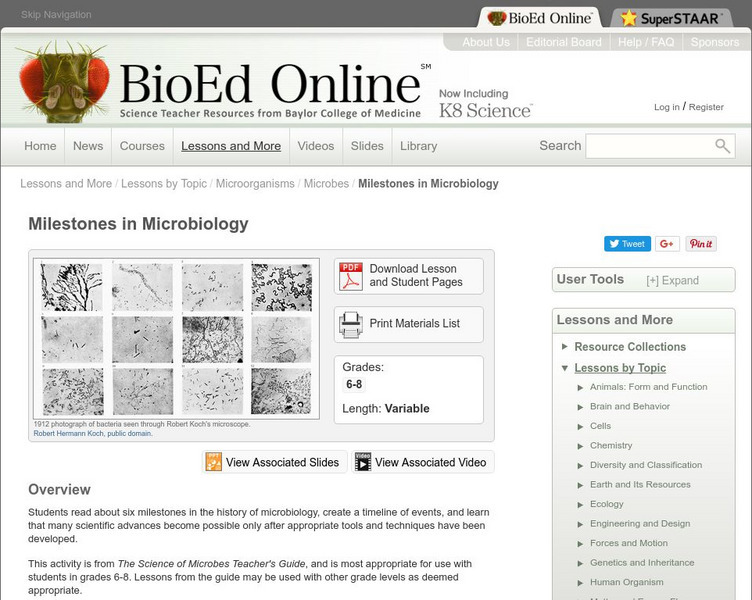
BioEd Online
Bio Ed Online: The Science of Microbes: Milestones in Microbiology
Middle schoolers read about six important discoveries in microbiology and put them on a timeline. They develop an understanding of how these discoveries connect to the invention of new scientific tools and technology. The lesson plan and...

Science Education Resource Center at Carleton College
Serc: Microbes in Action
The Microbes in Action program serves to promote an understanding and appreciation of the importance of microorganisms in our world by providing scientific information, hands-on activities, articles and news, curriculum units, and other...
Science Education Resource Center at Carleton College
Serc: Intimate Strangers: Unseen Life on Earth
This PBS documentary provides an overview of the microbial world and offers an exciting glimpse into the field of microbiology. Meet scientists from around the world investigating the microbial world in diverse locations, from a...
TeachEngineering
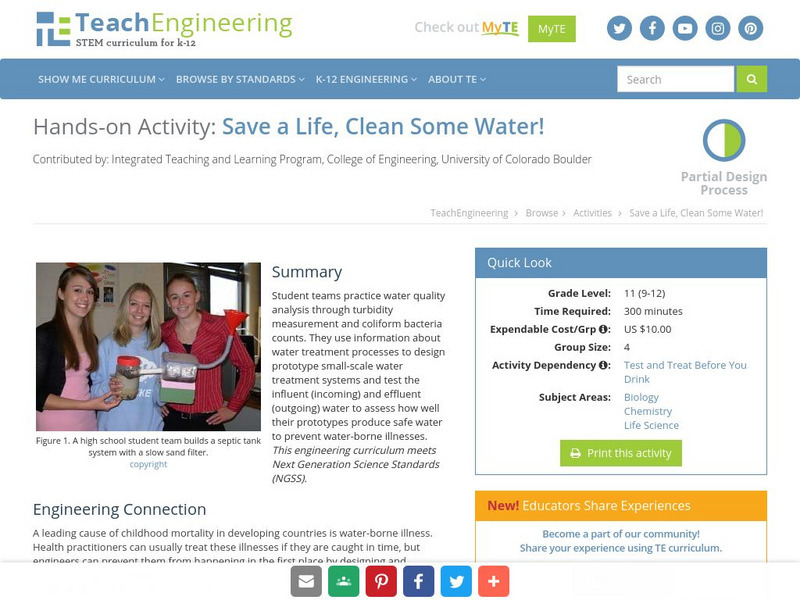
Teach Engineering: Save a Life, Clean Some Water!
Student teams practice water quality analysis through turbidity measurement and coliform bacteria counts. They use information about water treatment processes to design prototype small-scale water treatment systems and test the influent...
Science Education Resource Center at Carleton College
Serc: Microbial Communities
This 1986 journal article reports that most microbial communities have escaped description. Article covers communities and ecosystems, microbial communities in termite intestines, microbial mats in evaporite flats, and microbial...
Science Education Resource Center at Carleton College
Serc: Ecology in a Jar
This journal article discusses incorporation of the Winogradsky Column into high school science classrooms to demonstrate nutrient cycles and inter-relatedness of organisms in the environment.
Science Education Resource Center at Carleton College
Serc: Plankton in the Bay
Students will learn about plankton in relation to the Chesapeake Bay and how they grow and are sampled.
Science Education Resource Center at Carleton College
Serc: Nanobacteria: Are They or Aren't They Alive?
In this five-part activity, learners will learn whether or not nanobacteria are alive.
PBS
Pbs Teachers:odyssey of Life Ii the Unknown World
Observe organisms in various environments, determine what enables the organisms to live in that environment and discuss the varied biological functions of the organisms.