Hi, what do you want to do?





Shodor Education Foundation
Shodor Interactivate: Lesson: An Introduction to Quadrilaterals
Quadrilaterals-parallelograms, rectangles, and trapezoids-are thoroughly introduced in this lesson plan for upper elementary and middle school students. Lots of resources are linked to it to help support the teacher and students....
Shodor Education Foundation
Shodor Interactivate: Lesson: Area
This lesson plan helps students explore the mathematical concept of area and features resource links to further learning. CCSS.Math.Content.3.MD.C.7.a Find the area of a rectangle with whole-number side lengths by tiling it
Other
Helping With math.com: Ratios and Unit Rates
This site contains a lesson about ratios and unit rates as well as guided and independent practice for students to review the skills.

Better Lesson
Better Lesson: Patterns Make Ten
This instructional activity builds a foundation for adding larger numbers which is supported by the Common Core standards for second grade.
Other
West Contra Costa Usd: Volume: A Foundation in Unit Cubes [Pdf]
A very detailed lesson plan on determining the volume of rectangular prisms, teaching students how to derive the formula for volume, and to use it successfully. Plenty of examples, student work, and assessment options.
University of Nottingham
Mathematics Assessment Project: Modeling Population Growth: Having Kittens
This instructional activity unit guides learners in developing strategies for modeling problems. The task focuses on investigating a cat shelter's claims about the rate of cat population growth. The unit includes a full lesson plan,...
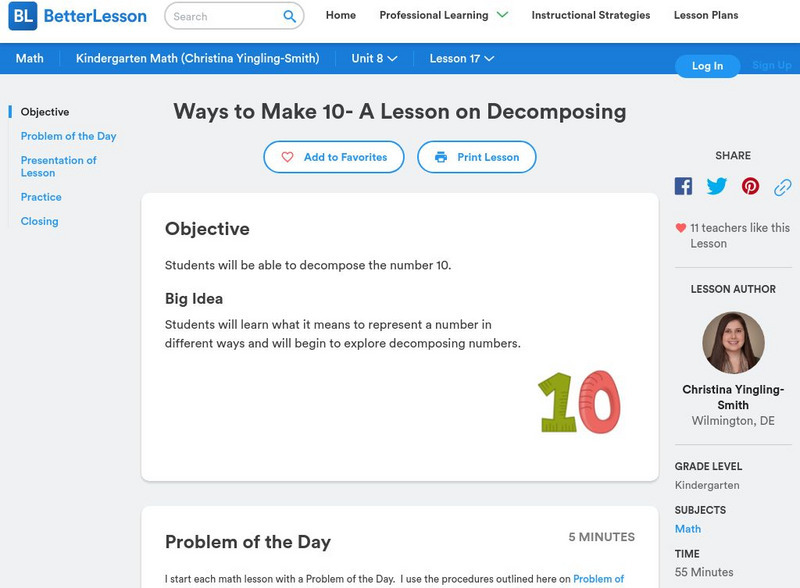
Better Lesson
Better Lesson: Ways to Make 10 a Lesson on Decomposing
Students will learn what it means to represent a number in different ways and will begin to explore decomposing numbers. Included is a detailed lesson plan, link to an online game, worksheet, center ideas, and a "Ways to Make 10" chart.
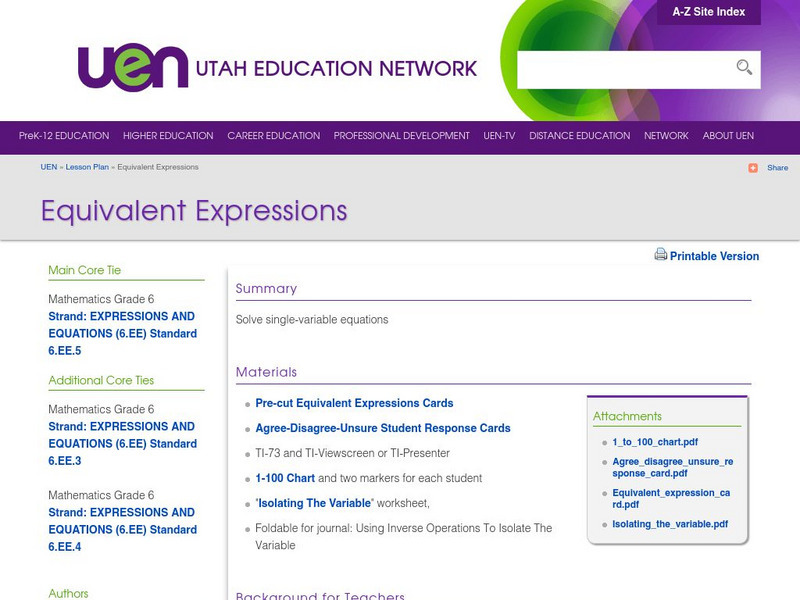
Utah Education Network
Uen: Equivalent Expressions
This multi-segment lesson plan uses games and calculators to explore the concept of equivalent expressions. Learners work together using inverse operations to isolate variables in algebraic equations. It also provides attachments for...
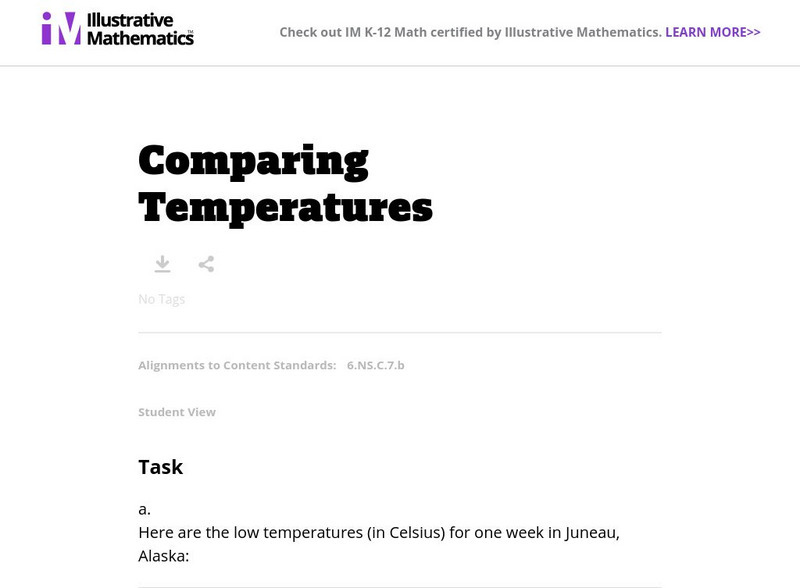
Illustrative Mathematics
Illustrative Mathematics: 6.ns Comparing Temperatures
This task has students do computations with positive and negative numbers in the context of temperature. Aligns with 6.NS.C.7.b.
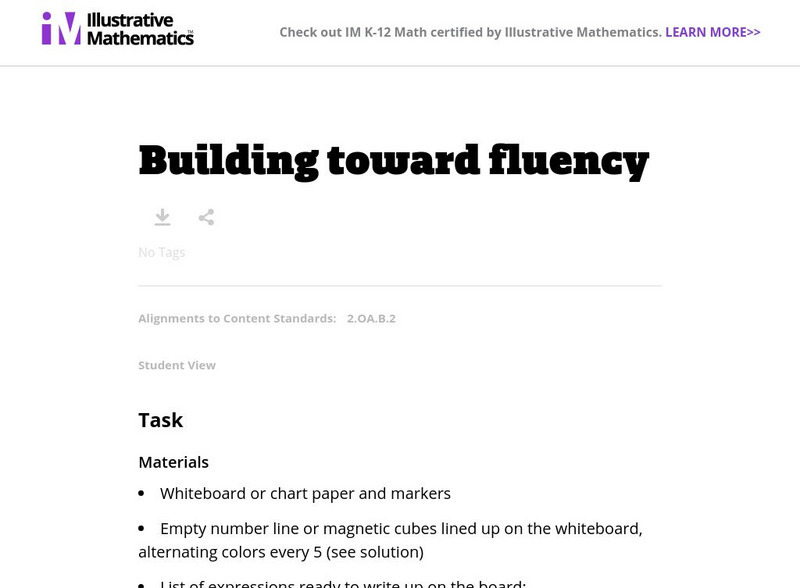
Illustrative Mathematics
Illustrative Mathematics: Building Toward Fluency
The purpose of this task is to promote certain addition strategies that will help students learn to fluently add and subtract within 20. Students will use a number line or magnetic cubes to solve addition problems. Students will be asked...
Illustrative Mathematics
Illustrative Mathematics: A Rei the Circle and the Line
Young scholars are required to solve a system of equations in this task which will demonstrate their understanding of the correspondence between intersection points of the two graphs and solutions of the system. Aligns with A-REI.C.7.
Illustrative Mathematics
Illustrative Mathematics: 6.ee Distance to School
This task asks students to find equivalent expressions by visualizing a familiar activity involving distance. The given solution shows some possible equivalent expressions, but there are many variations possible. Aligns with 6.EE.A.2.
Illustrative Mathematics
Illustrative Mathematics: Which Weighs More? Which Weighs Less?
Students will use a block to compare with other objects to decide which is heavier/lighter. They will fill in a chart by drawing a picture of it under "Heavier" or "Lighter" depending which applies.
Illustrative Mathematics
Illustrative Mathematics: Pick a Number, Counting On
Students will practice counting on with this class game. The teacher will put multiple numbers in a hat or on sticks from the known counting sequence. S/he randomly picks one number and asks the class to count on ten numbers from that...

Illustrative Mathematics
Illustrative Mathematics: Longer and Heavier? Shorter and Heavier?
Students will compare the length and weight of several pairs of objects to learn that weight and length are separate measurable attributes, and not always related.
Illustrative Mathematics
Illustrative Mathematics: 6.ns Fractions on the Number Line
In this task, 6th graders locate positive and negative fractions on a number line, determine if some inequalities are true, and compare fractions for their closeness to zero. Aligns with 6.NS.C.7.a.
Illustrative Mathematics
Illustrative Mathematics: 6.ns Interpreting a Division Computation
Sixth graders are shown the arithmetic for a multi-digit division problem and are asked to use it to find the products of related multiplication questions. Aligns with 6.NS.B.2.
Texas Instruments
Texas Instruments: Relationship of Angles to the Circle
In this activity, students recognize the relationship of angles to circles. They study the Inscribed Angle Theorem and its corollaries.

Texas Instruments
Texas Instruments: Segments Formed by Intersecting Chords, Secants, and Tangents
This activity is designed to help students discover several important theorems concerning lengths of segments formed by intersecting chords, secants, and tangents.
Other popular searches
- Common Core Math
- Common Core Math Lessons
- Math Common Core Lesson Plans
- Math Common Core Standards
- Common Core Kindergarten Math
- Common Core Math Fractions