Hi, what do you want to do?





Texas Instruments
Texas Instruments: Acceleration Due to Gravity
Students will collect data of different massed cars and compare the acceleration down an incline.
Science Education Resource Center at Carleton College
Serc: Newton's Second Law: How Does Acceleration Change With Varying Forces?
In this lab activity, young scholars investigate the effects of changing force on the acceleration of a lab cart testing Newton's Second Law of Motion. They will use distance and time to calculate velocity and create a graph representing...

Physics Aviary
Physics Aviary: Practice Problems: Displaced Angle for Accelerating Car
Students must solve for the tension in the rope and the acceleration of the car based on the angle of displacement for a hanging mass.
Sophia Learning
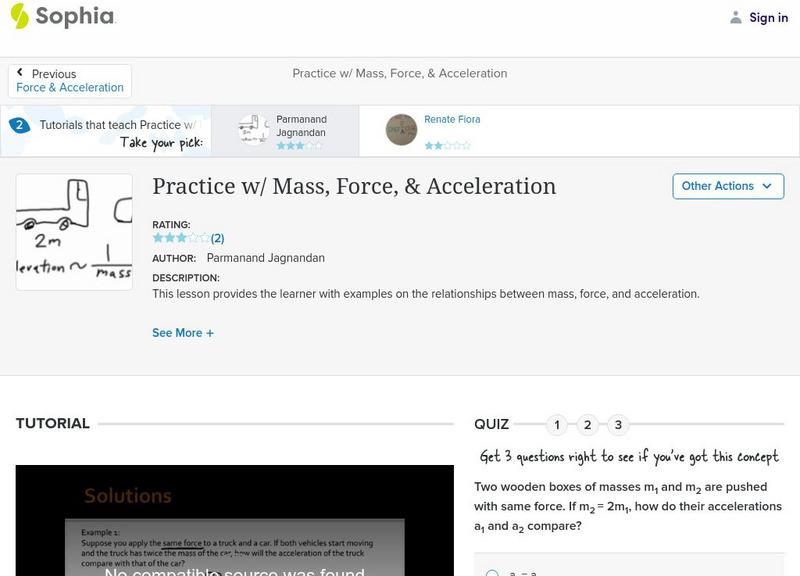
Sophia: Practice W/ Mass, Force, & Acceleration: Lesson 1
This lesson provides the learner with examples on the relationships between mass, force, and acceleration. It is 1 of 2 in the series titled "Practice w/ Mass, Force, & Acceleration."
Texas Instruments
Texas Instruments: The Science of Racing: Newton Knew
For race car engineers, F = m a, is the backbone of the vast majority of calculations. The selection of gear ratios is one example. Investigate and create a mathematical model for the relationship between force, speed, mass, distance and...
Exploratorium
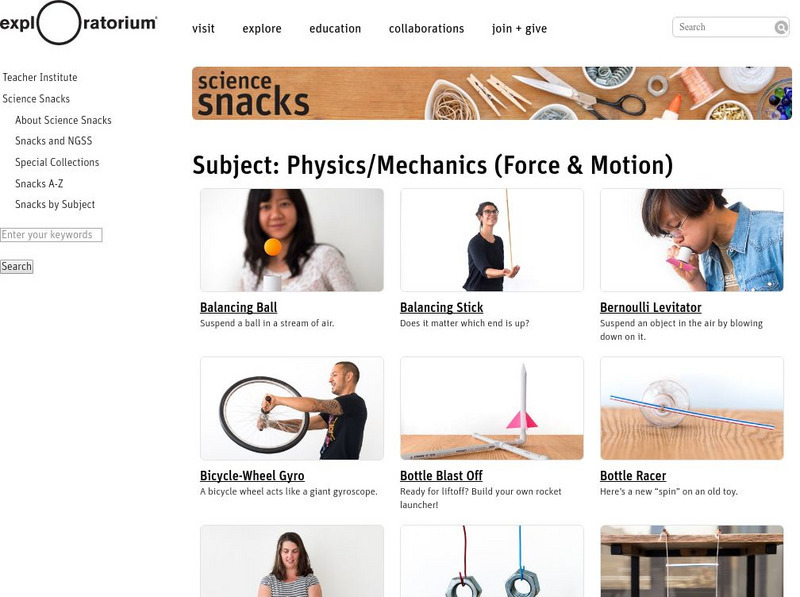
Exploratorium: Science Snacks: Physics/mechanics (Force and Motion)
A collection of mechanics activities. Many pertain to Newton's laws of motion. Step-by-step directions provided with illustrations. Great for teacher demos or student projects.
Physics Classroom
The Physics Classroom: Newton's Second Law of Motion
Learn more about finding acceleration through the practices found in this lesson. "The process of determining the acceleration of an object demands that the mass and the net force are known." Check out this comprehensive site.
Physics Classroom
The Physics Classroom: Kinetic Energy
Kinetic energy is defined and explained--learning exercises are included to assess your understanding.
Cosmo Learning
Cosmo Learning: Physics 240: Science and Engineering I
A collection of video lectures from a physics for science and engineering course taught at the University of Missouri-Kansas City. The course discusses the concepts of mechanics, wave motion, sound, heat and thermodynamics in thirty-five...
Sophia Learning
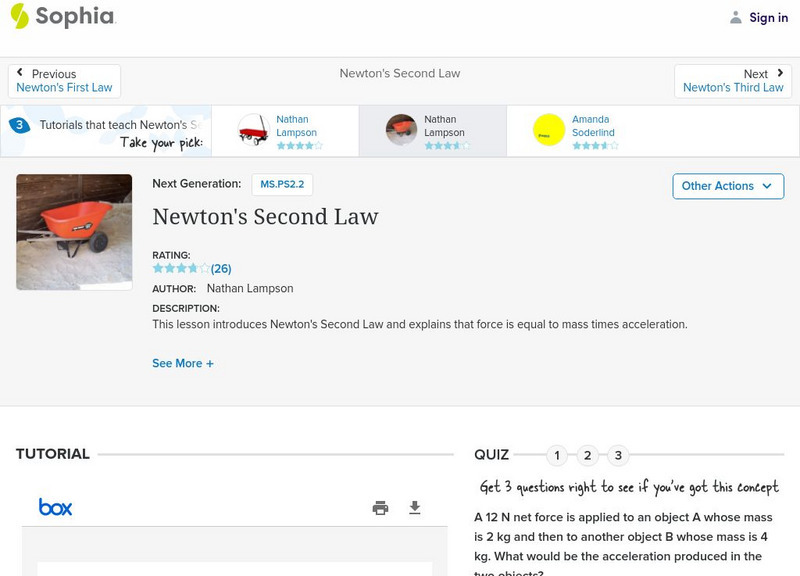
Sophia: Newton's Second Law: Lesson 3
This lesson introduces Newton's Second Law and explains that force is equal to mass times acceleration. It is 3 of 3 in the series titled "Newton's Second Law."
TeachEngineering
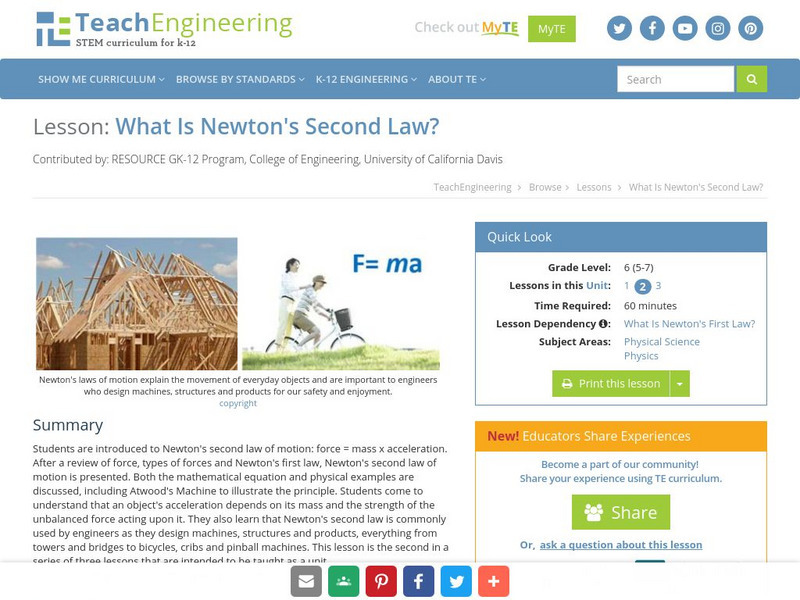
Teach Engineering: What Is Newton's Second Law?
After a review of force, types of forces, and Newton's first law, students are introduced to Newton's second law of motion: force = mass x acceleration.
Cornell University
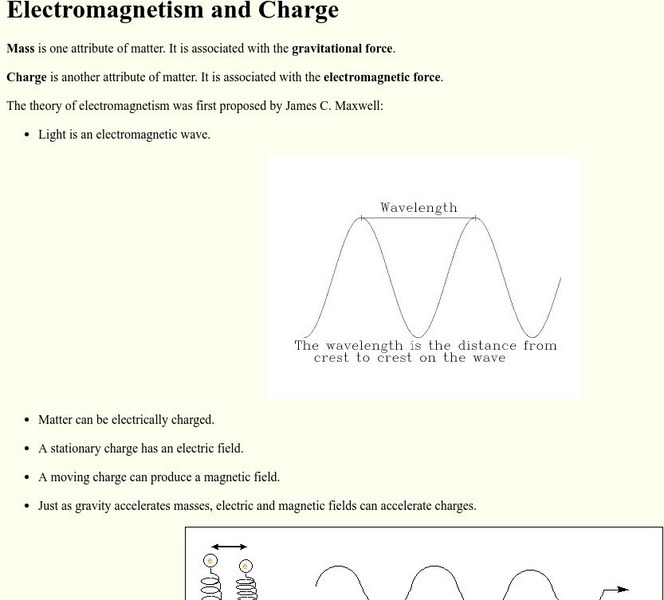
Cornell University: Astronomy: Electromagnetism and Charge
This site from Cornell University provides a very short, very telling comparison of matter and charge. This is a good site to check out on the subject, with a chart diagram to help with further information.
University of Maryland
Thinking Problems in Oscillations and Waves
A series of thought-provoking, multichoice questions from the University of Maryland on the topic of oscillations and waves. Equations for calculating the period of motion for masses on springs, pendulums, sounds, and waves on a string...
Other
Ask Numbers: Measurement Conversion Calculators and Charts
What kind of unit conversion would you like to do? This site will allow you to do a multitude of conversions. Just click on the specific measurement you are needing to convert. It also provides a history of measurements and a chart of...
Texas Education Agency
Texas Gateway: 4.3 Newton's Second Law of Motion: Concept of a System
By the end of this section, you will be able to define net force, external force, and system; understand Newton's second law of motion; and apply Newton's second law to determine the weight of an object.
CK-12 Foundation
Ck 12 Exploration Series: Simulations: Physics: Model Rocket
[Free Registration/Login Required] Learn about the relationship between position and velocity for a model rocket during launch and in free-fall. Experiment with rocket mass, rocket thrust, and rocket burn time to understand the...
University of New South Wales (Australia)
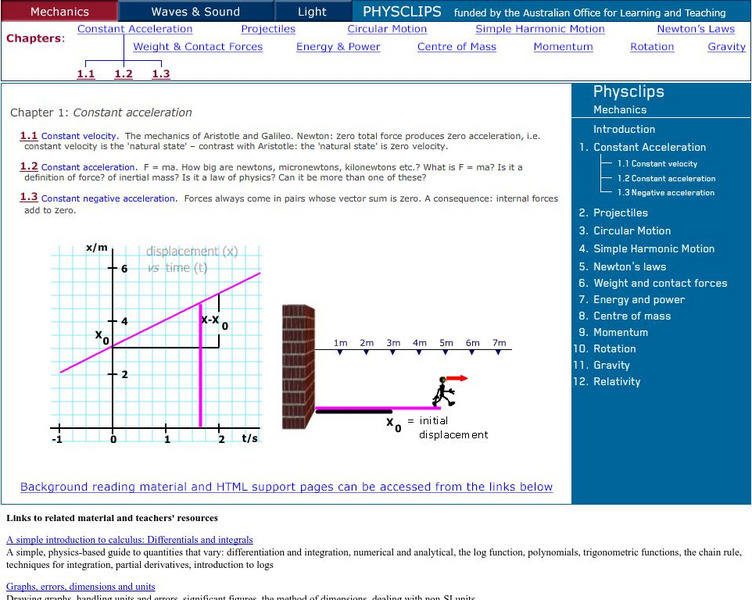
University of New South Wales: School of Physics: Physclips
Physiclips thoroughly presents mechanics concepts with animations and film clips.
TeachEngineering
Teach Engineering: Car Collision Testing & Tradeoffs: Don't Crack Humpty
Student groups are provided with a generic car base on which to design a device/enclosure to protect an egg as it rolls down a ramp at increasing slopes. During this activity, student teams design, build and test their prototype...
Science Education Resource Center at Carleton College
Serc: Exploring Newton's Second Law
Students conduct an experiment that will reinforce their understanding of Newton's Second Law. Using simple objects, students control force, mass, and acceleration, and how each is related to each other.
CK-12 Foundation
Ck 12: Physics Simulation: Hot Air Balloon
[Free Registration/Login Required] Learn about Newton's 2nd Law - the relationship between force, mass, and acceleration for a hot air balloon using this interactive simulation. A PDF worksheet and a video tutorial are also available....

Ducksters
Ducksters: Physics for Kids: Force
Kids learn about force in the science of physics and the laws of motion including units and measurement. How to calculate force from mass and acceleration.
Physics Aviary
Physics Aviary: Moment of Inertia of Pulley
This lab is designed to have students learn how the size, mass and mass distribution of a pulley influences the rate at which a mass attached to the pulley will accelerate. The pulley is frictionless and the string's mass is negligible.
Physics Aviary
Physics Aviary: Newton's Law Lab With Photogates
This lab was designed to have students investigate the factors that affect the acceleration of an object on a frictionless horizontal surface. The simulation will give the students data from two photogates which they must use to find the...
Texas Instruments
Texas Instruments: Good Vibrations
In this activity, students will investigate the motion of a mass moving up and down on a spring. They collect data for the position, velocity, and acceleration of the mass's motion and examine the relationship between them.