Hi, what do you want to do?






CK-12 Foundation
Ck 12: Life Science: 10.22 Mammal Classification
Understand how all mammals are divided into groups by similar characteristics.

Ducksters
Ducksters: Mammals for Kids: Learn About Animals and What Is a Mammal
Kids learn what is a mammal and what makes it different from other animals on this site.
Tramline
Tramline, Inc.: Virtual Ocean Field Trip
In this enchanting site, students will learn basic principles about oceans and will be introduced to an assortment of sea life, both plant and animal. Other interesting ocean links can be found on the teacher resource section of this link.

Enchanted Learning
Enchanted Learning: Polar Bears
Learn more about the polar bear when you visit this informative site that features a diagram of the polar bear and information on its diet, habitat, anatomy, reproduction and so on.
Smithsonian Institution
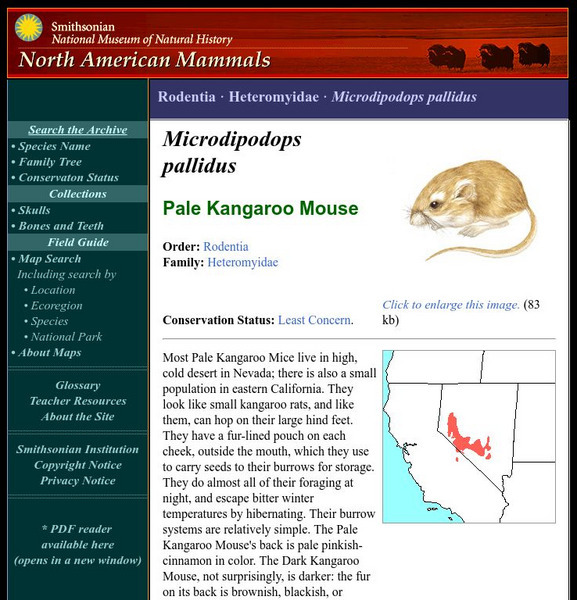
National Museum of Natural History: American Mammals: Pale Kangaroo Mouse
Most Pale Kangaroo Mice live in high, cold desert in Nevada; there is also a small population in eastern California. They look like small kangaroo rats, and like them, can hop on their large hind feet. Learn more about the Microdipodops...
Smithsonian Institution
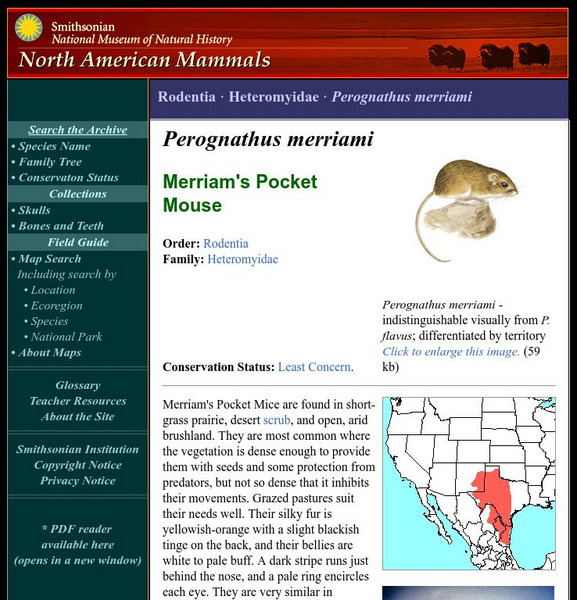
National Museum of Natural History: American Mammals: Merriam's Pocket Mouse
Merriam's Pocket Mice are found in short-grass prairie, desert scrub, and open, arid brushland. They are most common where the vegetation is dense enough to provide them with seeds and some protection from predators, but not so dense...
Smithsonian Institution
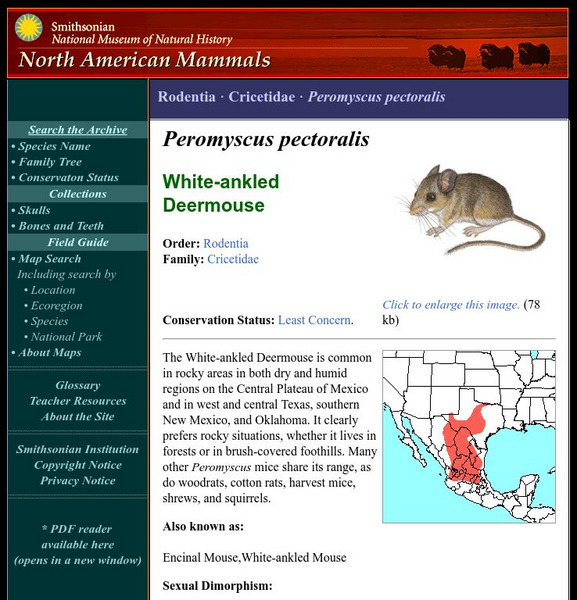
National Museum of Natural History: American Mammals: White Ankled Mouse
The White-ankled Mouse is common in rocky areas in both dry and humid regions on the Central Plateau of Mexico and in west and central Texas, southern New Mexico, and Oklahoma. It clearly prefers rocky situations, whether it lives in...
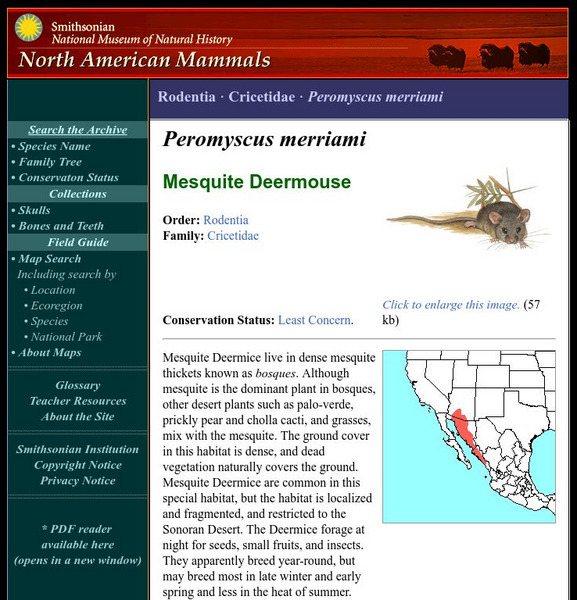
Smithsonian Institution
National Museum of Natural History: American Mammals: Mesquite Mouse
Mesquite Mice live in dense mesquite thickets known as bosques. Although mesquite is the dominant plant in bosques, other desert plants such as palo-verde, prickly pear, and cholla cacti, and grasses, mix with the mesquite. Learn more...
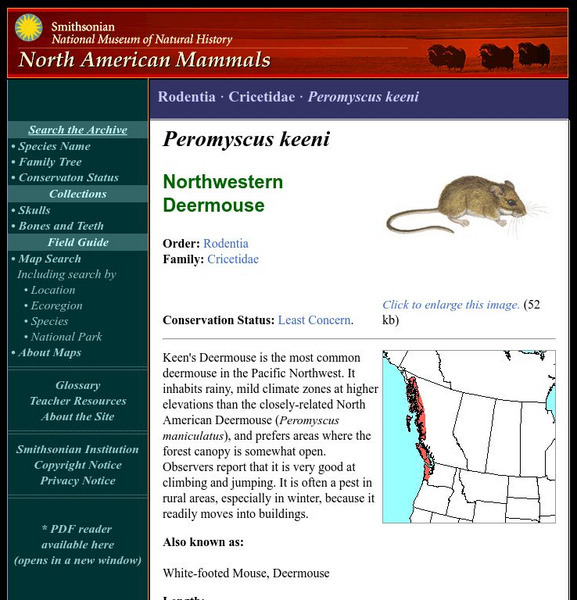
Smithsonian Institution
National Museum of Natural History: American Mammals: Northwestern Deermouse
Keen's Deermouse is the most common deermouse in the Pacific Northwest. It inhabits rainy, mild climate zones at higher elevations than the closely-related Deermouse (Peromyscus maniculatus), and prefers areas where the forest canopy is...
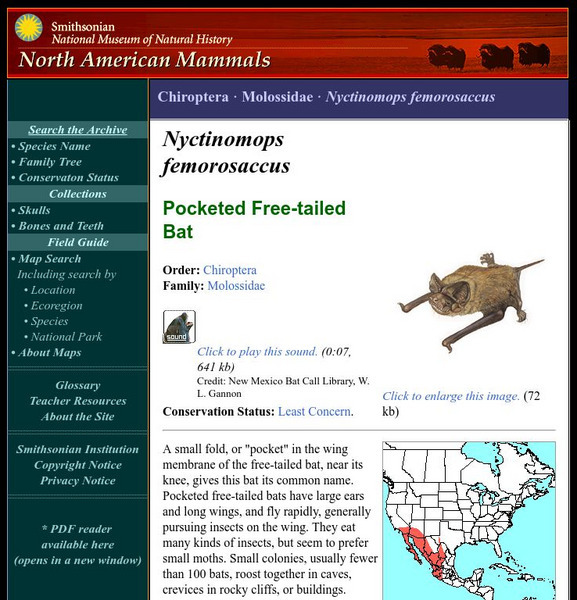
Smithsonian Institution
National Museum of Natural History: American Mammals: Pocketed Free Tailed Bat
A small fold, or "pocket" in the wing membrane of the free-tailed bat, near its knee, gives this bat its common name. Pocketed free-tailed bats have large ears and long wings, and fly rapidly, generally pursuing insects on the wing....
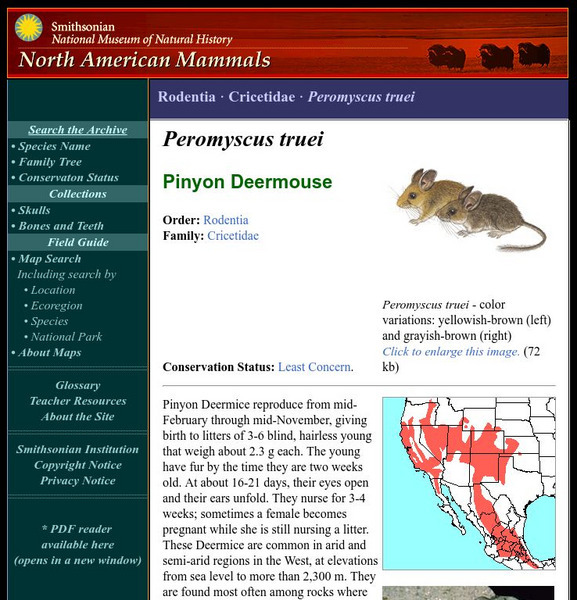
Smithsonian Institution
National Museum of Natural History: American Mammals: Pinyon Deermouse
Pinyon Deermice reproduce from mid-February through mid-November, giving birth to litters of 3-6 blind, hairless young that weigh about 2.3 g each. Learn more about the Peromyscus truei, more commonly known as a Pinyon Mouse, in this...
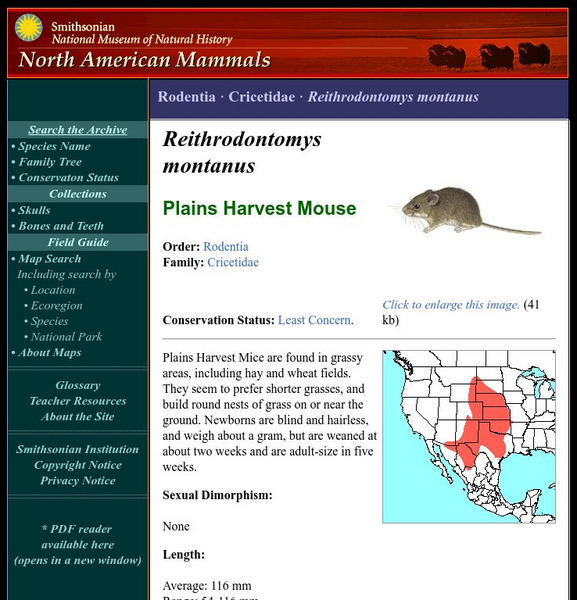
Smithsonian Institution
National Museum of Natural History: American Mammals: Plains Harvest Mouse
Plains Harvest Mice are found in grassy areas, including hay and wheat fields. They seem to prefer shorter grasses, and build round nests of grass on or near the ground. Learn more about the Reithrodontomys montanus, more commonly known...
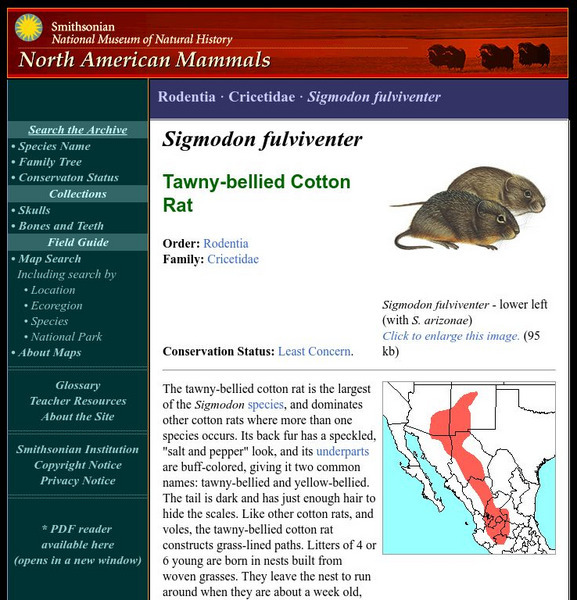
Smithsonian Institution
National Museum of Natural History: American Mammals: Tawny Bellied Cotton Rat
The tawny-bellied cotton rat is the largest of the Sigmodon species, and dominates other cotton rats where more than one species occurs. Its back fur has a speckled, "salt and pepper" look, and its underparts are buff-colored, giving it...
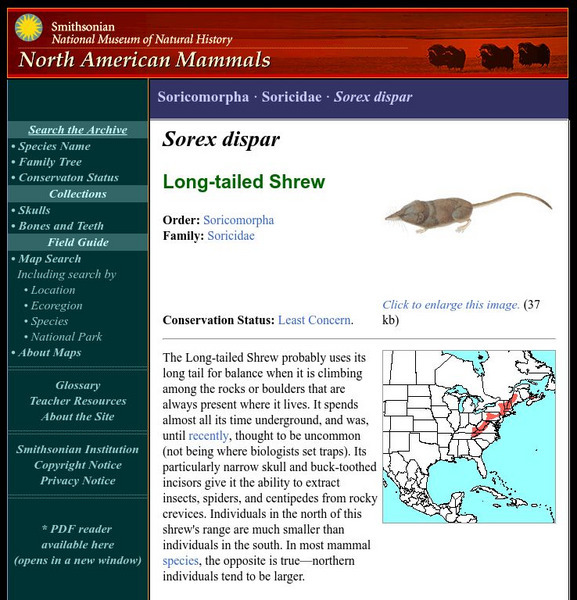
Smithsonian Institution
National Museum of Natural History: American Mammals: Long Tailed Shrew
The Long-tailed Shrew probably uses its long tail for balance when it is climbing among the rocks or boulders that are always present where it lives. It spends almost all its time underground, and was, until recently, thought to be...
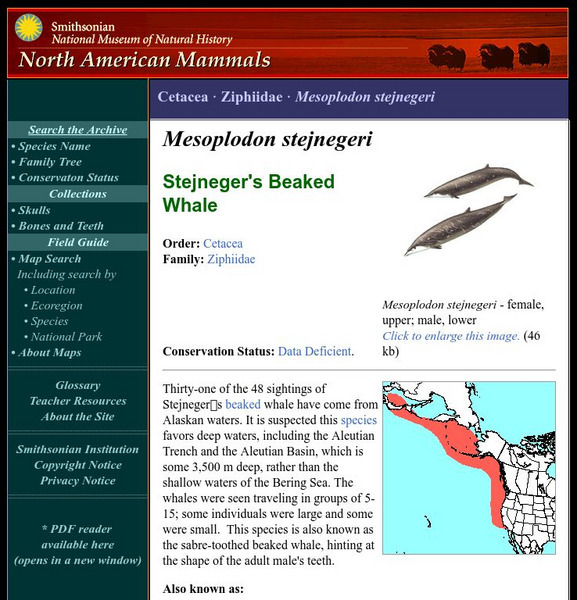
Smithsonian Institution
National Museum of Natural History: American Mammals: Stejneger's Beaked Whale
Thirty-one of the 48 sightings of Stejneger's beaked whale have come from Alaskan waters. It is suspected this species favors deep waters, including the Aleutian Trench and the Aleutian Basin, which is some 3,500 m deep, rather than the...
Smithsonian Institution
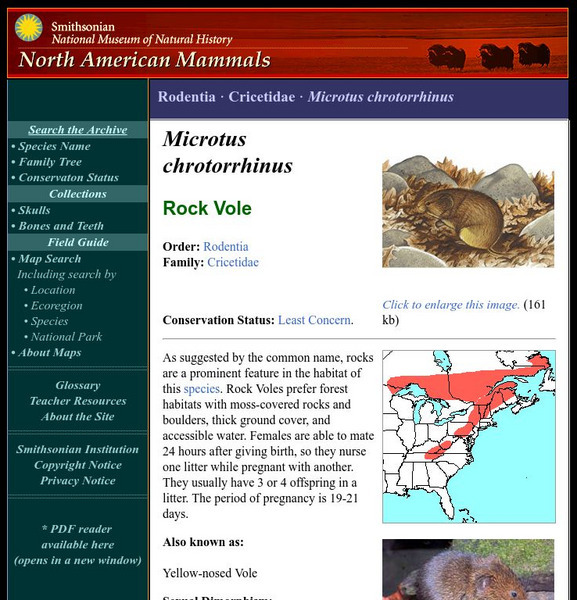
National Museum of Natural History: American Mammals: Rock Vole
As suggested by the common name, rocks are a prominent feature in the habitat of this species. Rock Voles prefer forest habitats with moss-covered rocks and boulders, thick ground cover, and accessible water. Learn more about the...

Smithsonian Institution
National Museum of Natural History: American Mammals: Southeastern Myotis
The southeastern myotis occurs as far west as northeastern Texas and southwestern Oklahoma. Its preferred daytime roosts are caves with pools of water. Learn more about the Myotis austroriparius, more commonly known as a Southeastern...
Smithsonian Institution
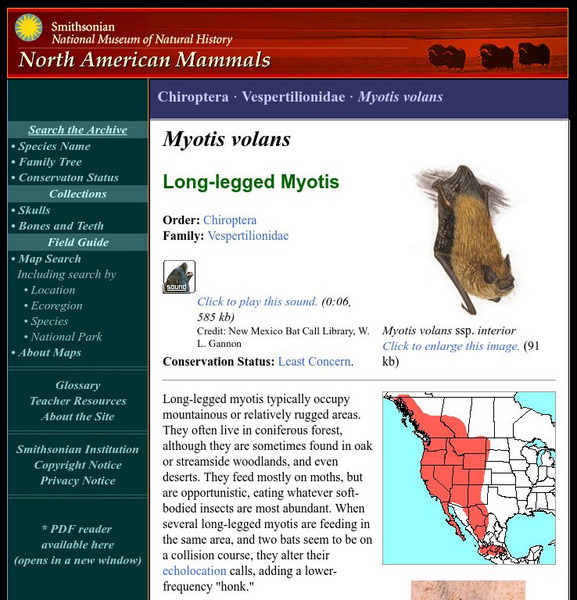
National Museum of Natural History: American Mammals: Long Legged Myotis
Long-legged myotis typically occupy mountainous or relatively rugged areas. They often live in coniferous forests, although they are sometimes found in oak or streamside woodlands, and even deserts. Learn more about the Myotis volans,...
Smithsonian Institution
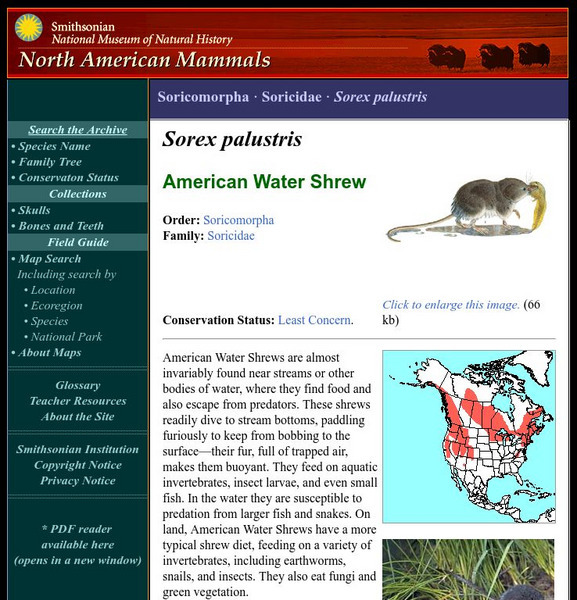
National Museum of Natural History: American Mammals: Water Shrew
Water Shrews are almost invariably found near streams or other bodies of water, where they find food and also escape from predators. These shrews readily dive to stream bottoms, paddling furiously to keep from bobbing to the surface,...
Smithsonian Institution
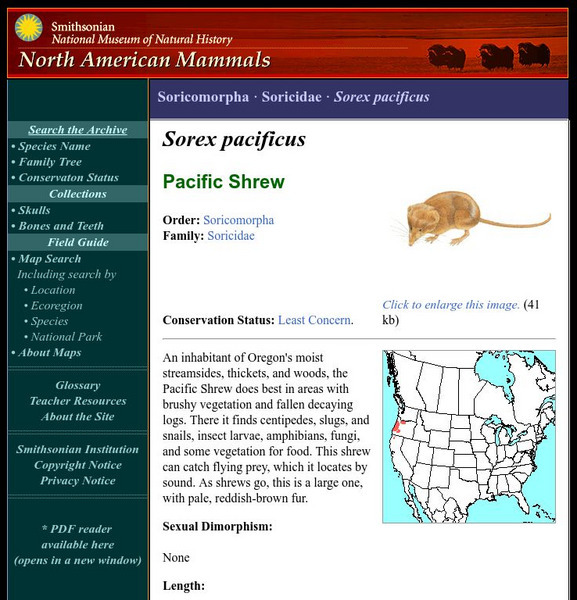
National Museum of Natural History: American Mammals: Pacific Shrew
An inhabitant of Oregon's moist streamsides, thickets, and woods, the Pacific Shrew does best in areas with brushy vegetation and fallen decaying logs. There it finds centipedes, slugs, and snails, insect larvae, amphibians, fungi, and...
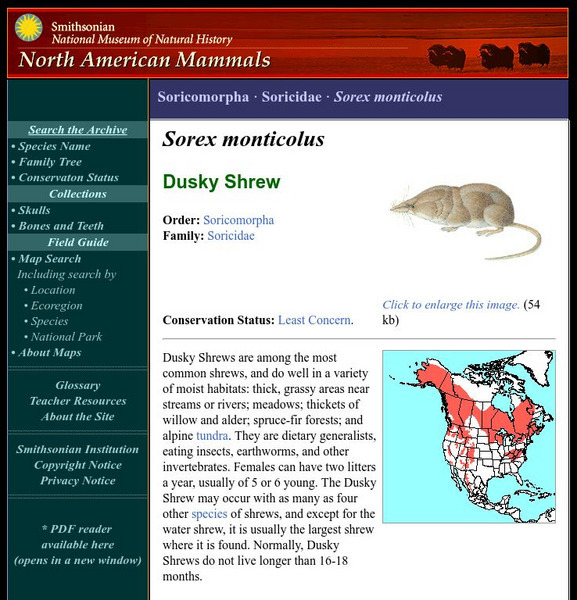
Smithsonian Institution
National Museum of Natural History: American Mammals: Montane Shrew
Montane Shrews are among the most common shrews, and do well in a variety of moist habitats: thick, grassy areas near streams or rivers; meadows; thickets of willow and alder; spruce-fir forests; and alpine tundra. They are dietary...
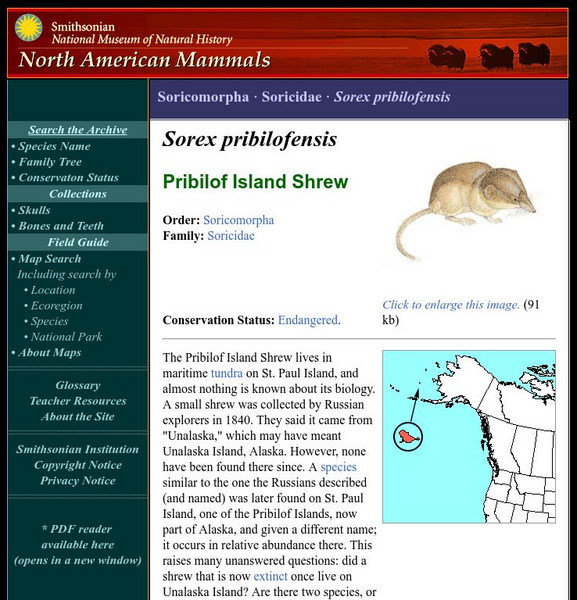
Smithsonian Institution
National Museum of Natural History: American Mammals: Pribilof Island Shrew
The Pribilof Island Shrew lives in maritime tundra on St. Paul Island, and almost nothing is known about its biology. Learn more about the Sorex pribilofensis, more commonly known as a Pribilof Island Shrew, in this easy-to-read species...
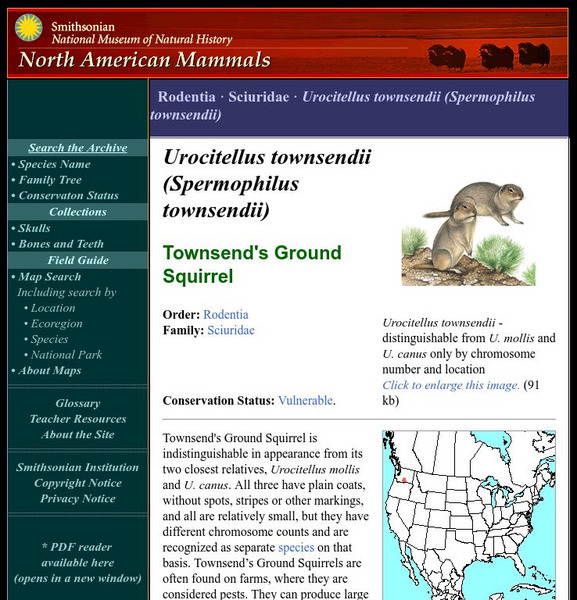
Smithsonian Institution
National Museum of Natural History: American Mammals: Townsend's Ground Squirrel
Townsend's Ground Squirrel is indistinguishable in appearance from its two closest relatives, Spermophilus mollis and S. canus. Learn more about the Spermophilus townsendii, more commonly known as a Townsend's Ground Squirrel, in this...
Other popular searches
- Ocean Mammals
- Characteristics of Mammals
- Marine Mammals
- Mammals and Fish
- Animals Mammals
- Land Mammals
- Mammals (Wildlife)
- Prehistoric Mammals
- Mammals Word Search
- Mammals Crossword
- Sea Mammals
- Ocean Mammals 1st Grade