Hi, what do you want to do?






Teach Engineering
Bridging to Polymers: Thermoset Lab
Investigate thermoset polymers through experimentation. In an effort to determine the strongest, most flexible mixture, groups conduct an experiment on different-ratio epoxy-amine polymers to finish the set of two lessons.

Curated OER
Fun Polymer Activity
Students add borax to a latex polymer and play with it to see the characteristics it now contains. In this polymer lesson plan, students see if it stretches, if it's durable, if the molecules break easily, and more.

Royal Society of Chemistry
The Treatment of Oil Spills—Microscale Chemistry
When oil spills happen, how is the oil cleaned up? Pupils of polymer science discover an amazing substance that turns oil into a solid during a microscale experiment. Individuals observe oil or paraffin before and after addition of the...

Teach Engineering
Creepy Silly Putty
It might be silly to determine the creep rate of putty but groups will enjoy making different formulations of silly putty and playing with them to understand how the different mixtures behave. The second part of the activity has groups...

Teach Engineering
Aerogel Cookies
Cookies are definitely important for scientific learning. To study aerogels, future engineers use chocolate chip cookie dough to make models. Their task is to design a process that removes the chocolate chips from the cookie dough,...

Teach Engineering
Battle of the Beams
Make the strongest beam possible using taffy? Groups mold a taffy-water mixture into a beam and a reinforcing material of their choice. To finish the final installment of a two-part series, participants test its strength by adding...

Teach Engineering
Edible Algae Models
Sometimes it's okay to eat your science experiment. A hands-on activity has pupils create models for algae to learn about its cellular structure. The best part of the experiment? The resulting juice-filled gels are edible—yum!

DiscoverE
Creepy Putty
Mold your learners into materials engineers. Using glue, Borax, and water, scholars create a viscoelastic material. But your class might know it by another name—Silly Putty.

American Chemical Society
Energy and Entropy of a Stretched Rubber Band
Stephen Perry invented and patented the modern rubber band in 1845. Young scientists put his discovery to work as they use rubber bands to observe entropy and enthalpy. They determine the change in free energy to figure out if it...

Curated OER
The Bio-fuel Project: Creating Bio-diesel
Students investigate bio-fuel. In this investigative lesson, students create bio-fuel from vegetable oil waste. Students will analyze, predict, collect and synthesize data from their experiments with bio-fuel.

Southwestern Medical Center
A Classroom Demonstration of Protein Folding
Does the mention of proteins and polypeptide relationships in your classroom result in mass confusion? Does the attempt to teach this important concept generate multiple questions and, at times, lead to a room filled with blank...
TeachEngineering
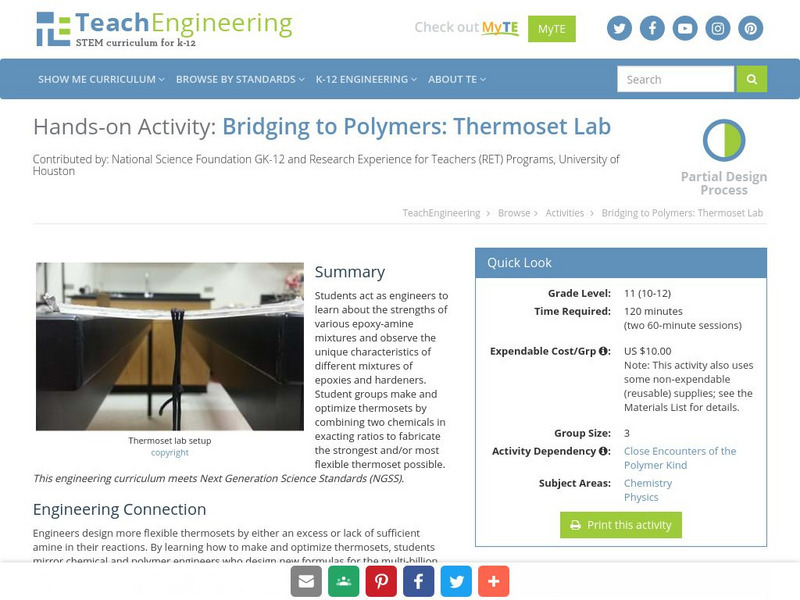
Teach Engineering: Bridging to Polymers: Thermoset Lab
Students act as engineers to learn about the strengths of various epoxy-amine mixtures, and observe the unique characteristics of different mixtures of epoxies and hardeners. Student groups make and optimize thermosets by combining two...
TeachEngineering
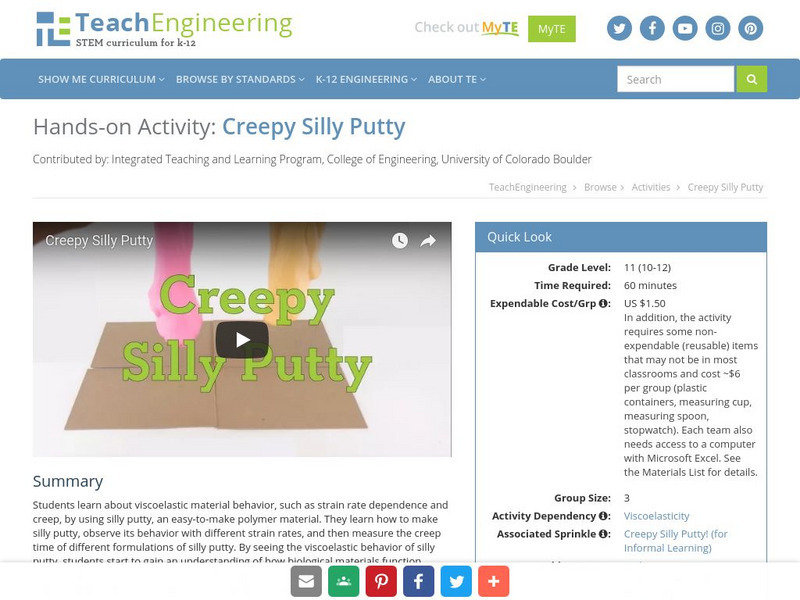
Teach Engineering: Creepy Silly Putty
Students learn about viscoelastic material behavior, such as strain rate dependence and creep, by using silly putty, an easy-to-make polymer material. They learn how to make silly putty, observe its behavior with different strain rates,...

Museum of Science
Museum of Science and Industry: Online Science: Activities: Make Slime
Step-by-step instructions, with photos, of how to create slime made of polymer chains using Borax and white glue.

Smithsonian Institution
Lemelson Center: Spark!lab: Make a Polymer
Polymers are all around us. Learn how to make your own, then answer scientific questions about your experiment.
BiologyWise
Biology Wise: How to Make a 3 D Dna Model Project
Describes the steps for how to make a model of DNA using colored polymer clay and wire. Students will gain a good understanding of the structure of DNA by doing this project.
Science is Fun
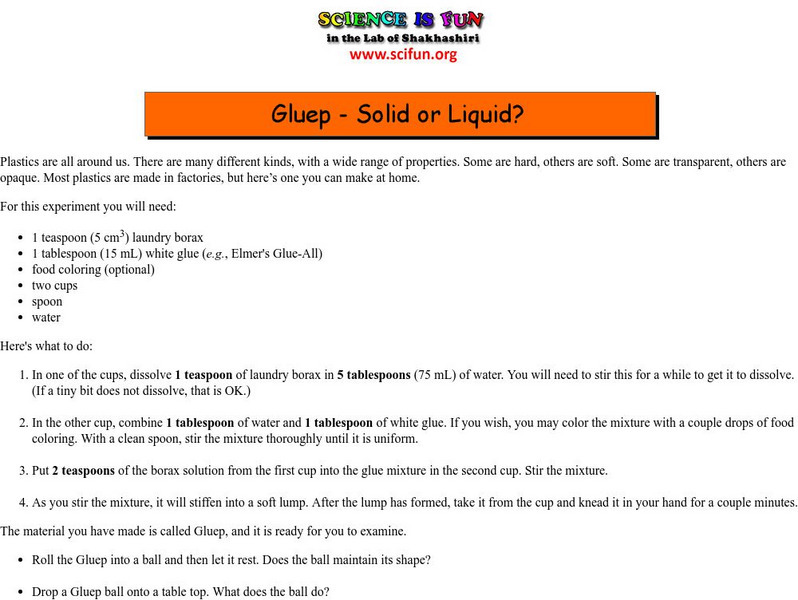
Science Is Fun: Gluep Solid or Liquid?
In this experiment, students create a polymer substance called Gluep, then investigate its properties. Includes a detailed explanation of how the polymer molecules bond together to form the plastic.
Science Bob Pflugfelder
Science Bob: Homemade Slime!
Contains a procedure for creating slime -- a polymer formed by mixing water, borax, Elmer's glue, and food coloring. Following the procedure, the site contains a brief description of what polymers are.
TeachEngineering
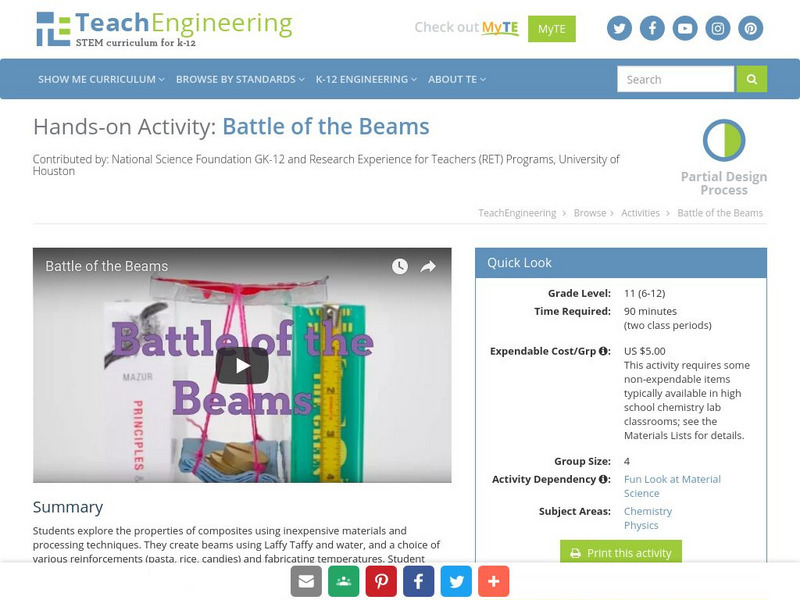
Teach Engineering: Battle of the Beams
Students explore the properties of composites using inexpensive materials and processing techniques. They create beams using Laffy Taffy and water, and a choice of various reinforcements (pasta, rice, candies) and fabricating...
TeachEngineering
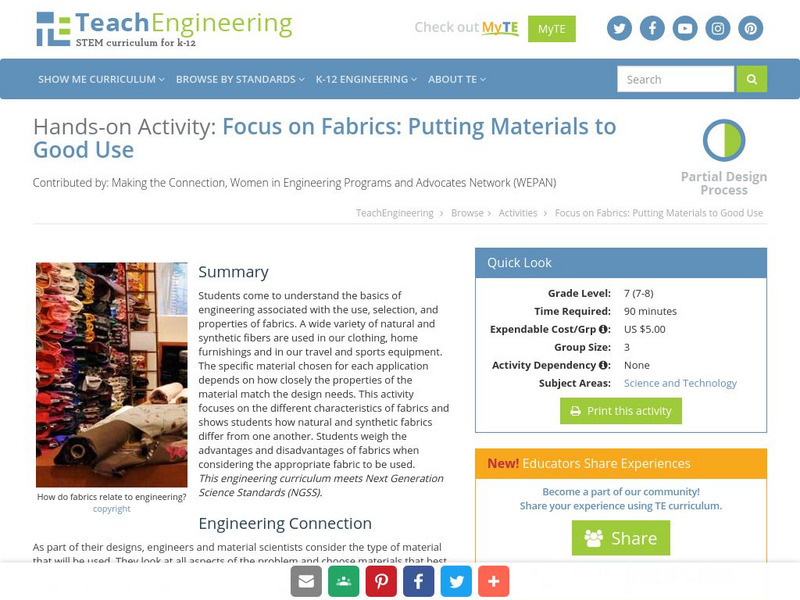
Teach Engineering: Focus on Fabrics: Putting Materials to Good Use
The goal is for students to understand the basics of engineering associated with the use, selection, and properties of fabrics. A wide variety of natural and synthetic fibers are used in our clothing, home furnishings and in our travel...
TeachEngineering
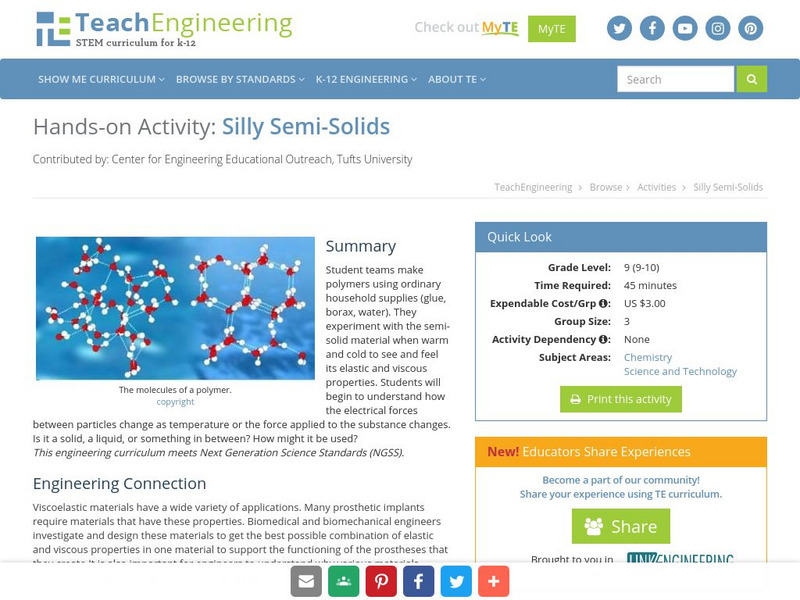
Teach Engineering: Silly Semi Solids
Groups of students make a polymer out of household items. They then experiment with the polymer to determine its various properties.
Other
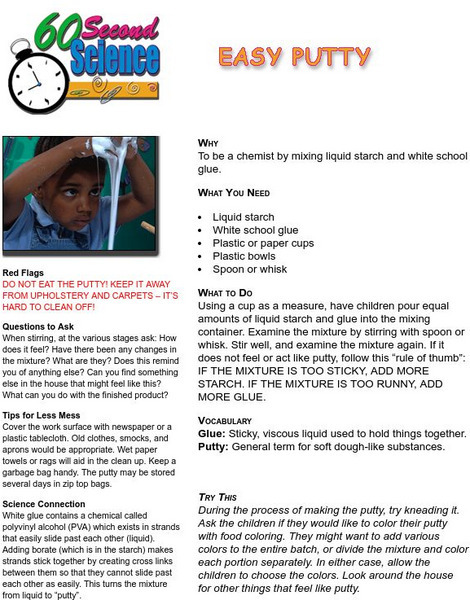
60 Second Science: Easy Putty
Explore the properties of colloids while making putty. Discover how some mixtures can display properties of both solids and liquids.
Science Fun for Everyone
Science Fun: Squishy Turkeys
Watch Scientist Joe demonstrate how to make a turkey in a glove using homemade slime in this video presentation.
TeachEngineering
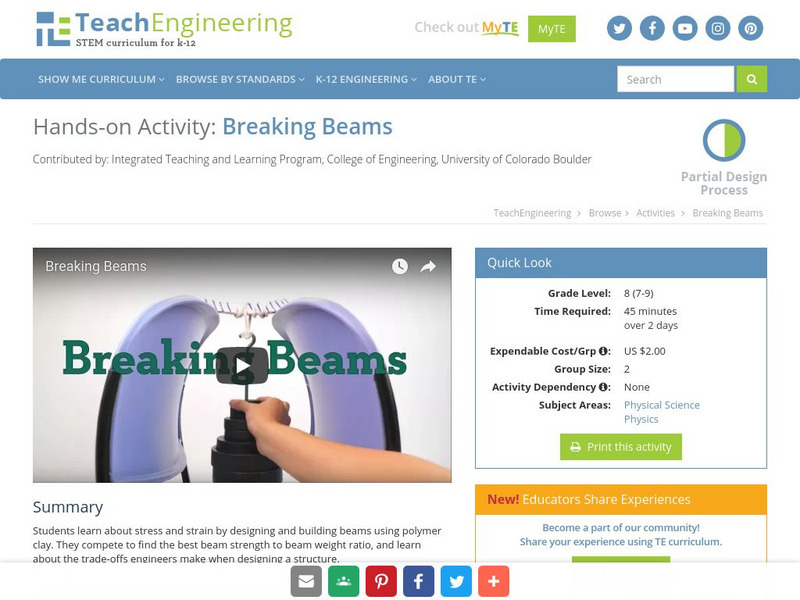
Teach Engineering: Breaking Beams
Students learn about stress and strain by designing and building beams using polymer clay. They compete to find the best beam strength to beam weight ratio, and learn about the trade-offs engineers make when designing a structure.